

Turbine blade nested seal and damper assembly
Patent Information
- Authority / Receiving Office
- US · United States
- Current Assignee / Owner
- Publication Date
- 2009-01-01
Smart Images
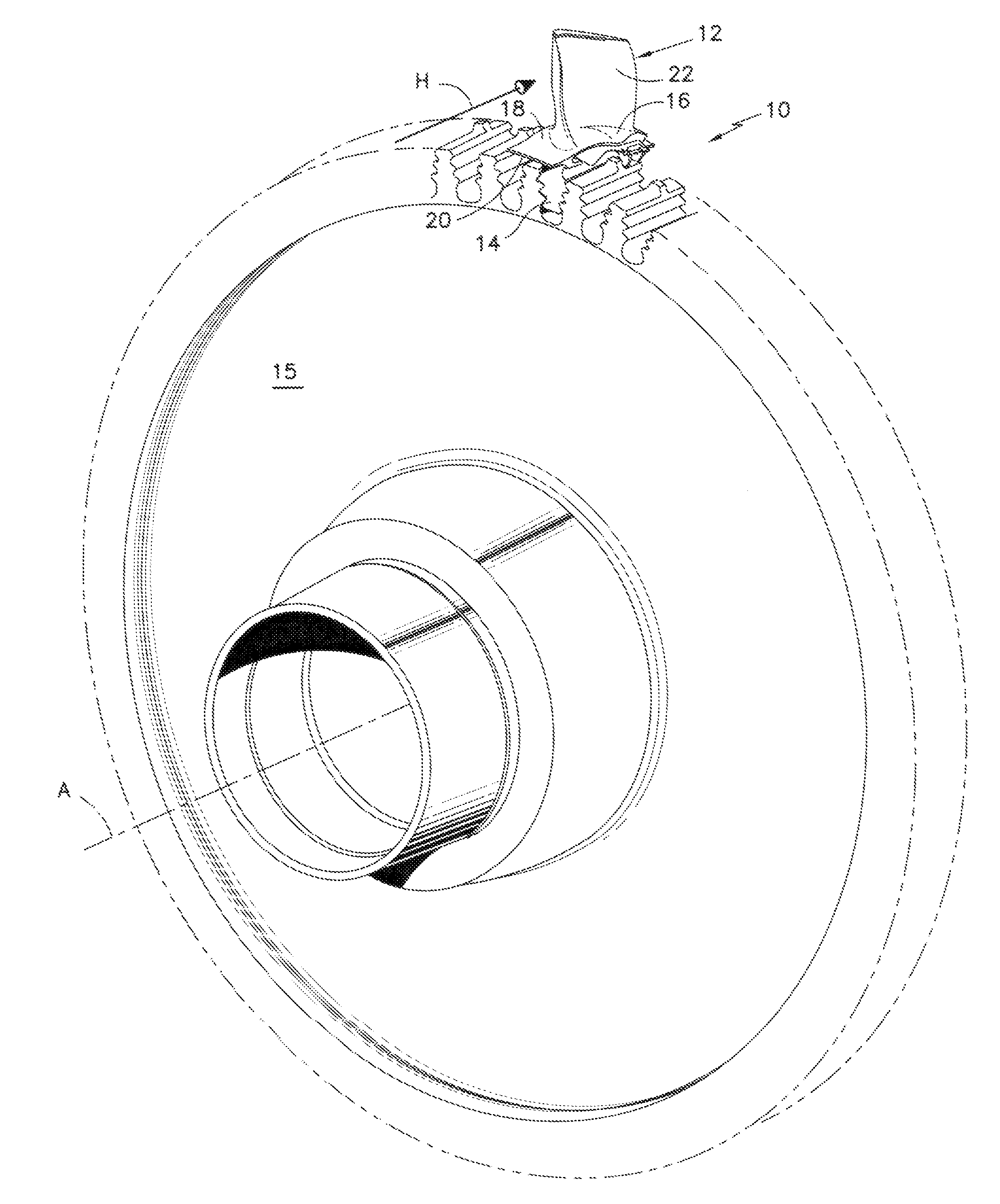
Figure 1 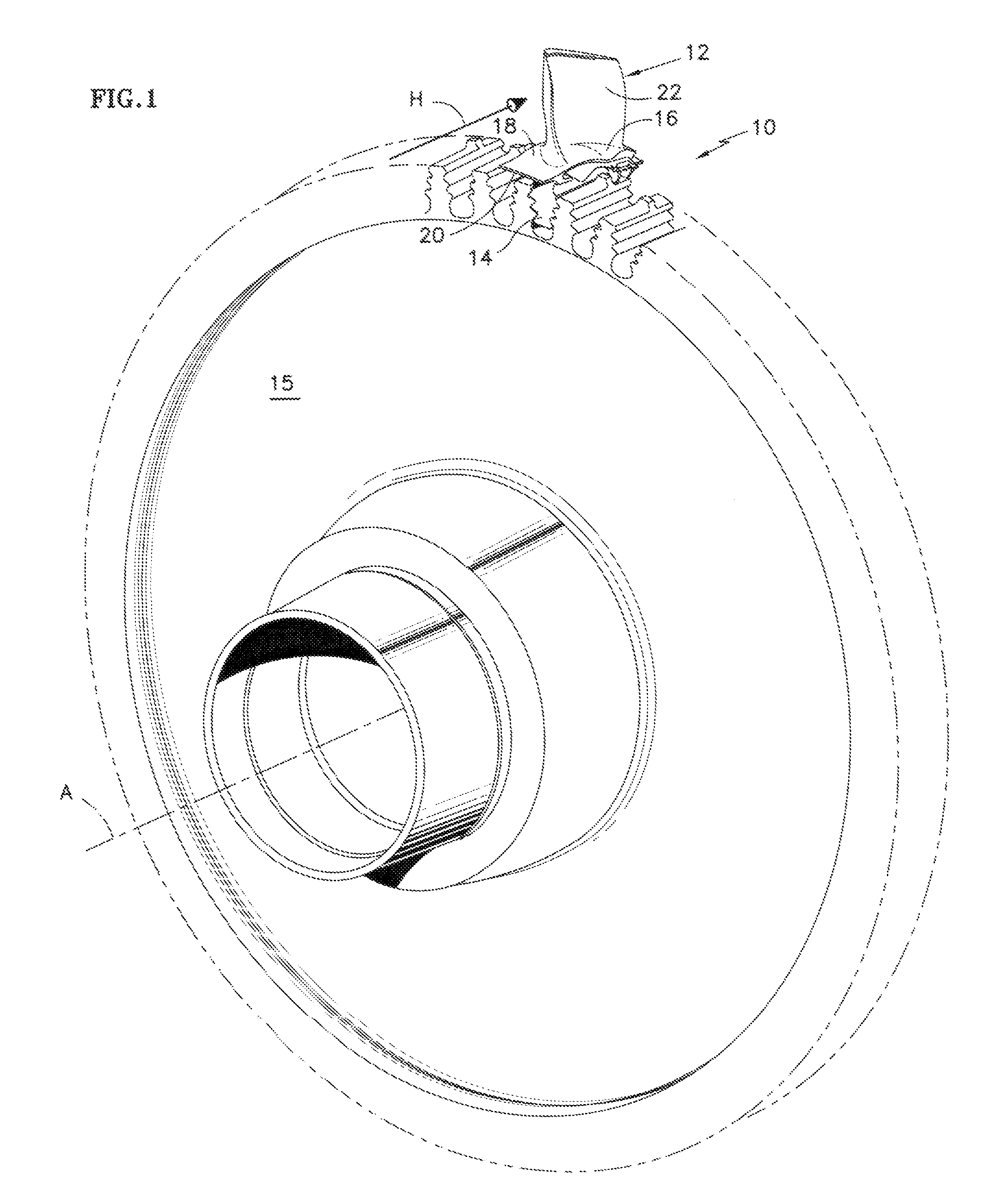
Figure 2 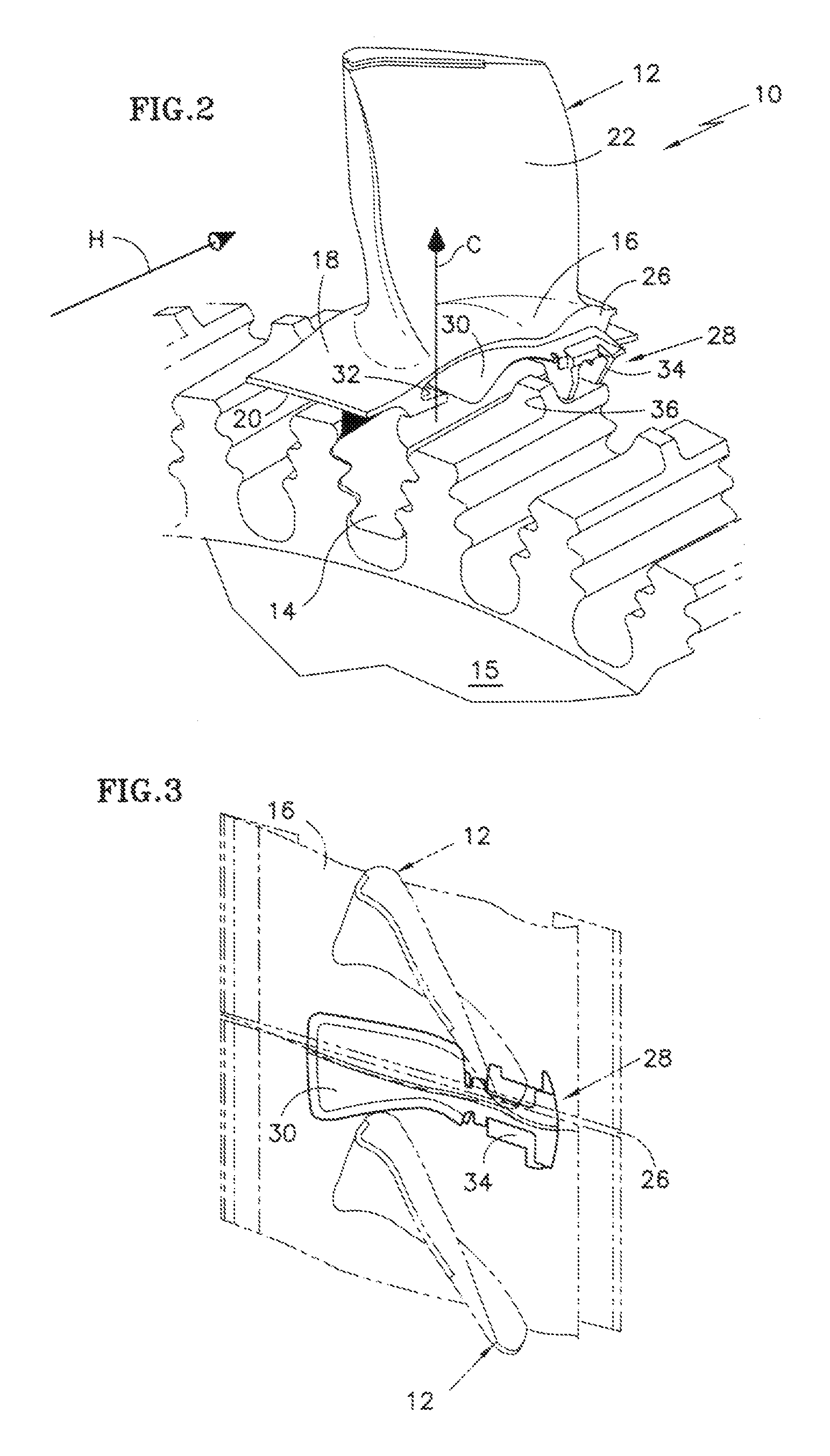
Figure 3
Abstract
Description
BACKGROUND OF THE INVENTION
[0001] This application relates generally to a turbine blade damper-seal assembly.
[0002] Conventional gas turbine engines include a turbine assembly that has a plurality of turbine blades attached about a circumference of a turbine rotor. Each of the turbine blades is spaced a distance apart from adjacent turbine blades to accommodate movement and expansion during operation. Each blade includes a root that attaches to the rotor, a platform, and an airfoil that extends radially outwardly from the platform.
[0003] Hot gases flowing over the platform are prevented from leaking between adjacent turbine blades by a seal as components below the platform are generally not designed to operate for extended durations at the elevated temperatures of the hot gases. The seal is typically a metal sheet nested between adjacent turbine blades on an inner surface of the platform. The seal is flexible so as to conform to the inner surface of the platform and prevent the intrusi...
Examples
Embodiment Construction
[0022]Referring to FIG. 1, a turbine rotor assembly 10 includes a plurality of adjacent turbine blades 12 (one shown) mounted to a turbine rotor disk 15 about an engine axis A. Each of the turbine blades 12 includes a root 14 that is fit into a corresponding slot of the turbine rotor disk 15. Radially outward of the root 14 is a platform 16. The platform 16 defines an outer platform surface 18 and an inner platform surface 20. The inner surface 20 is disposed radially inward of the outer surface 18. An airfoil 22 extends outward from the platform 16.
[0023]Referring to FIG. 2, hot gas H flows around the airfoil 22 and over the outer platform surface 18 while relatively cooler high pressure air (C) pressurizes the cavity under the platform 16. A gap 26 extends axially between adjacent turbine blades 12 (FIG. 3). The gap 26 prevents contact and allows for thermal growth between adjacent turbine blades 12. A damper-seal assembly 28 includes a seal 30 and a damper 34 to prevent hot gases...