
Fast error-correcting of embedded interaction codes
a technology of embedded interaction and error correction, applied in the field of identifying sections of linear codes, can solve the problems of difficult later converting annotations into electronic forms, scanned images frequently cannot be edited, and there is no way to separate annotations from the underlying text of the original document, so as to simplify the decoding technique and generate a large amount of solution candidates
- Summary
- Abstract
- Description
- Claims
- Application Information
AI Technical Summary
Benefits of technology
Problems solved by technology
Method used
Image

Examples
Embodiment Construction
[0015]Operating Environment
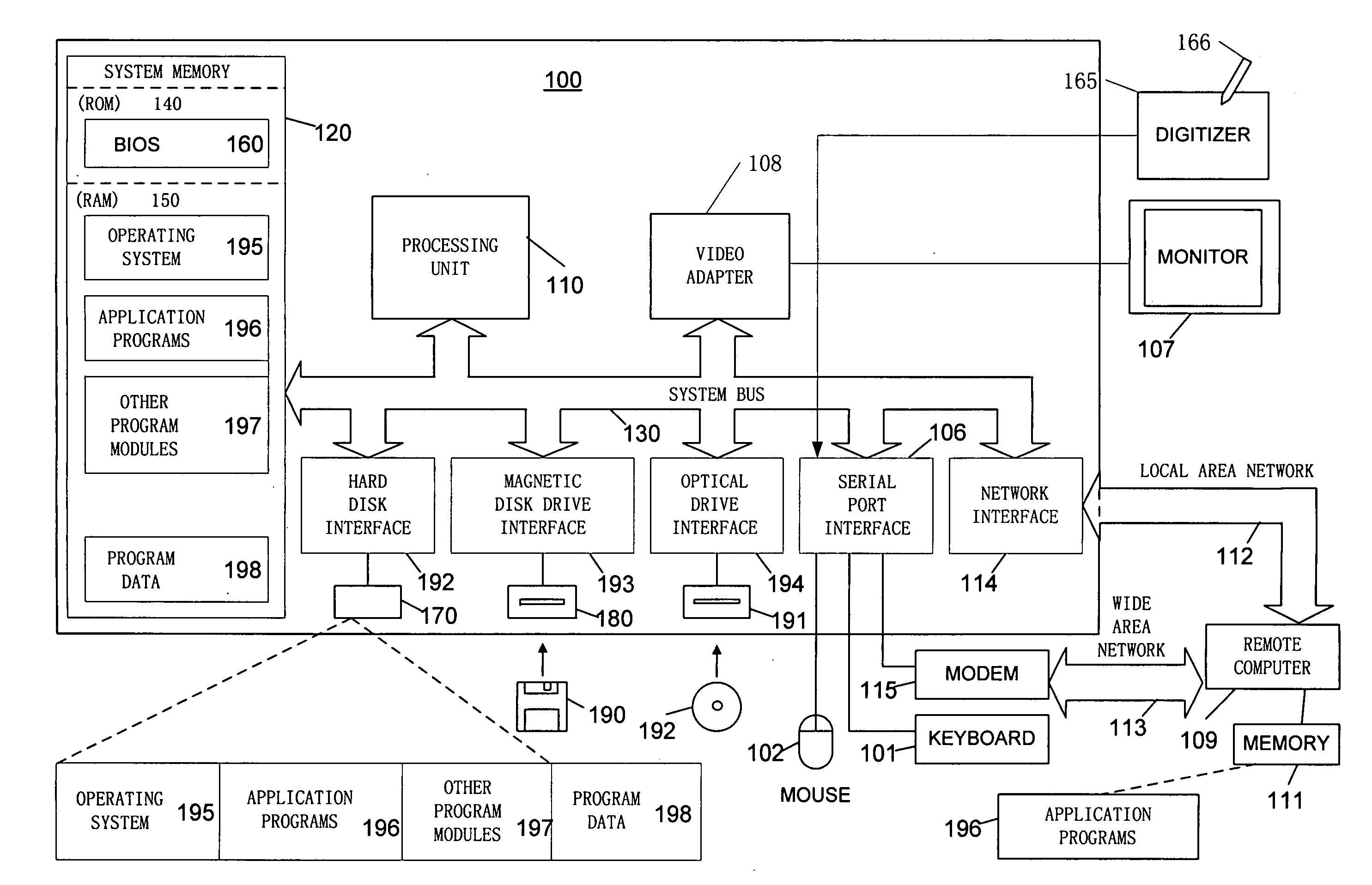
[0016]While some examples of the invention may be implemented using analog circuits, many examples of the invention may conveniently be implemented using a programmable computing device executing software instructions to perform various functions. FIG. 1 shows a functional block diagram of an example of a conventional general-purpose digital computing environment that may therefore be used to implement various aspects of the present invention. In FIG. 1, a computer 100 includes a processing unit 110, a system memory 120, and a system bus 130 that couples various system components including the system memory to the processing unit 110. The system bus 130 may be any of several types of bus structures including a memory bus or memory controller, a peripheral bus, and a local bus using any of a variety of bus architectures. The system memory 120 includes read only memory (ROM) 140 and random access memory (RAM) 150.
[0017]A basic input / output system 160 (BIOS),...
PUM
 Login to View More
 Abstract
Description
Claims
Application Information
 Login to View More