
Vertical transitions, printed circuit boards therewith and semiconductor packages with the printed circuit boards and semiconductor chip
- Summary
- Abstract
- Description
- Claims
- Application Information
AI Technical Summary
Benefits of technology
Problems solved by technology
Method used
Image

Examples
first exemplary embodiment
A First Exemplary Embodiment
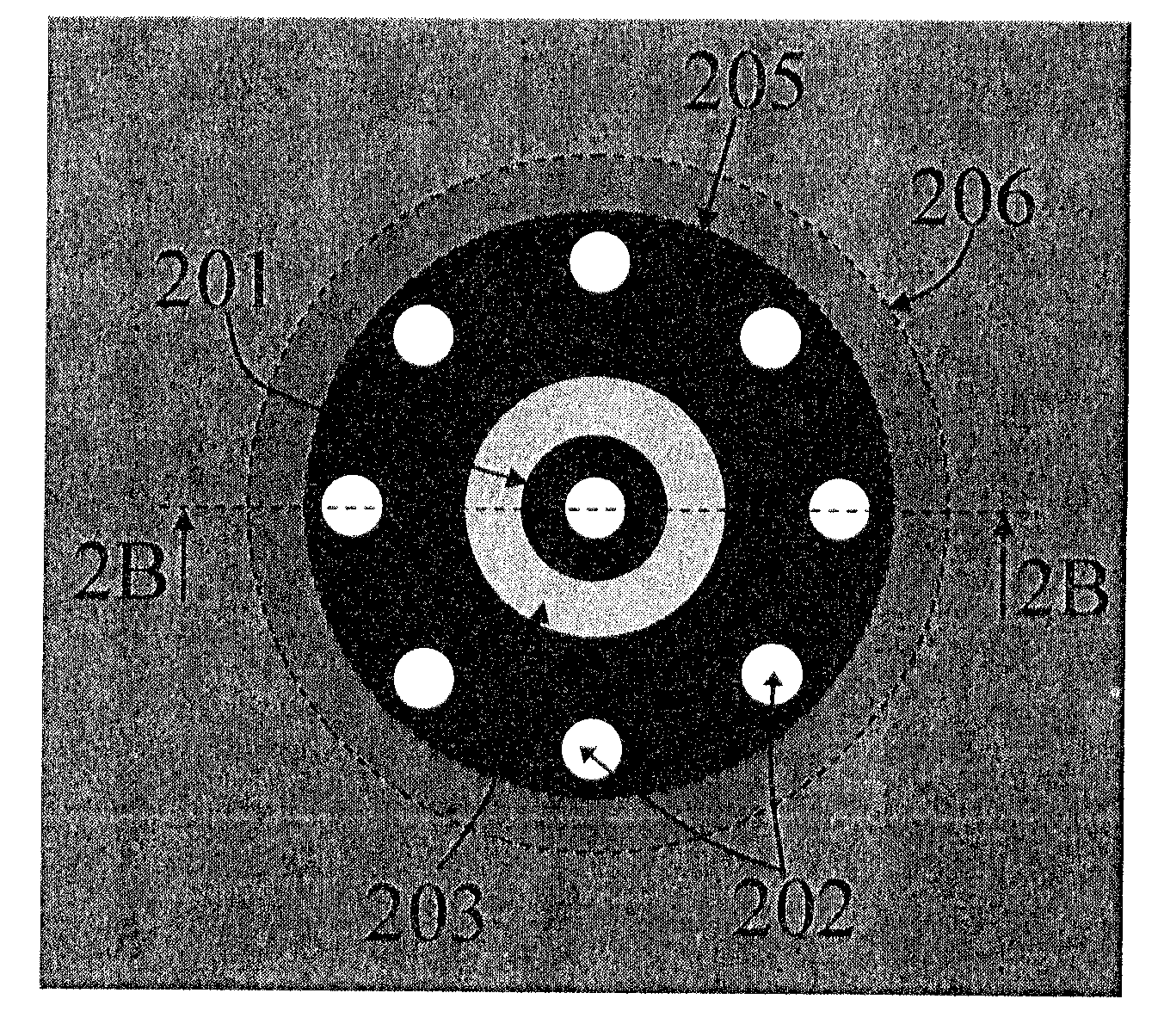
[0142]Referring to the drawings, FIGS. 4A and 4B show a vertical transition with a round arrangement of ground vias 202 of a first exemplary embodiment. The vertical transition is embedded in a 12-conductor-layer PCB.
[0143]FIG. 4B shows a cross-sectional view of a vertical transition (in a direction of a dotted line 2B in FIG. 4A), the arrangement of conductor layers of the PCB separated by an isolating material is as follows: Ground planes are 2nd, 4th, 6th, 7th, 9th, and 11th layers; Power supply plane is 5th layer; Signal planes are 1st, 3rd, 8th, 10th, and 12th layers. The single signal via 201 is separated electrically from conductor planes of the PCB by a clearance hole 203.
[0144]FIG. 4A shows a top view of a power supply layer which is 5th layer of a vertical transition. The number of ground vias 202 is 8. In addition, although the number of ground vias 202 is 8 here, the number can be selected as necessary.
[0145]To improve the shielding properties...
second exemplary embodiment
A Second Exemplary Embodiment
[0154]In FIGS. 6A and 6B a vertical transition with another arrangement of ground vias 402 such as square one is shown. This vertical transition is embedded in a 10-conducter-layer PCB which serves as an example of multilayer PCBs.
[0155]FIG. 6B shows a cross-sectional view of a vertical transition (in a direction of a dotted line 4B in FIG. 6A), the arrangement of conductor layers of the PCB separated by an isolating material is as follows: Ground planes are 2nd, 4th, 6th, 7th and 9th layers; Power supply plane is 5th layer; Signal planes are 1st, 3rd, 8th and 10th layers. The single signal via 401 is separated from conductor planes of the PCB by a clearance hole 403.
[0156]FIG. 6A shows a top view of a power supply layer which is 5th layer of a vertical transition. The vertical transition is formed by a signal via 401, an assembly of ground vias 402 around the signal via 401, ground plates 408 from conductor layers connected to the ground vias 402, close...
third exemplary embodiment
A Third Exemplary Embodiment
[0157]In FIGS. 7A and 7B a vertical transition with the same arrangement of ground vias as in FIGS. 6A and 6B is shown. This vertical transition is also embedded in a 10-conducter-layer PCB which has the same constitution as that in FIGS. 6A and 6B.
[0158]FIG. 7B shows a cross-sectional view of a vertical transition (in a direction of a dotted line 5B in FIG. 7A).
[0159]FIG. 7A shows a top view of a power supply layer which is 5th layer of a vertical transition. The vertical transition is formed by a signal via 501, an assembly of ground vias 502 around the signal via 501, ground plates 508 from conductor layers connected to the ground vias 502, closed ground stripline 505 connecting the ground vias in turn, and an isolating slot 506 between said ground stripline and power supply layer 509 of the PCB. The number of ground vias 502 is 8. In addition, although the number of ground vias 502 is 8 here, the number can be selected as necessary. However a clearanc...
PUM
 Login to View More
 Abstract
Description
Claims
Application Information
 Login to View More