This helps you quickly interpret patents by identifying the three key elements:
Problems solved by technology
Method used
Benefits of technology
Benefits of technology
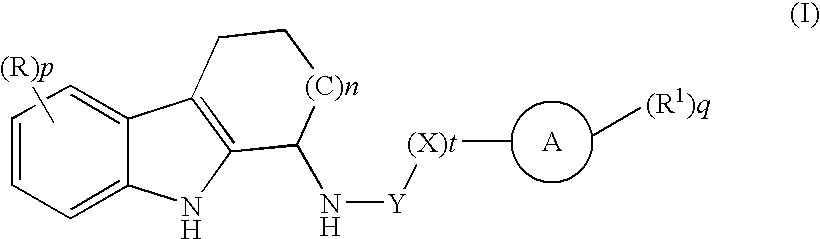
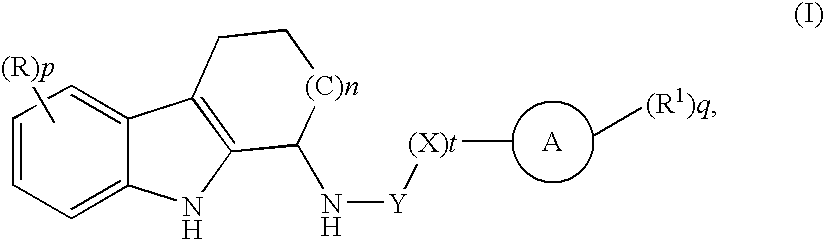
[0012]In one embodiment p is 1 or more and R is selected from halogen, alkyl, haloalkyl, —OR2, —NR2R3, —C(O)R2, —CO2R2, cyano, nitro, or azido. Preferably R is halogen, alkyl, haloalkyl. Preferably R is substituted para to the depicted N atom. Preferably R is halogen. Preferably R is Br or Cl.
[0013]In one embodiment q is 1 or more and R1 is selected from halogen, alkyl, haloalkyl, —OR2, —NR2R3, —C(O)R2, —CO2R2, Ay, Het, cyano, nitro, or azido. Preferably R1 is selected from halogen, alkyl, haloalkyl, —OR2, —NR2R3, —C(O)R2, —C
Problems solved by technology
Due to the high degree of variability in the viral surface antigens, existence of multiple viral genotypes, and demonstrated specificity of immunity, the development of a successful vaccine in the near future is unlikely.
This therapy remains less effective against infections caused by HCV genotype 1 (which constitutes ˜75% of all HCV infections in the developed markets) compared to infections caused by the other 5 major HCV genotypes.
Unfortunately, only ˜50-80% of the patients respond to this treatment (measured by a reduction in serum HCV RNA levels and normalization of liver enzymes) and, of those treated, 50-70% relapse within 6 months of cessation of treatment.
Method used
the structure of the environmentally friendly knitted fabric provided by the present invention; figure 2 Flow chart of the yarn wrapping machine for environmentally friendly knitted fabrics and storage devices; image 3 Is the parameter map of the yarn covering machine
View more
Image
Smart Image Click on the blue labels to locate them in the text.
Viewing Examples
Smart Image
Click on the blue label to locate the original text in one second.
Reading with bidirectional positioning of images and text.
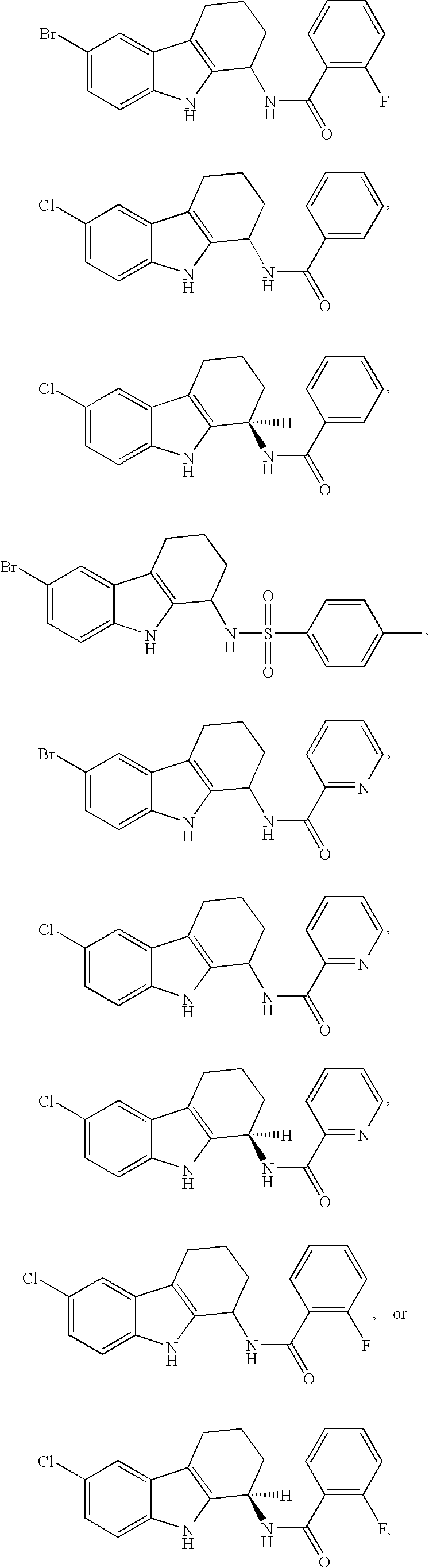
[0127]To a cold (0° C.) solution of 4-chloroaniline (5.6 g, 44 mmol) in concentrated hydrochloric acid (5 mL) was added sodiumnitrite (3.0 g, 44 mmol) dissolved in water (10 mL) portionwise over 20 minutes. The mixture was stirred at 0° C. for 30 minutes. In a separate flask, a cool solution of 2-(hydroxymethylene)cyclohexanone (Organic Syntheses, Collective Vol 4, 1963, pg. 536) (5.0 g, 40 mmol) in methanol (30 mL) was treated with a solution of sodium acetate (8.3 g, 101 mmol) in water (25 mL). The mixture was stirred at 0° C. for 20 minutes and the diazonium salt slurry was added. The combined mixture was stirred for 10-15 minutes, collected by filtration, triturated with ethanol, and collected by filtration to give cyclohexane-1,2-dione (4-chlorophenyl)hydrazone (4.6 g, 49% yield) as a yellow solid. 1H-NMR (DMSO-d6): δ 9.93 (s, 1H), 7.29 (m, 4H), 2.55 (m, 2H), 2.40 (m, 2H), 1.84...
example 2
6-Chloro-2,3,4,9-tetrahydro-1H-carbazol-1-amine
[0129]
[0130]To a solution of 6-chloro-2,3,4,9-tetrahydro-1H-carbazol-1-one (500 mg, 2.3 mmol) and ammonium acetate (1.8 g, 23 mmol) in methanol (9 mL) was added sodium cyanoborohydride (720 mg, 11.5 mmol). After heating at 60° C. for 15 hours, the mixture was cooled and treated with concentrated hydrochloric acid until pH=1. The organics were removed under reduced pressure and the resulting precipitate was collected by filtration, dissolved in ethyl acetate and methanol, and washed with saturated aqueous sodium carbonate. The phases were separated and the organic phase was concentrated to yield 6-chloro-2,3,4,9-tetrahydro-1H-carbazol-1-amine (260 mg, 52% yield) as a light brown solid. 1H-NMR (DMSO-d6): δ 10.90 (s, 1H), 7.34 (m, 1H), 7.27 (d, 1H), 6.97 (dd, 1H), 3.90 (t, 1H), 2.54 (m, 2H), 2.04-1.89 (m, 2H), 1.66 (m, 1H), 1.50 (m, 1H); MS m / z 221 (M+1).
example 3
6-Bromo-2,3,4,9-tetrahydro-1H-carbazol-1-one
[0131]
[0132]6-Bromo-2,3,4,9-tetrahydro-1H-carbazol-1-one was prepared from bromoaniline and 2-(hydroxymethylene)cyclohexanone in a similar manner as described in Example 1 to give a brown solid. 1H-NMR (CDCl3): δ 8.79 (s, 1H), 7.80 (s, 1H), 7.44 (d, 1H), 7.30, (d, 1H), 2.97 (t, 2H), 2.66 (t, 2H), 2.27 (quint, 2H); MS m / z 265 (M+1).
the structure of the environmentally friendly knitted fabric provided by the present invention; figure 2 Flow chart of the yarn wrapping machine for environmentally friendly knitted fabrics and storage devices; image 3 Is the parameter map of the yarn covering machine
Login to View More
PUM
Login to View More
Abstract
The present invention relates to compounds that are useful in the treatment of viruses belonging to Flaviviridae, including flaviviruses, pestiviruses, and hepaciviruses. The invention includes compounds useful for the treatment or prophylaxis of dengue fever, yellow fever, West Nile virus, and HCV.
Description
FIELD OF THE INVENTION[0001]The present invention relates to compounds useful as anti-viral agents. The present invention relates to compounds that are useful in the treatment of viruses belonging to Flaviviridae, including flaviviruses, pestiviruses, and hepaciviruses. The invention includes compounds useful for the treatment or prophylaxis of dengue fever, yellow fever, West Nile virus, and HCV.BACKGROUND OF THE INVENTION[0002]Infection with HCV is a major cause of human liverdisease throughout the world. In the US, an estimated 4.5 million Americans are chronically infected with HCV. Although only 30% of acute infections are symptomatic, greater than 85% of infected individuals develop chronic, persistent infection. Treatment costs for HCV infection have been estimated at $5.46 billion for the US in 1997. Worldwide over 200 million people are estimated to be infected chronically. HCV infection is responsible for 40-60% of all chronic liver disease and 30% of all liver transplant...
Claims
the structure of the environmentally friendly knitted fabric provided by the present invention; figure 2 Flow chart of the yarn wrapping machine for environmentally friendly knitted fabrics and storage devices; image 3 Is the parameter map of the yarn covering machine
Login to View More
Application Information
Patent Timeline
Application Date:The date an application was filed.
Publication Date:The date a patent or application was officially published.
First Publication Date:The earliest publication date of a patent with the same application number.
Issue Date:Publication date of the patent grant document.
PCT Entry Date:The Entry date of PCT National Phase.
Estimated Expiry Date:The statutory expiry date of a patent right according to the Patent Law, and it is the longest term of protection that the patent right can achieve without the termination of the patent right due to other reasons(Term extension factor has been taken into account ).
Invalid Date:Actual expiry date is based on effective date or publication date of legal transaction data of invalid patent.



 Login to View More
  Login to View More