
Semiconductor device
a technology of semiconductors and capacitors, applied in the direction of semiconductor devices, basic electric elements, electrical appliances, etc., can solve the problems of reducing the performance of the device, the on-resistance, and the breakage voltage, so as to reduce the parasitic capacitance. , the effect of reducing the parasitic capacitan
- Summary
- Abstract
- Description
- Claims
- Application Information
AI Technical Summary
Benefits of technology
Problems solved by technology
Method used
Image

Examples
first embodiment
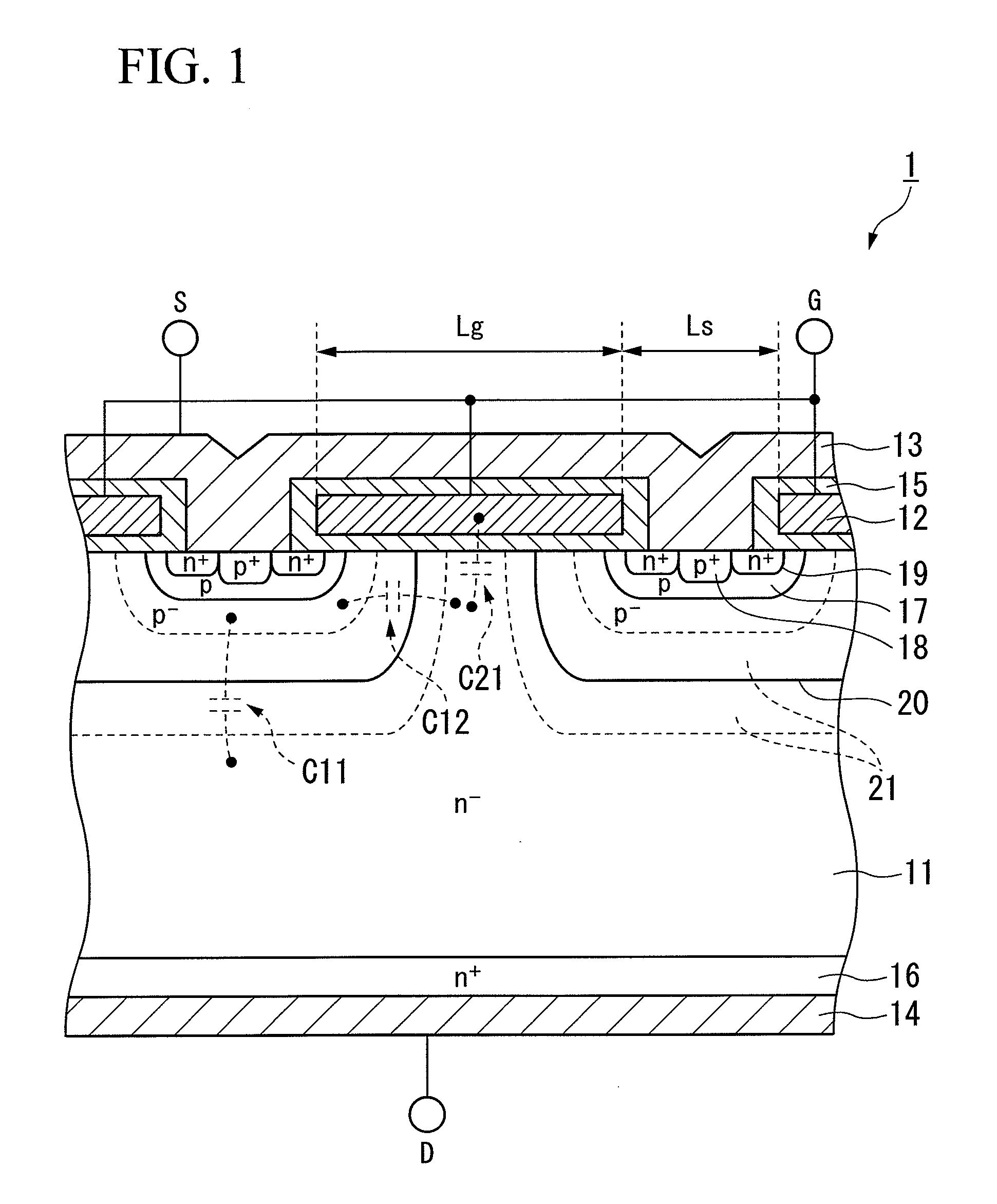
[0032]FIG. 1 is a cross-sectional view showing a schematic configuration of a semiconductor device according to a first embodiment of the invention. As shown in FIG. 1, a semiconductor device 1 of this embodiment includes a gate electrode (electrode) 12 and a source electrode 13, which are provided on a top face side of a substrate (e.g. n-type silicon) whereon an n− drift layer (first region) 11 and the like are formed, and a drain electrode 14 which is provided on a bottom face side of the n− drift layer 11. The semiconductor device 1 has a source terminal S, a gate terminal G, and a drain terminal D.
[0033]In FIG. 1, a layer designated by symbol ‘n’ has electrons as its majority carrier (first conductive layer). A layer designated by symbol ‘p’ has holes as its majority carrier (second conductive layer). Symbol ‘+’ appended to the symbols ‘n’ and ‘p’ indicates that the layer has comparatively high impurity-density, while symbol ‘−’ indicates that the layer has comparatively low im...
second embodiment
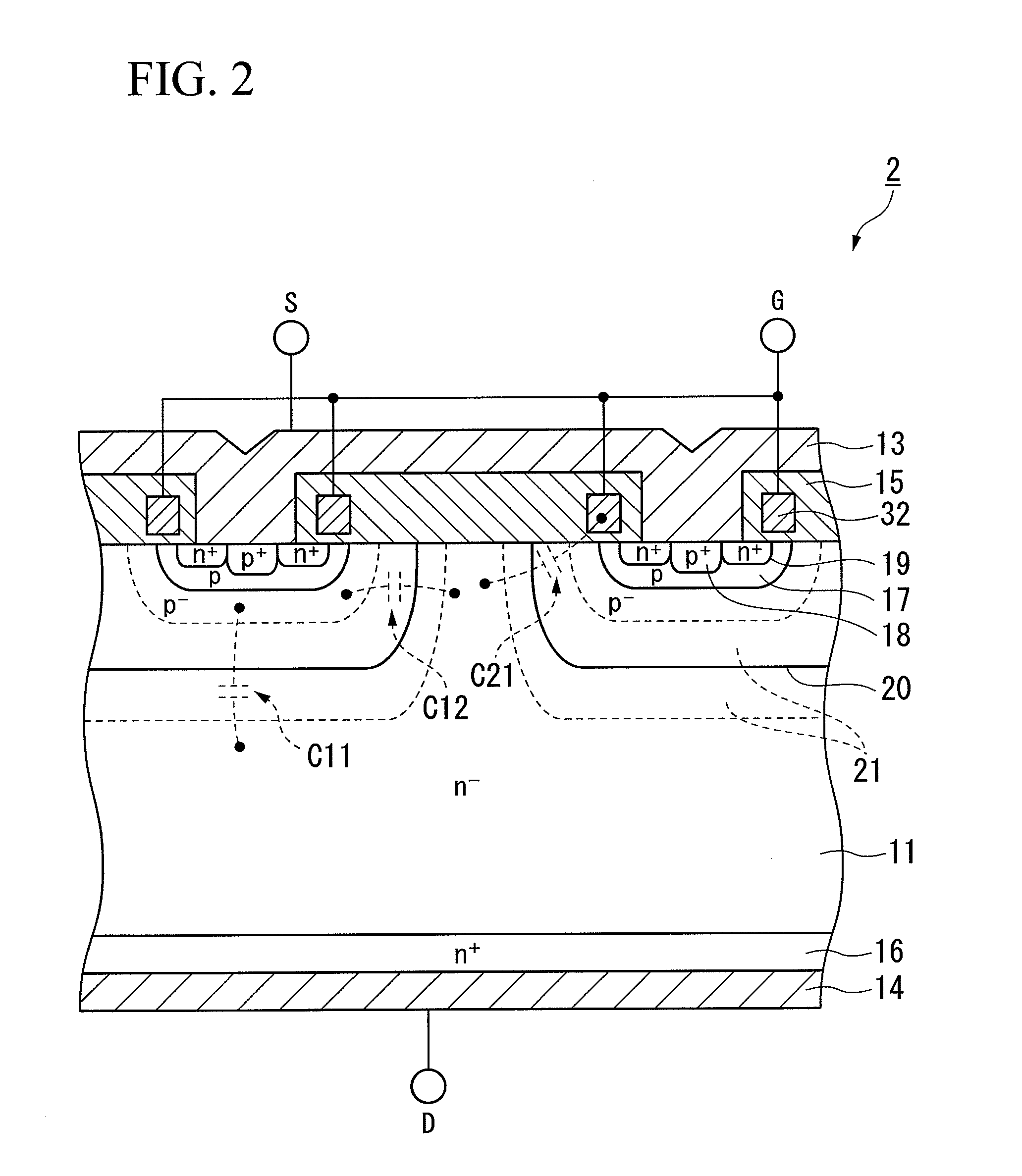
[0038]FIG. 2 is a cross-sectional view showing a schematic configuration of a semiconductor device according to a second embodiment of the invention. As shown in FIG. 2, while the configuration is roughly similar to that of the semiconductor device 1 in FIG. 1, one difference is the inclusion of a gate electrode 32 having a structure that differs from that of the gate electrode 12. The semiconductor device 1 shown in FIG. 1 includes the gate electrode 12 whose length is the length from the n+ layer 19 formed on one of adjacent p base layers 17 to the n+ layer 19 formed on the other p base layer 17. In contrast, the semiconductor device 2 of the embodiment shown in FIG. 2 includes a gate electrode 32 with an opening above a portion where the n− drift layer 11 is exposed at the surface (intermediary portion between adjacent p base layers 17).
[0039]Inclusion of the gate electrode 32 having the structure shown in FIG. 2 reduces the plan-view overlap between the n− drift layer 11 and the...
third embodiment
[0041]FIG. 3 is a cross-sectional view showing a schematic configuration of a semiconductor device according to a third embodiment of the invention. As shown in FIG. 3, a semiconductor device 3 according to this embodiment differs in that, instead of the gate electrode 12 and the oxide film 15 shown in FIG. 1, it includes a gate electrode 42 and an oxide film 45 which have different structures thereto. The semiconductor device 3 of this embodiment includes an oxide film 45 made by local oxidation of silicon (LOCOS), and a gate electrode 42 that is formed on the oxide film 45.
[0042]As shown in FIG. 3, the oxide film 45 is formed so as to be embedded in the substrate where the n-drift layer 11 and the like are formed between p base layers 17. The oxide film 45 electrically isolates the p base layers 17 from each other. For example, SiO2 can be used as the oxide film 45. Since the oxide film 45 is formed by embedding, as shown in FIG. 3, it is thick. The gate electrode 42 is formed fro...
PUM
 Login to View More
 Abstract
Description
Claims
Application Information
 Login to View More