Check patentability & draft patents in minutes with Patsnap Eureka AI!

Method of removing impurities from solids

Inactive Publication Date: 2009-10-22
LEE CHANG H
View PDF7 Cites 1 Cited by
  • Summary
  • Abstract
  • Description
  • Claims
  • Application Information

AI Technical Summary

Benefits of technology

[0011]The invention also provides for a system for ion exchange containing ionic elements including functional ionic resin or resins; an

Problems solved by technology

Purification of solids to remove impurities is a complex and often expensive process, though is often essential in order to meet the standards required of their end use.
Even if origin of the impurities is determined, removal or prevention of the same is not always practically possible.
This is often on account of the cost of treatment that render the process not economically feasible, or sometimes due to lack of adequate treating technology.
Though separation or classification to remove or reduce impurities in solids such as carbon has been done using air or dry systems, these methods often results in imperfections or inconsistency in the treated carbon.
However, sometimes the content of elemental carbon is much lower, which results in the deterioration of value of the final industrial product.
Moreover, the principle of ion exchange has not been applied for the removal of impurities or purification of carbon.

Method used

the structure of the environmentally friendly knitted fabric provided by the present invention; figure 2 Flow chart of the yarn wrapping machine for environmentally friendly knitted fabrics and storage devices; image 3 Is the parameter map of the yarn covering machine
View more

Image

Smart Image Click on the blue labels to locate them in the text.
Viewing Examples
Smart Image
  • Method of removing impurities from solids
  • Method of removing impurities from solids

Examples

Experimental program
Comparison scheme
Effect test

example 1

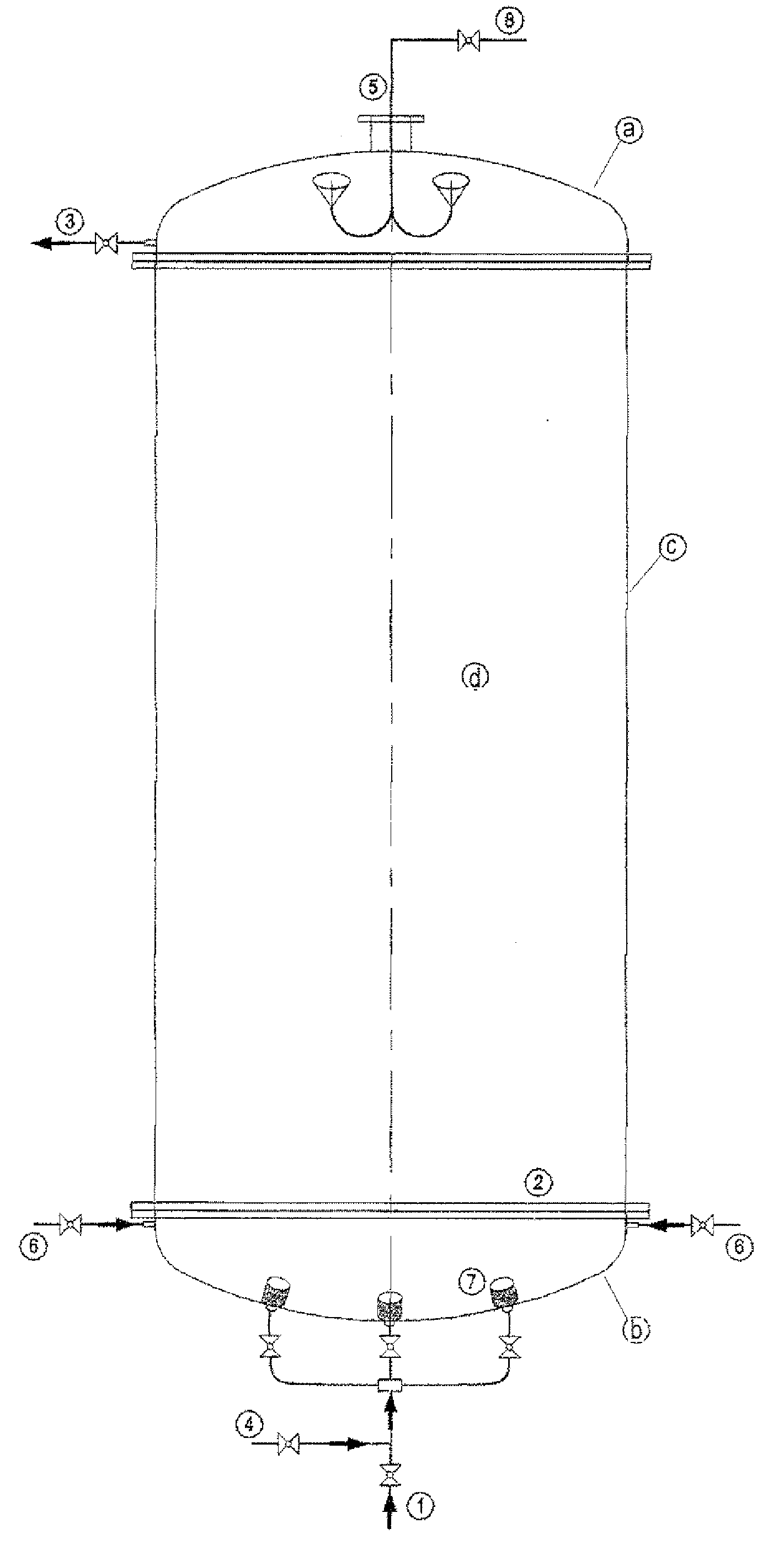
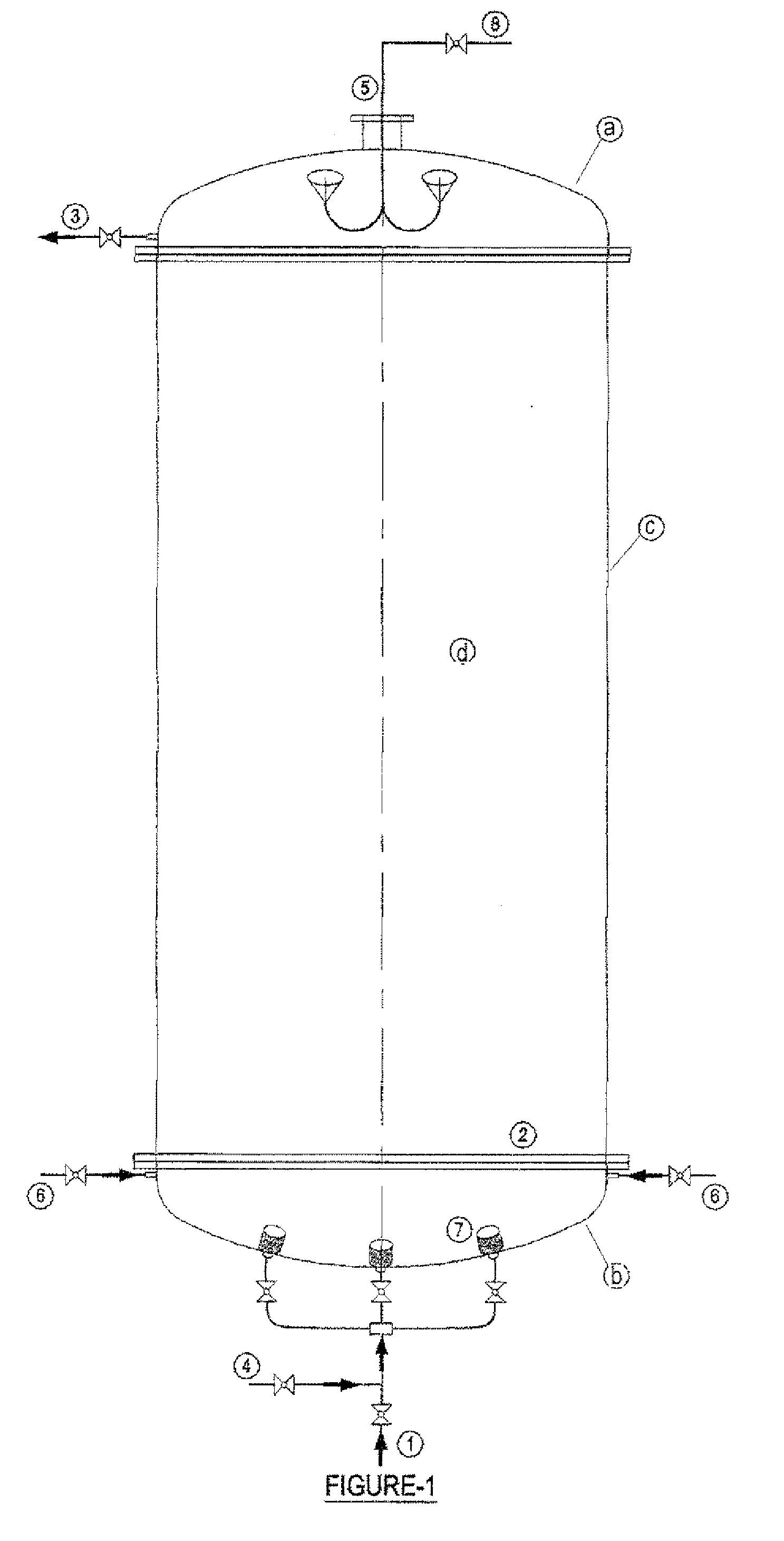
[0035]The 2 kg of Carbon black, N330 per ASTM D11765 is dispersed in 40 gallons of water with a non-ionic surfactant for 30 minutes by a high shearing impeller mixer at 1800 rpm. The resulting carbon solution is fed to the ion exchanger containing cationic resin of sulfonic acid. The carbon solution enters the ion exchanger from two side inlets (6), as illustrated in FIG. 17 in a tangential flow along the shell of the ion exchanger. Simultaneously, compressed air enters the exchanger by inlet (1) and distributor (7) at a predetermined rate, such as 100 liter per minute. The flow rate of carbon solution and the compressed air is adjusted such that the flow of resin beads through the discharge port (3) on the top of the ion exchanger is minimized or preferably eliminated. The distributor has helical slits such that it brings about a whirl and bubbles upwards to scatter the particles of carbon and impurities through resin bed. The air is discharged through outlet (5) at the top end of ...

example 2

[0037]A carbon solution is prepared as described in example 1 above. With reference to FIG. 1, the carbon solution is fed to the ion exchanger from inlet port (l) and distributor (7). Simultaneously, compressed air is introduced into the exchanger through the two ports (6) at a predetermined rate, such as 100 liter per minute, in tangential flow. The flow so created results in the carbon solution passing through the resin bed of the ion exchanger in a distributed manner. The air is discharged by outlet (5) at the top end of the ion exchanger. The carbon solution is recovered from the discharge port (3) and the ash content, by ASTM D1506 Method A, on the recovered carbon solution improved 99% compared to the untreated.

[0038]Similarly, both the solid solution and the compressed air can enter from the bottom of the ion exchanger through ports (1) and (4) and the distributors will create the necessary tangential or helical flow of the carbon solution through the resin bed.

the structure of the environmentally friendly knitted fabric provided by the present invention; figure 2 Flow chart of the yarn wrapping machine for environmentally friendly knitted fabrics and storage devices; image 3 Is the parameter map of the yarn covering machine
Login to View More

PUM

PropertyMeasurementUnit
Concentrationaaaaaaaaaa
Solutionaaaaaaaaaa
Login to View More

Abstract

The invention relates to a method of removing impurities from solids comprising forming a solid solution, passing the solid solution through an ion exchanger such that at least some impurities present in the solid solution are retained by the ion exchanger, and recovering the solid solution from the ion exchanger.

Description

CROSS-REFERENCE TO RELATED APPLICATIONS[0001]This application claims the benefit of Indian Patent Application No. 857 / Del / 2007 filed on Apr. 19, 2007.DESCRIPTION OF RELATED ART[0002]Various materials and elements required in industry are in, or required in solid form and contain contaminants and impurities. Purification of solids to remove impurities is a complex and often expensive process, though is often essential in order to meet the standards required of their end use. Moreover, various industrial processes also require separation of mixtures and recovery of precious substances in catalysis of chemical reactions. Carbon is one such solid used in industry and the invention shall be explained with reference to the removal of impurities or purification of carbon, as an example.[0003]Even if origin of the impurities is determined, removal or prevention of the same is not always practically possible. This is often on account of the cost of treatment that render the process not econo...

Claims

the structure of the environmentally friendly knitted fabric provided by the present invention; figure 2 Flow chart of the yarn wrapping machine for environmentally friendly knitted fabrics and storage devices; image 3 Is the parameter map of the yarn covering machine
Login to View More

Application Information

Patent Timeline
no application Login to View More
IPC IPC(8): B01D15/36C01B31/02
CPCB01J39/04C01B31/02B01J47/028B01J41/04C01B32/05
Inventor LEE, CHANG H.
Owner LEE CHANG H
Features
  • R&D
  • Intellectual Property
  • Life Sciences
  • Materials
  • Tech Scout
Why Patsnap Eureka
  • Unparalleled Data Quality
  • Higher Quality Content
  • 60% Fewer Hallucinations
Social media
Patsnap Eureka Blog
Learn More