
Optoelectronic display and method of manufacturing the same
a technology of optoelectronic display and manufacturing method, which is applied in the direction of discharge tube luminescnet display, electric discharge lamp, instruments, etc., can solve the problem of difficult to provide an intricately patterned colour-forming layer, and achieve the effect of negligible tooling costs
- Summary
- Abstract
- Description
- Claims
- Application Information
AI Technical Summary
Benefits of technology
Problems solved by technology
Method used
Image

Examples
Embodiment Construction
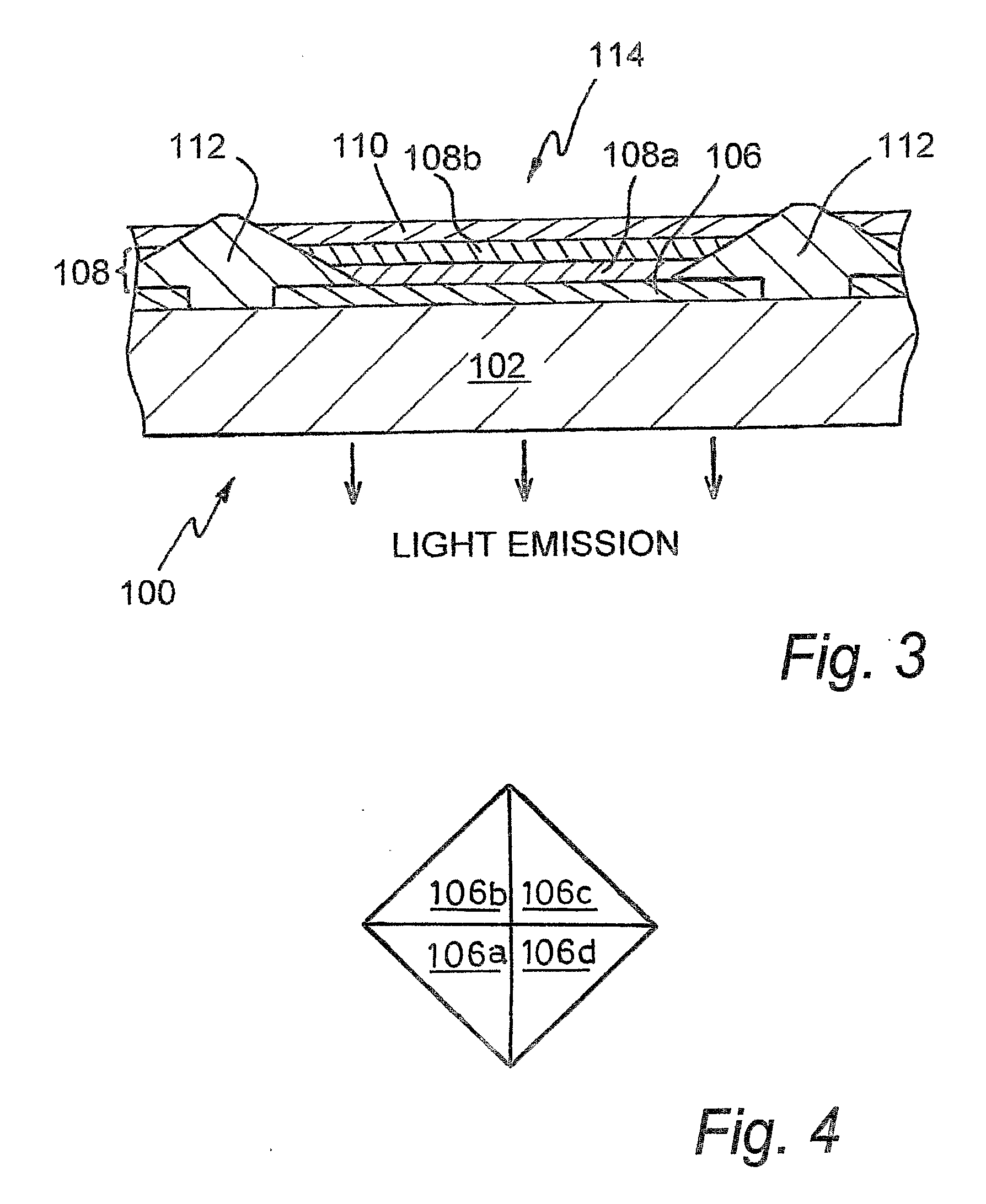
[0054]FIG. 3 shows a vertical cross section through an example of an OLED device 100. The structure of the device is somewhat simplified for the purposes of illustration.
[0055]The OLED 100 comprises a substrate 102, typically 0.7 mm or 1.1 mm glass but optionally clear plastic, on which an anode layer 106 is deposited comprising four separately drivable sub-anodes (shown in FIG. 4). The anode layer typically comprises around 150 nm thickness of ITO (indium tin oxide), over which is provided a metal contact layer, typically around 500 nm of aluminium, sometimes referred to as anode metal. Glass substrates coated with ITO and contact metal may be purchased from Corning, USA. The contact metal (and optionally the ITO) is patterned as desired so that it does not obscure the display, by a conventional process of photolithography followed by etching.
[0056]A substantially transparent hole conducting layer 108a is provided over the anode metal, followed by an electroluminescent layer 108b. ...
PUM
 Login to View More
 Abstract
Description
Claims
Application Information
 Login to View More