2-aminothiazole-4-carboxylic amides as protein kinase inhibitors
What is AI technical title?
AI technical title is built by Patsnap AI team. It summarizes the technical point description of the patent document.
a technology of aminothiazole and carboxylic amide, which is applied in the field of anilinopiperazine derivatives, can solve the problems of increased cdk2 activity, poor overall survival, and inducible apoptosis (programmed cell death)
Active Publication Date: 2010-05-27
MERCK SHARP & DOHME LLC
View PDF5 Cites 10 Cited by
Summary
Abstract
Description
Claims
Application Information
AI Technical Summary
This helps you quickly interpret patents by identifying the three key elements:
Problems solved by technology
Method used
Benefits of technology
Benefits of technology
[0045]In another aspect, the present invention provides pharmaceutical compositions comprising an effective amount of at least one Anilinopiperazine Derivative and a pharmaceutically acceptable carrier. The compositions can be useful for treating or preventing a Condition in a patient.
Problems solved by technology
Their altered expression has been shown to correlate with increased CDK2 activity levels and poor overall survival.
Checkpoints prevent cell cycle progression at inappropriate times, such as in response to DNA damage, and maintain the metabolic balance of cells while the cell is arrested, and in some instances can induce apoptosis (programmed cell death) when the requirements of the checkpoint have not been met.
Misregulation of the cell cycle can lead to cellular proliferation and other abnormalities.
Method used
the structure of the environmentally friendly knitted fabric provided by the present invention; figure 2 Flow chart of the yarn wrapping machine for environmentally friendly knitted fabrics and storage devices; image 3 Is the parameter map of the yarn covering machine
View more
Image
Smart Image Click on the blue labels to locate them in the text.
Viewing Examples
Smart Image
Click on the blue label to locate the original text in one second.
Reading with bidirectional positioning of images and text.
[0359]To a solution of 2-bromo-thiazole-4-carboxylic acid (2.0 mmol, 0.42 g), N,N-diisopropylethylamine (3.0 mmol, 0.52 mL) and HATU (2.0 mmol, 0.76 g) in DMF (10 mL) was added 4-(2-aminophenyl)-piperazine-1-carboxylic acid tert-butyl ester (2.0 mmol, 0.56 g). The reaction mixture was stirred at 80° C. for 3 h, and then concentrated in vacuo. The resulting residue was purified using flash column chromatography on silica gel (eluent: Hexane:EtOAc (4.5:1)) to provide Compound A as a yellow solid (0.67 g, 72%). 1H NMR (400 MHz, CDCl3) δ 10.38 (s, 1 H), 8.49 (dd, J=8.0, 1.2 Hz, 1H), 8.14 (s, 1H), 7.23-7.10 (m, 3H), 3.72 (br s, 4H), 2.89-2.87 (m, 4H), 1.50 (s, 9H). HPLC-MS RT=2.39 min, mass calculated for formula C19H23BrN4O3S 466.07, observed LCMS m / z 467.05 (M+H).
example 2
Preparation of Compound 1
[0360]
[0361]A solution of Compound A (0.050 mmol, 23 mg), N,N-diisopropylethylamine (0.20 mmol, 35 μL) and 2,3-dihydro-1H-pyrrolo[3,4-c]pyridine (0.1 mmol) in DMF (1 mL) was irradiated using microwave for 15 minutes at a temperature of 180° C. The reaction mixture was then concentrated in vacuo, and to the resulting residue was added TFA (0.5 mL). The resulting solution was allowed to stir at room temperature for 10 minutes and was then concentrated in vacuo. The resulting residue was purified using reverse phase HPLC to provide Compound 1.
example 3
Preparation of Compound 2
[0362]
[0363]Using the method described in Example 2 and substituting 6,7-dimethoxy-1,2,3,4-tetrahydro-isoquinoline for 2,3-dihydro-1H-pyrrolo[3,4-c]pyridine, Compound 2 was prepared.
the structure of the environmentally friendly knitted fabric provided by the present invention; figure 2 Flow chart of the yarn wrapping machine for environmentally friendly knitted fabrics and storage devices; image 3 Is the parameter map of the yarn covering machine
Login to View More
PUM
Property
Measurement
Unit
Temperature
aaaaa
aaaaa
Temperature
aaaaa
aaaaa
Temperature
aaaaa
aaaaa
Login to View More
Abstract
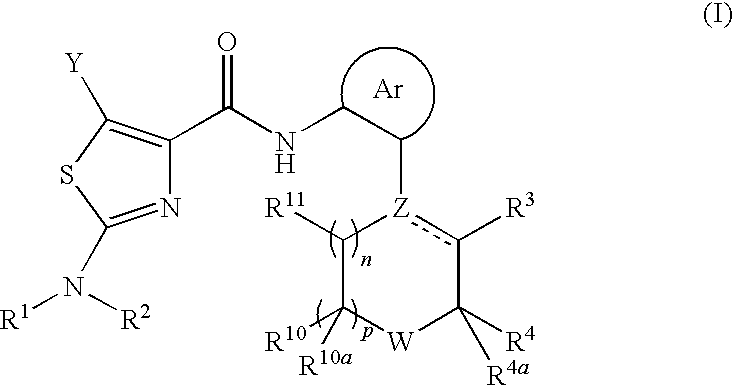
The present invention relates to novel Anilinopiperazine Derivatives of formula (I), compositions comprising the Anilinopiperazine Derivatives, and methods for using the Anilinopiperazine Derivatives for treating or preventing a proliferative disorder, an anti-proliferative disorder, inflammation, arthritis, a central nervous system disorder, a cardiovascular disease, alopecia, a neuronal disease, an ischemic injury, a viral disease, a fungal infection, or a disorder related to the activity of a proteinkinase.
Description
FIELD OF THE INVENTION[0001]The present invention relates to novel Anilinopiperazine Derivatives, compositions comprising the Anilinopiperazine Derivatives, and methods for using the Anilinopiperazine Derivatives for treating or preventing a proliferative disorder, an anti-proliferative disorder, inflammation, arthritis, a central nervous system disorder, a cardiovascular disease, alopecia, a neuronal disease, an ischemic injury, a viral disease, a fungal infection, or a disorder related to the activity of a proteinkinase.BACKGROUND OF THE INVENTION[0002]Protein kinases are a family of enzymes that catalyze phosphorylation of proteins, in particular the hydroxyl group of specific tyrosine, serine, or threonine residues in proteins. Protein kinases are pivotal in the regulation of a wide variety of cellular processes, including metabolism, cell proliferation, cell differentiation, and cell survival. Uncontrolled proliferation is a hallmark of cancer cells, and can be manifested by a...
Claims
the structure of the environmentally friendly knitted fabric provided by the present invention; figure 2 Flow chart of the yarn wrapping machine for environmentally friendly knitted fabrics and storage devices; image 3 Is the parameter map of the yarn covering machine
Login to View More
Application Information
Patent Timeline
Application Date:The date an application was filed.
Publication Date:The date a patent or application was officially published.
First Publication Date:The earliest publication date of a patent with the same application number.
Issue Date:Publication date of the patent grant document.
PCT Entry Date:The Entry date of PCT National Phase.
Estimated Expiry Date:The statutory expiry date of a patent right according to the Patent Law, and it is the longest term of protection that the patent right can achieve without the termination of the patent right due to other reasons(Term extension factor has been taken into account ).
Invalid Date:Actual expiry date is based on effective date or publication date of legal transaction data of invalid patent.


 Login to View More