Unlock instant, AI-driven research and patent intelligence for your innovation.

Expanding the operating envelope of advanced combustion engines using fuel-alcohol blends

Inactive Publication Date: 2010-12-30
EXXON RES & ENG CO
View PDF11 Cites 2 Cited by
  • Summary
  • Abstract
  • Description
  • Claims
  • Application Information

AI Technical Summary

Benefits of technology

[0014]Given their improved combustion characteristics, the methods described herein enable advanced combustion engines to operate in an advanced combustion mode (e.g. HCCI mode) over a broad range of speeds and loads. For example, the methods described herein should expand an engine's HCCI load range by about 10% to about 30% without encountering unacceptable engine noise, metallurgical stress, or elevated NOx emission levels. Because of their thermal efficiency and low NOx emission levels, the methods described herein offer substantial environmental advantages.
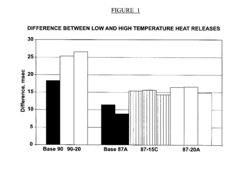
[0017]The methods described herein achieve efficient combustion over a wide range of engine speeds and loads. Because of delayed ignition and delayed and broadened HTHR, combustion is more uniform throughout the engine's cylinders under high load conditions where larger amounts of fuel are fed to the cylinder. Also, combustion stability is improved and cycle-to-cycle variability is reduced.

Problems solved by technology

While these attributes of HCCI are known, it has still proven difficult to operate HCCI engines over a wide range of loads for a number of reasons.
Since HCCI engines rely on auto-ignition, combustion phasing (the timing of auto-ignition) is inherently difficult to control.
The rapid rate of heat release by a HCCI engine as its load increases can lead to mechanical and noise problems.
Also, combustion occurs very rapidly in HCCI engines and the maximum rate of pressure rise limits the ability of HCCI engines to achieve medium and high loads.
Although external exhaust gas recirculation (EGR) and variable valve timing (VVT) help to control the combustion heat release, rate of pressure rise, and NOx emissions of HCCI and other IC engines, each of these design options has its detriments.
External EGR leads to a slow response rate since EGR gases must flow through the exhaust and EGR system.
External EGR also requires substantial heat dissipation; EGR must often be cooled prior to introduction into the engine.
Further, to achieve high load performance with EGR, a larger engine size is needed (due to the displacement of air by EGR), which leads to a loss of efficiency and power.
While internal EGR strategies using VVT have faster response rates, these valve strategies contend with delayed intake valve closure time, which also decreases power and efficiency.

Method used

the structure of the environmentally friendly knitted fabric provided by the present invention; figure 2 Flow chart of the yarn wrapping machine for environmentally friendly knitted fabrics and storage devices; image 3 Is the parameter map of the yarn covering machine
View more

Image

Smart Image Click on the blue labels to locate them in the text.
Viewing Examples
Smart Image
  • Expanding the operating envelope of advanced combustion engines using fuel-alcohol blends
  • Expanding the operating envelope of advanced combustion engines using fuel-alcohol blends
  • Expanding the operating envelope of advanced combustion engines using fuel-alcohol blends

Examples

Experimental program
Comparison scheme
Effect test

example 1

Combustion Characteristics

[0074]Compositions and combustion characteristics of five fuels and fuel blends were evaluated and are summarized below in Table IA and Table IB. The fuels and fuel blends were grouped into two octane quality levels: (1) (RON+MON) / 2 of about 87, and (2) (RON+MON) / 2 of about 90.

TABLE IASample NameBase 87ABase 87A87-15C87-15C87-15C87-20A87-20A87-20ASample Lab. No.08-1559208-1559208-1916908-1916908-1916908-1583208-1583208-15832Run No.420423416418424417419425(RON + MON) / 287.787.786.786.786.788.588.588.5RON90.690.692.092.092.093.293.293.2Ignition Delay,14.012.820.020.119.021.321.319.7msecLow5.76.57.77.78.07.97.98.5TemperatureCombustion50% PointHigh17.115.323.123.322.424.424.523.3TemperatureHeat Release50% PointDelta11.48.915.415.614.316.516.614.9(HTHR50 -LTC50)Average PeakNA103.3NANA14.1NANA12.1NOx

TABLE IBSample NameBase 9090-2090-20Sample Lab. No.08-1395508-1395608-13956Run No.421414422(RON + MON) / 290.190.690.6RON95.297.197.1Ignition Delay, msec22.031.432.5Low ...

example 2

The Effect of Fuel Composition on Peak NOx Emission Levels

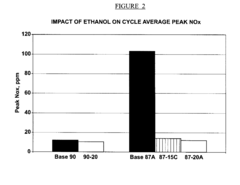
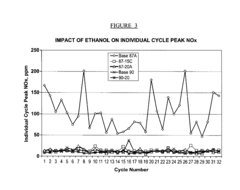
[0080]During the combustion experiments described in Example 1, the impact of ethanol on peak NOx emission levels was also studied. FIG. 2 illustrates the effect of ethanol on cycle average peak NOx emission levels for the base (ethanol-free) and ethanol-containing fuels, as averaged over thirty-two test cycles.

[0081]The use of 15% or more ethanol reduced cycle average peak NOx levels by about 86-89% at 87 (RON+MON) / 2 and 14% at 90 (RON+MON) / 2. While both sets of fuels at lower and higher octane levels saw significant NOx reduction, the result for the 87 (RON+MON) / 2 fuel is an impressively large reduction. It is theorized that at the lower octane number, use of the non-ethanol fuel results in a not completely homogeneous fuel / air mixture. This can lead to less efficient combustion, increased peak combustion temperatures, and locally hot zones. NOx formation is very temperature-dependent, and tends to increase significantly wi...

the structure of the environmentally friendly knitted fabric provided by the present invention; figure 2 Flow chart of the yarn wrapping machine for environmentally friendly knitted fabrics and storage devices; image 3 Is the parameter map of the yarn covering machine
Login to View More

PUM

No PUM Login to View More

Abstract

The invention provides methods that expand the operating envelope of advanced combustion engines during operation in an advanced combustion mode by supplying an engine cylinder during operation in the advanced combustion mode with fuel-alcohol blends, e.g. gasoline-alcohol blends. In methods of the invention, fuel-alcohol blends combust efficiently over a wide range of engine loads, and the need for EGR, VVT, NVO, rebreathing, or multiple fuel injection is either reduced or eliminated.

Description

CROSS REFERENCE TO RELATED APPLICATION[0001]This Application claims the benefit of U.S. Provisional Application 61 / 269,856 filed Jun. 30, 2009.[0002]This Application claims the benefit of U.S. Provisional Application 61 / 269,856 filed Jun. 30, 2009.FIELD OF THE INVENTION[0003]The invention provides thermally-efficient and environmentally-friendly methods for expanding the operating envelope of advanced combustion engines.BACKGROUND OF THE INVENTION[0004]Internal combustion (IC) engines can operate in a spark ignition (SI) mode, in which a nearly homogeneous air and fuel charge is spark-ignited within a combustion chamber. IC engines may also operate in a compression ignition mode, in which compression of a non-homogeneous air and fuel charge within a combustion chamber ignites the charge. Homogeneous charge compression ignition (HCCI) is a type of compression ignition in which air and fuel are thoroughly mixed in an engine cylinder before compression-initiated self-ignition. Worldwid...

Claims

the structure of the environmentally friendly knitted fabric provided by the present invention; figure 2 Flow chart of the yarn wrapping machine for environmentally friendly knitted fabrics and storage devices; image 3 Is the parameter map of the yarn covering machine
Login to View More

Application Information

Patent Timeline
no application Login to View More
IPC IPC(8): F02B43/00
CPCC10L1/023F02D19/084Y02T10/36F02B1/12Y02T10/30
Inventor YEH, LISA I.HOROWITZ, ALAN M.
Owner EXXON RES & ENG CO