
Image processor, image processing method, digital camera, and imaging apparatus
a technology of image processing and image processor, applied in the field of image processing method, image processing method, digital camera, imaging apparatus, can solve the problems of reducing processing speed and causing cost increase, and achieve the effect of reducing processing speed and increasing costs
- Summary
- Abstract
- Description
- Claims
- Application Information
AI Technical Summary
Benefits of technology
Problems solved by technology
Method used
Image

Examples
first embodiment
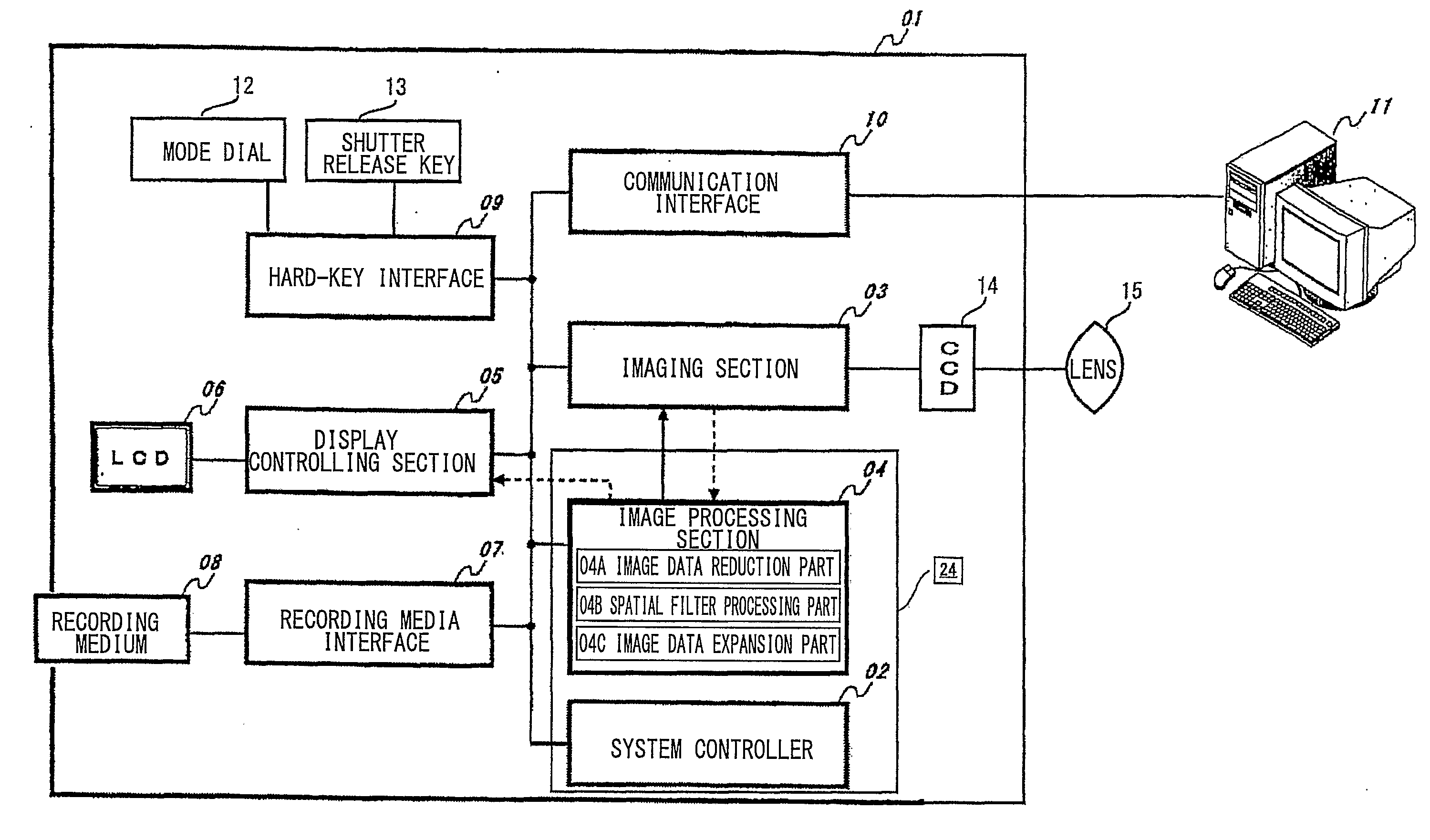
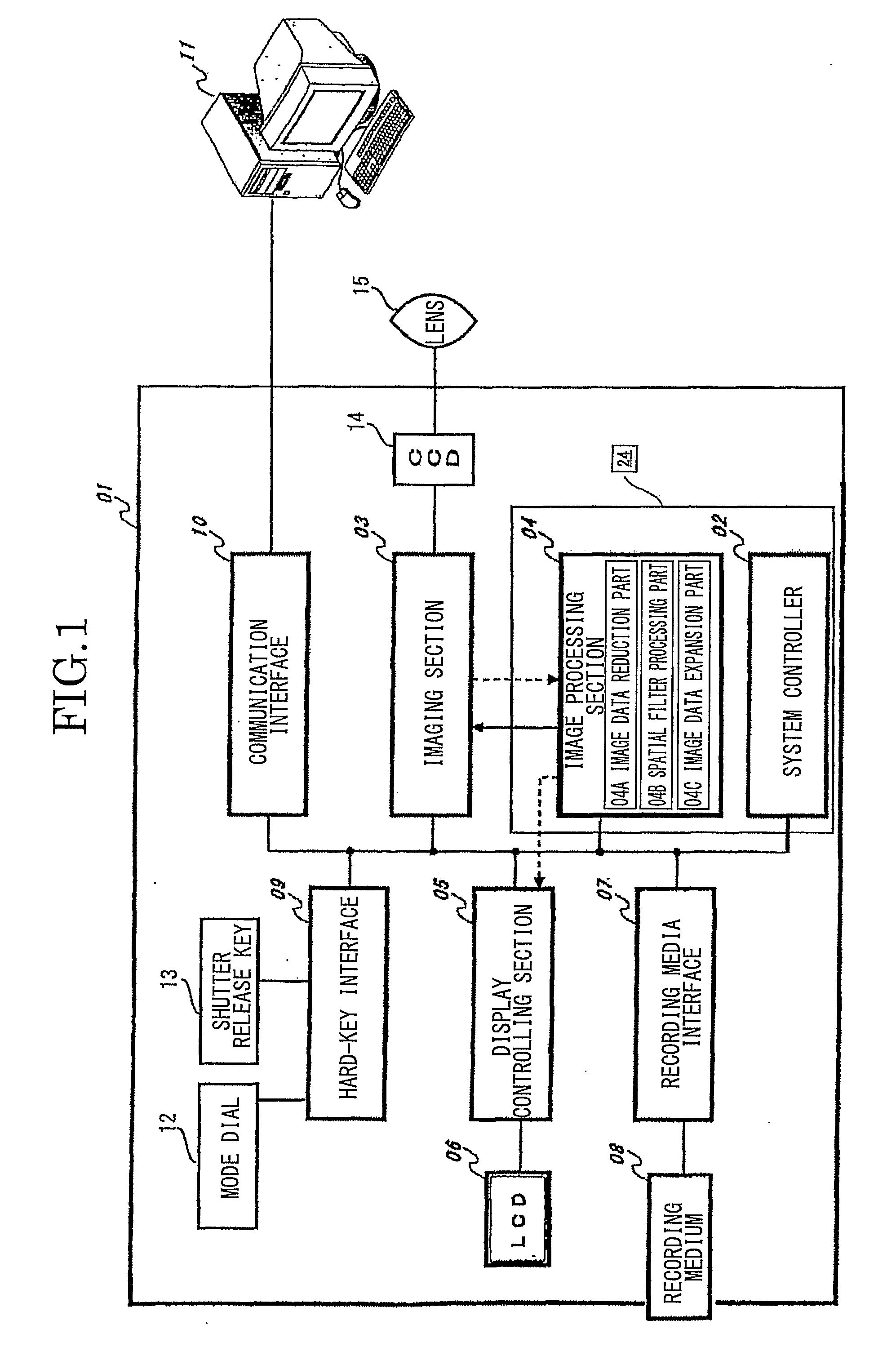
[0058]FIG. 1 schematically illustrates a structure of a digital camera and a connected device according to a first embodiment of the present invention.
[0059]Referring to FIG. 1, a digital camera 01 is illustrated. The digital camera 01 includes a system controller 02, and an imaging section 03. The system controller 02 is provided, for example, with a CPU (Central Processing Unit), a NAND flash memory, a SDRAM (Synchronous Dynamic Random Access Memory), and a timer, and is provided for controlling all parts of the digital camera 01. The imaging section 03 is provided, for example, with a motor for driving an imaging optical system, a CCD driving circuit for driving a CCD (Charge-Coupled Device) 14, and an A / D (Analog / Digital) converter.
[0060]The digital camera 01 includes an image processing section 04, which applies various image processes to an image signal obtained by the imaging section 03. The image processing section 04 is provided, for example, with an image processing DSP (D...
second embodiment
[0112]Next, a second embodiment of the present invention will be described with reference to FIGS. 11 and 12. The second embodiment obtains a photographic object distance in each region including a photographic object and a background part, and changes an amount of blurring according to the photographic object distance in each of the regions.
[0113]FIG. 11 is a flowchart illustrating a flow of operation of a digital camera according to the second embodiment of the invention. In FIG. 11, steps 02-001 to 02-007 are similar to the steps 01-001 to 01-007 of FIG. 5A, so they will not be described in detail. The image processing section 04 divides a background image into plural parts on the basis of photographic object distances (step 02-008).
[0114]FIG. 12 explains image processing of the digital camera according to the second embodiment, in which the background image is divided into several parts. Referring to FIG. 12, a photographing image 200, a main photographic object 201, an extracte...
PUM
 Login to View More
 Abstract
Description
Claims
Application Information
 Login to View More