
Process for purifying cyclolipopeptide compounds or the salts thereof
a technology of cyclolipopeptide and purification process, which is applied in the field of purification process of cyclolipopeptide compound, can solve the problems of high incidence and mortality of immunodeficiency patients, adverse to the environment protection, and transplant recipients are also high-risk populations, so as to improve the purity of the compound of formula
- Summary
- Abstract
- Description
- Claims
- Application Information
AI Technical Summary
Benefits of technology
Problems solved by technology
Method used
Image

Examples
example 1
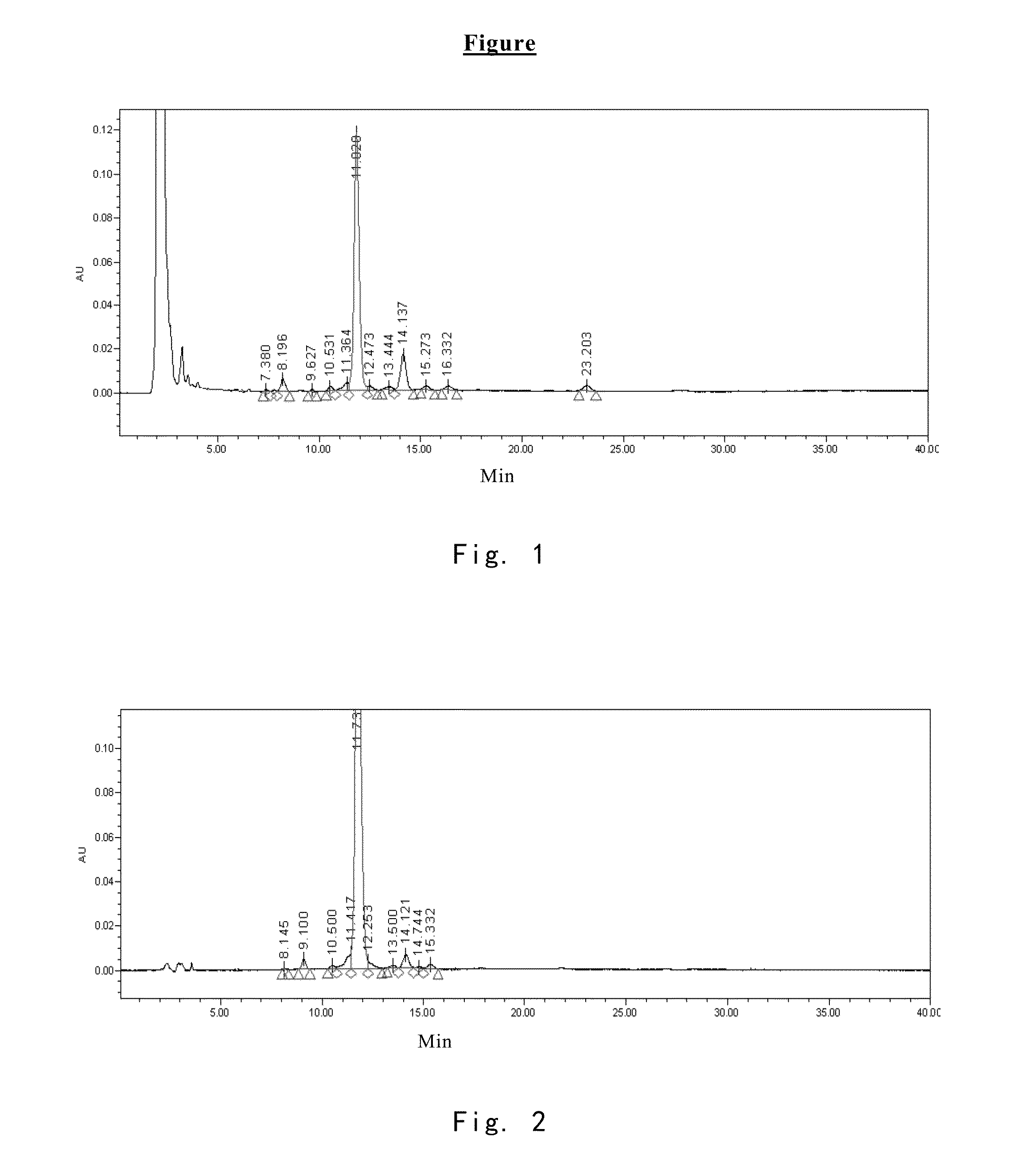
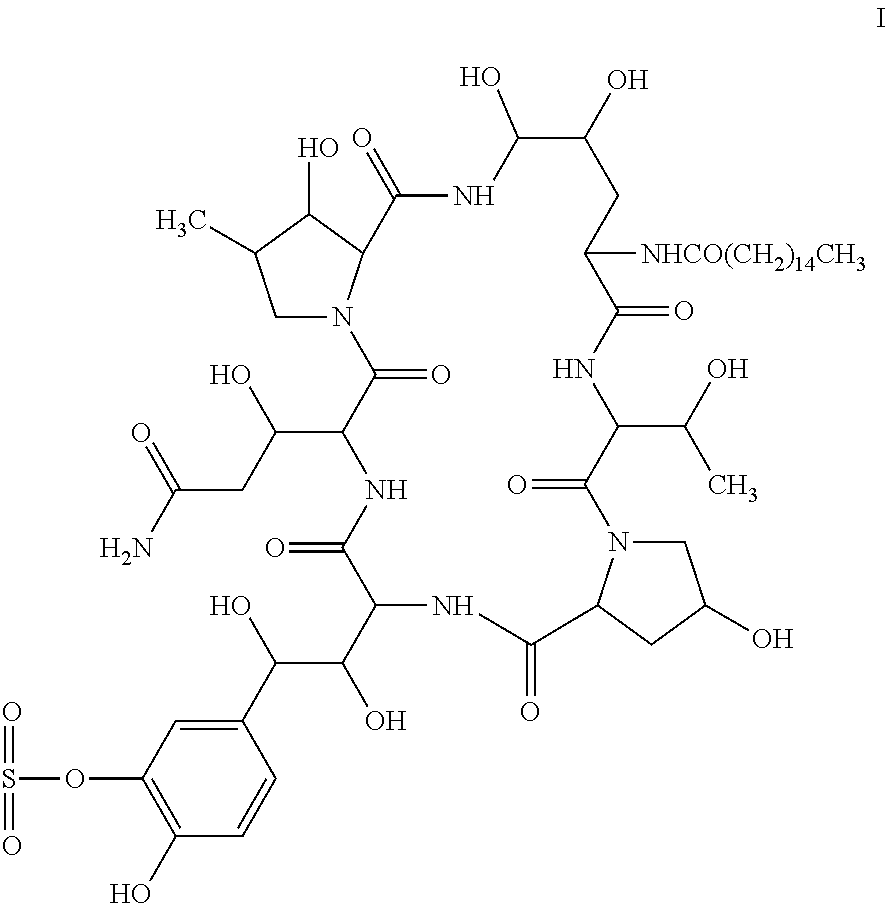
[0069]2200 L of fermentation liquid comprising compound I was obtained by the method described in Example 1 of EP0431350B1. Upon filtration, 650 kg of wet mycelia was obtained. Into 65 kg of the wet mycelia, 100 L of ethanol was added for extration, the resulting mixture was filtered through plate-frame pressure filtration, the filter cake was washed, and 160 L of extract 1 comprising compound I was obtained. In extract 1, the content of compound I was 0.11 g / L, and the HPLC purity of which is 74.08% (see FIG. 1 and table 1 for the HPLC pattern).
[0070]50 L of extract 1 comprising 5.5 g compound I in total was diluted by using pure water, so that the content of ethanol was reduced to 33%, and 100 L of extract 2 comprising compound I was obtained.
[0071]Extract 2 comprising compound I obtained in the previous step was loaded onto a chromatographic column with 550 ml of HP20ss resin with the flow rate for loading being 3 column volumes per hour. Afterwards, 33% aqueous ethanol (2×column...
example 2
[0072]2200 L of fermentation liquid comprising compound I was obtained by the method described in Example 1 of EP0431350B1. Into the fermentation liquid, the same volume of methanol was added for extration. Upon filtration, extract 1 comprising compound I was obtained, wherein, the content of compound I was 0.051 g / L, and the HPLC purity was 74.5%. 100 L of extract 1 comprising 5.1 g compound I in total was diluted by using pure water, so that the content of methanol was reduced to 40%, and 200 L of extract 2 comprising compound I was obtained.
[0073]Extract 2 comprising compound I obtained in the previous step was loaded onto a chromatographic column with 700 ml of XAD-16 resin with the flow rate for loading being 1 column volume per hour. Afterwards, 40% aqueous methanol (2×column volumes) was used to wash the column with the flow rate for washing being 1 column volume per hour. And then, 1800 ml of 50% aqueous methanol was used as the eluent, wherein the flow rate for eluting is 1...
example 3
[0074]2200 L of fermentation liquid comprising compound I was obtained by the method described in Example 1 of EP0431350B1. Into the fermentation liquid, the same volume of acetone was added for extration. Upon filtration, extract 1 comprising compound I was obtained, wherein, the content of compound I was 0.051 g / L, and the HPLC purity was 74.5%. 40 L of extract 1 comprising 2.04 g compound I in total was diluted by using pure water, so that the content of acetone was reduced to 20%, and 80 L of extract 2 comprising compound I was obtained.
[0075]Extract 2 comprising compound I obtained in the previous step was placed into a 100 L white plastic-bucket, and 1000 ml of XAD-16HP resin was added. The resulting mixture was agitated for 120 mins at the room temperature, and then filtered by a Büchner funnel on which a piece of filter paper was laid. The filtrate was discarded, and the resin was loaded on a chromatographic column. 2000 mL of 20% aqueous acetone was used to wash the column....
PUM
| Property | Measurement | Unit |
|---|---|---|
| particle size | aaaaa | aaaaa |
| particle size | aaaaa | aaaaa |
| adsorption | aaaaa | aaaaa |
Abstract
Description
Claims
Application Information
 Login to View More