Method and apparatus for adapting the data transmission security in a serial bus system

a serial bus and data transmission technology, applied in the field of serial bus system data transmission security adapter and serial bus system adapter, can solve the problems of unsatisfactory results of related art, achieve the effects of improving the reliability of data transmission or detection probability, reducing the adaptation effort of application software, and high flexibility

US20140157080A1Active Publication Date: 2014-06-05ROBERT BOSCH GMBH
9 Cites 3 Cited by

Patent Information

Authority / Receiving Office
US · United States
Patent Type
Applications(United States)
Current Assignee / Owner
Publication Date
2014-06-05

Smart Images

  • Figure 1
    Figure 1
  • Figure 2
    Figure 2
  • Figure 3
    Figure 3
Patent Text Reader

Abstract

A method for serial data transmission in a bus system having at least two subscribed data processing units, the data processing units exchanging messages via the bus, the transmitted messages having a logical structure in accordance with the CAN standard ISO 11898-1, the logical structure including a start-of-frame bit, an arbitration field, a control field, a data field, a CRC field, an acknowledge field and an end-of-frame sequence, the control field including a data length code, which contains information regarding the length of the data field. The CRC field of the transmitted messages may have at least two different numbers of bits as a function of the content of the data length code.
Need to check novelty before this filing date? Find Prior Art

Description

FIELD OF THE INVENTION

[0001] The present invention relates to a method and a device for adapting the data transmission reliability between at least two subscribers in a serial bus system.BACKGROUND INFORMATION

[0002] For example, the ISO standard family 11898-1 through -5 describes the Controller Area Network (CAN) as well as an extension of the CAN called “time-triggered CAN” (TTCAN), referred to in the following also as standard CAN. The media access control method used in the CAN standard is based on a bit-wise arbitration. In bit-wise arbitration, multiple subscriber stations are simultaneously able to transmit data via the channel of the bus system, without thereby interfering with the data transmission. Furthermore, the subscriber stations are able to ascertain the logical state (0 or 1) of the channel while transmitting a bit over the channel. If a value of the transmitted bit does not correspond to the ascertained logical state of the channel, the subscriber station terminates ...

Examples

Embodiment Construction

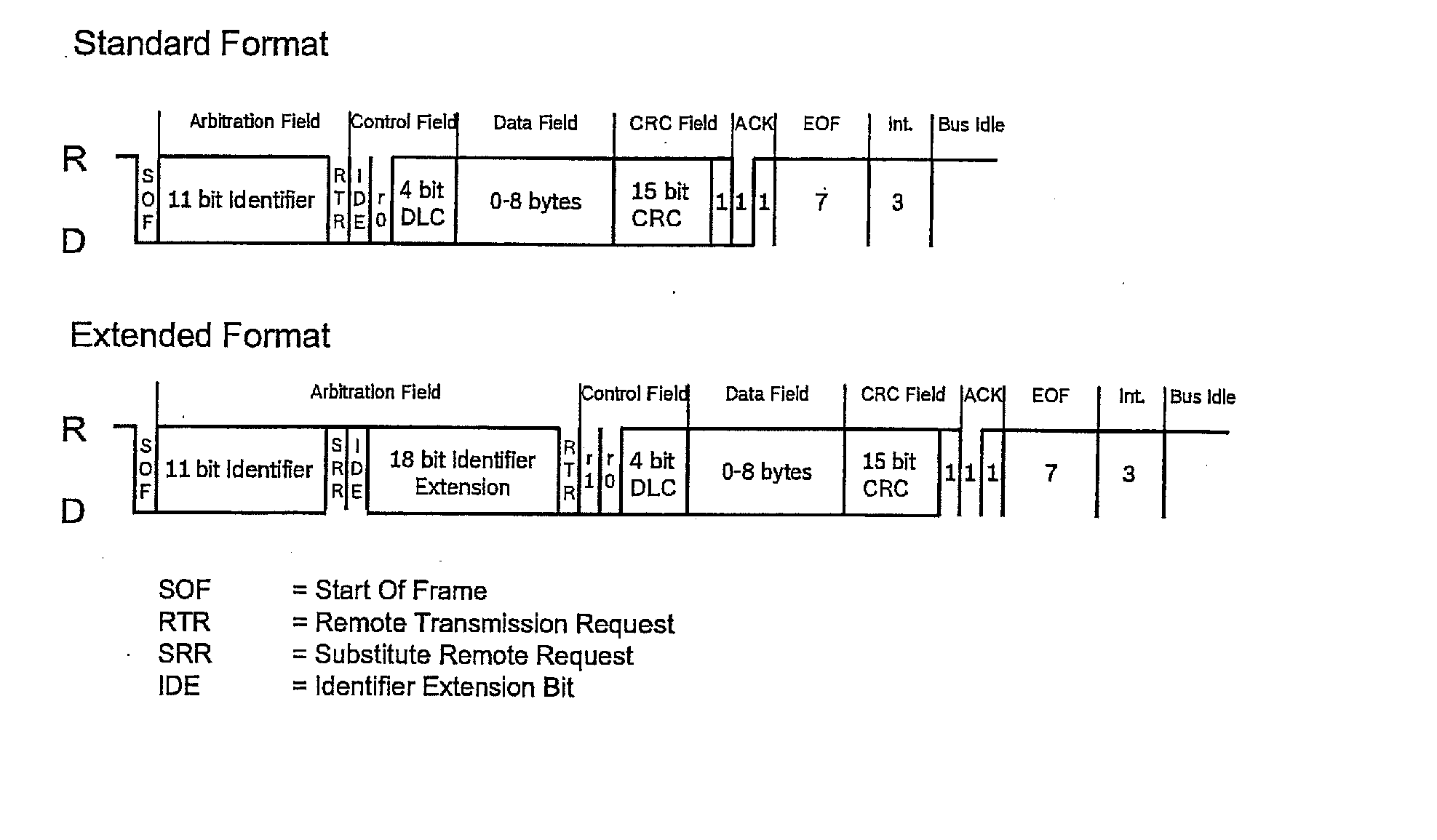
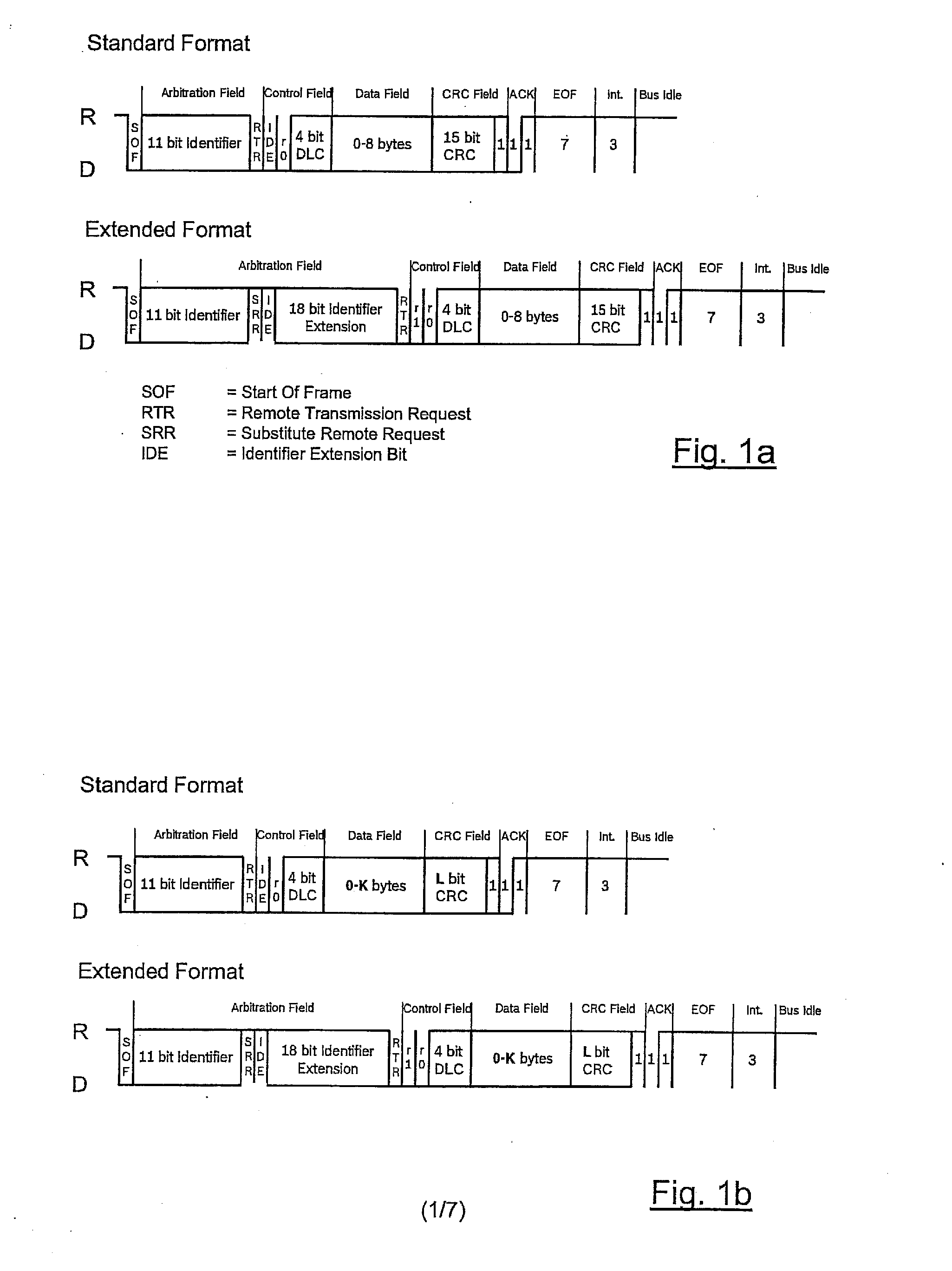
[0028]FIG. 1a shows the structure of messages as they are used in a CAN bus for data transmission. The two different formats “standard” and “extended” are shown. The method according to the present invention is equally applicable to both formats.

[0029]The message begins with a “start of frame” (SOF) bit, which signals the beginning of the message. This is followed by a section that is used primarily for identifying the message and on the basis of which the subscribers of the bus system decide whether they receive the message or not. This section is called an “arbitration field” and contains the identifier. This is followed by a “control field” containing, among other things, the data length code. The data length code contains information about the size of the data field of the message. This is followed by the actual “data field”, which contains the data to be exchanged between the subscribers of the bus system. This is followed by the “CRC field” having the 15-bit checksum and a del...