

Inks containing metal precursors nanoparticles
a technology of metal precursors and inks, applied in the field of new ink formulations, can solve the problems of metal-based ink formulations that are prone to oxidation, require integration and optimization, and are therefore relatively unstable, and achieve the effect of low cost and ease of production
Active Publication Date: 2015-02-26
SINGAPORE ASAHI CHEM & SOLDER IND
View PDF9 Cites 39 Cited by
- Summary
- Abstract
- Description
- Claims
- Application Information
AI Technical Summary
Benefits of technology
This patent is about a new way to make printed electronics using a stable printing formulation with metal precursors. The metal salt particles are stabilized by dispersing agents to prevent agglomeration and make a stable dispersion. The formulation can be printed onto plastic substrates using ink-jet printing techniques without causing clogging problems. The metal complexes used in this process have the added benefits of higher conductivity due to lower organic content and lower energy requirement for removal of fewer complexing agents.
Problems solved by technology
However, the printed electronics technology requires integration and optimization of many factors from the printing formulation (ink) and the substrate to the printed pattern.
As known in the field, one of the drawbacks associated with the production of ink formulations, which are based on metal complexes solubilized in organic solvents is the necessity to utilize high amount of complexing agents (organic ligand).
Similarly, metal-based ink formulations are prone to oxidation and are therefore relatively unstable.
Method used
the structure of the environmentally friendly knitted fabric provided by the present invention; figure 2 Flow chart of the yarn wrapping machine for environmentally friendly knitted fabrics and storage devices; image 3 Is the parameter map of the yarn covering machine
View moreImage
Smart Image Click on the blue labels to locate them in the text.
Smart ImageViewing Examples

Examples
Experimental program
Comparison scheme
Effect test
example 3
Copper Particles Obtained by Bead Milling with 0.1 mm Beads
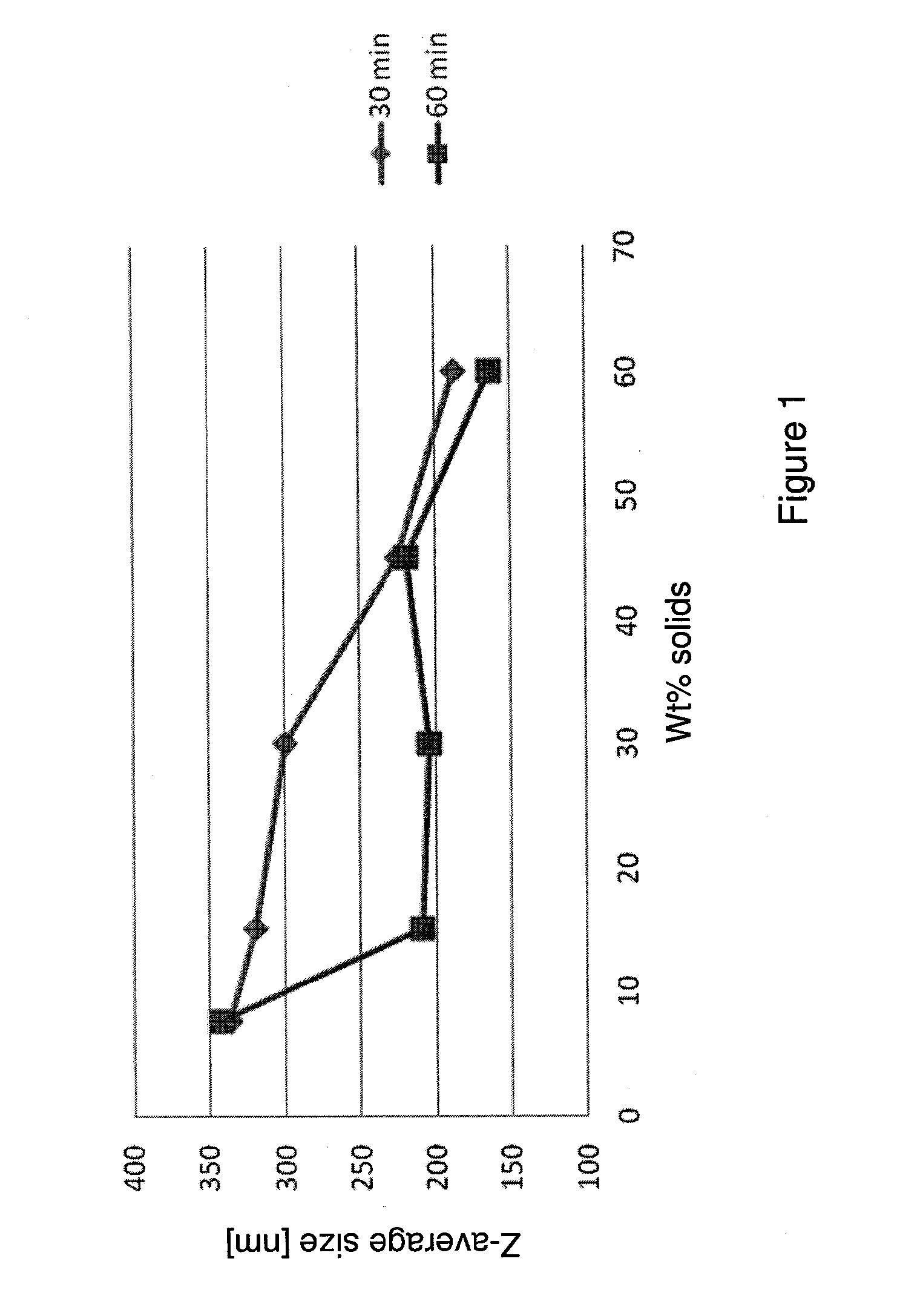
[0174]The particles obtained in Example 2 were further milled using 0.1 mm beads. The particle size decreased to 115 nm
example 4
[0175]75 g of Nickel formate were mixed with 7.5 g of a cationic polymer (MW=2000) with 67.5 g DPM (Dipropylene glycol methyl ether). Then, the mixture was bead milled (WAB) to obtain nickel formate nanoparticles.
example 5
Mixture of Copper and Nickel Precursor Particles Obtained by Bead Milling
[0176]37.5 g of Nickel formate and 37.5 g of copper formate were mixed with 7.5 g of a cationic polymer (MW=2000) with 67.5 g DPM (Dipropylene glycol methyl ether). Then the mixture was bead milled (WAB) to obtain copper and nickel formate NPs.
the structure of the environmentally friendly knitted fabric provided by the present invention; figure 2 Flow chart of the yarn wrapping machine for environmentally friendly knitted fabrics and storage devices; image 3 Is the parameter map of the yarn covering machine
Login to View More PUM
| Property | Measurement | Unit |
|---|---|---|
| temperature | aaaaa | aaaaa |
| temperature | aaaaa | aaaaa |
| mean particle size | aaaaa | aaaaa |
Login to View More
Abstract
Description
TECHNOLOGICAL FIELD[0001]The present invention is generally directed to novel ink formulations and uses thereof for producing conducting patterns.BACKGROUND[0002]In recent years, the synthesis of copper (Cu) nanoparticles has become of great importance from a scientific point of view as well as from an industrial point of view; due to its huge potential for replacing expensive nano-silver-based inks. Since the 1990s, many attempts have been made to synthesize nano-copper by wet chemistry processes, as well as by gas or solid phase methods. Among these are the sonochemical method, microemulsion techniques, polyol processes, radiation methods, thermal reduction, reducing flame synthesis, metal vapor synthesis, vacuum vapor deposition and chemical reduction in solution[1-3].[0003]Copper NPs can be mainly used in ink formulations for printing conductive patterns. Copper NPs based inks suffer from two main disadvantages: poor resistance to oxidation and high sintering temperatures. There...
Claims
the structure of the environmentally friendly knitted fabric provided by the present invention; figure 2 Flow chart of the yarn wrapping machine for environmentally friendly knitted fabrics and storage devices; image 3 Is the parameter map of the yarn covering machine
Login to View More Application Information
Patent Timeline
 Login to View More
 Patent Type & AuthorityApplications(United States)
IPC IPC(8): C09D11/52H01B13/00C08K5/098
CPCC09D11/52C08K5/098H01B13/0016H01B13/003H01B13/0026H05K1/097H05K2203/1131Y10T428/24909H01B1/22
InventorGROUCHKO, MICHAELMAGDASSI, SHLOMO
OwnerSINGAPORE ASAHI CHEM & SOLDER IND