Unlock instant, AI-driven research and patent intelligence for your innovation.

Method for removing copper and aluminum from an electrode material, and process for recycling electrode material from waste lithium-ion batteries

a technology of waste lithium-ion batteries and electrode materials, which is applied in the field of lithium-ion batteries, can solve the problems of ineffectiveness, ineffectiveness, and inability to achieve 100% effective initial isolation of purely cathode materials, and achieve the effect of practicality and efficiency

Active Publication Date: 2016-02-18
FARASIS TECH (GANZHOU) CO LTD
View PDF0 Cites 6 Cited by
  • Summary
  • Abstract
  • Description
  • Claims
  • Application Information

AI Technical Summary

Benefits of technology

The present invention provides a method for recycling and purifying electrode active materials from waste lithium-ion batteries. The method uses an aqueous solution that is corrosive to both copper and aluminum, but not to the transition-metal oxides typically used as electrode active materials. This allows for complete dissolution of copper and aluminum in the recycled material, while keeping the chemical and physical state of the electrode active material intact. The method is practical and efficient, providing a useful solution for waste management in the battery industry.

Problems solved by technology

In practice, the initial isolation of purely a cathode material would be both impractical and inefficient, or less that 100% effective.

Method used

the structure of the environmentally friendly knitted fabric provided by the present invention; figure 2 Flow chart of the yarn wrapping machine for environmentally friendly knitted fabrics and storage devices; image 3 Is the parameter map of the yarn covering machine
View more

Image

Smart Image Click on the blue labels to locate them in the text.
Viewing Examples
Smart Image
  • Method for removing copper and aluminum from an electrode material, and process for recycling electrode material from waste lithium-ion batteries
  • Method for removing copper and aluminum from an electrode material, and process for recycling electrode material from waste lithium-ion batteries
  • Method for removing copper and aluminum from an electrode material, and process for recycling electrode material from waste lithium-ion batteries

Examples

Experimental program
Comparison scheme
Effect test

example 1

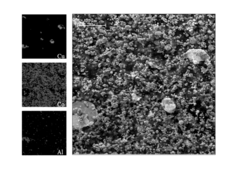
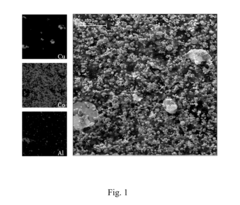
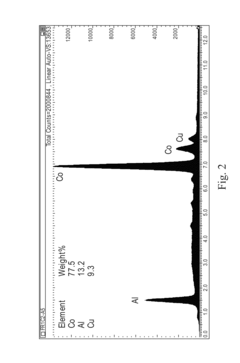
[0045]A slurry consisting of 90 wt. % ground LiCoO, cathode laminate, 5 wt. % aluminum powder, and 5 wt. % copper powder was mixed with polyvinylidene fluoride (PVDF) binder, and coated and dried as a thin film onto a stainless steel substrate. FIG. 1 shows an electron micrograph of a selected area of the electrode film before treatment, and X-ray elemental mapping showing the distribution of cobalt, aluminum and copper particles for the electrode film before treatment. FIG. 2 shows a spectrum of the X-ray elemental composition for the area shown in FIG. 1.

[0046]After the area had been mapped, the sample was placed in an aqueous solution comprising 5 mol / L NH4OH and 1 mol / L LiOH in deionized water, with the dissolved oxygen content maintained by aerating with oxygen gas, and having a pH value above 13. The sample was stirred and allowed to soak in the aqueous solution at room temperature for a period of 12 hours, and then was rinsed with deionized water and dried. The sample was aga...

example 2

[0047]To a beaker containing 10 g of aqueous 5 mol / L NH4OH and 1 mol / L LiOH in deionized water was added 0.2 g of a powder consisting of 90 wt. % ground LiCoO2 cathode laminate, 5 wt. % aluminum and 5 wt. % copper. The mixture was stirred at room temperature for 12 hours, then the solids were filtered and rinsed with deionized water and dried in a vacuum oven at 90° C. to remove any residual water. The obtained powder was mixed with acetylene black and PVDF to form a slurry, then coated onto aluminum foil to form a new cathode laminate. A coin cell was made comprising the cathode laminate, electrolyte, separator, and a lithium metal anode, and the coin cell was charged to 4.3V then discharged to 3.0V at a current of 0.15 mA. FIG. 5 shows the voltage curves for the first 10 cycles. And the result shows that the cycling performance of the recycled LiCoO2 is consistent with untreated LiCoO2. As can he seen from this example, the performance of the recycled electrode active material can...

the structure of the environmentally friendly knitted fabric provided by the present invention; figure 2 Flow chart of the yarn wrapping machine for environmentally friendly knitted fabrics and storage devices; image 3 Is the parameter map of the yarn covering machine
Login to View More

PUM

PropertyMeasurementUnit
Temperatureaaaaaaaaaa
Timeaaaaaaaaaa
Login to View More

Abstract

The present invention provides a method for removing copper and aluminum from an electrode material and a process for recycling electrode material from waste lithium-ion batteries. The method for removing copper and aluminum from the electrode material comprises: subjecting the electrode material containing electrode active material, copper and aluminum to reaction with an aqueous solution, wherein the aqueous solution has a pH value of higher than 10, and comprises base, oxidizing agent and complexing agent. The process for recycling electrode material from waste lithium-ion batteries comprises: a) harvesting an electrode material containing electrode active material, copper and aluminum from waste lithium-ion batteries; b) removing copper and aluminum from the electrode material according to the foresaid method; and c) further purifying and regenerating the electrode active material for reuse in new lithium-ion batteries. The present invention thus provides a practical and efficient method for recycling active materials from waste lithium-ion batteries.

Description

CROSS-REFERENCE TO RELATED APPLICATION[0001]This application claims priority to U.S. provisional patent application No. 62 / 036,932, filed on Aug. 13, 2014, entitled “Method for Removing Copper and Aluminum from Recycled Battery Electrodes”, which is specifically and entirely incorporated by reference.FIELD OF THE INVENTION[0002]The present invention relates to the field of lithium-ion batteries, and specifically to a method for removing copper and aluminum from an electrode material, and a process for recycling electrode material from waste lithium-ion batteries.BACKGROUND OF THE INVENTION[0003]Various methods exist for retrieving valuable components of “spent” lithium-ion secondary batteries in order to re-use the components in a recycled battery product. Specifically, the lithium-transition-metal oxides comprising the cathode active materials (e.g., LiCoO2, LiMn2O4, LiNiO2, LiNiCoO2, Li(LiNiCoMn)O2, and LiNiCoMnO2) are of particular value in any lithium-ion battery recycling proce...

Claims

the structure of the environmentally friendly knitted fabric provided by the present invention; figure 2 Flow chart of the yarn wrapping machine for environmentally friendly knitted fabrics and storage devices; image 3 Is the parameter map of the yarn covering machine
Login to View More

Application Information

Patent Timeline
no application Login to View More
IPC IPC(8): H01M10/54C22B3/00C22B7/00C22B26/12
CPCH01M10/54C22B23/04C22B26/12C22B7/006H01M4/525H01M10/0525C22B7/008C22B23/0446H01M10/052Y02E60/10Y02P10/20Y02W30/84
Inventor TSANG, FLORISHAILEY, PHILLIP
Owner FARASIS TECH (GANZHOU) CO LTD