
Method for producing arylpropenes
a technology of arylpropene and arylpropene, which is applied in the field of producing arylpropene, can solve the problems of insufficient cleavage of bis(methoxyphenyl)propanes, high cost of fragrance production from natural sources, and limited quantities thus obtainable, so as to achieve good product selectivity, reduce the formation of unwanted isomers, and reduce the formation of by-products
- Summary
- Abstract
- Description
- Claims
- Application Information
AI Technical Summary
Benefits of technology
Problems solved by technology
Method used
Image

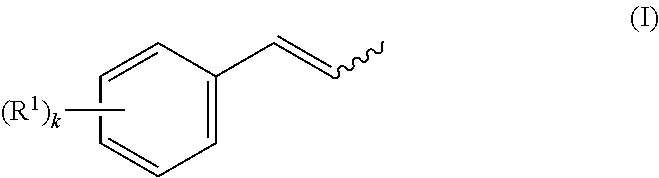
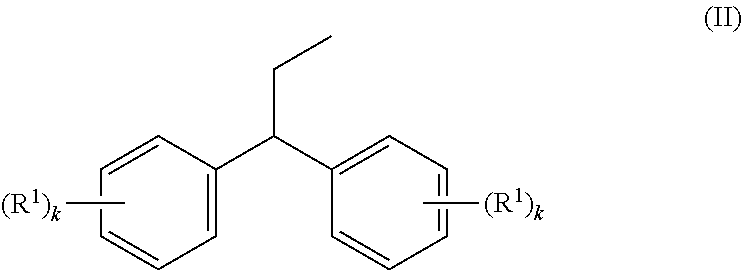
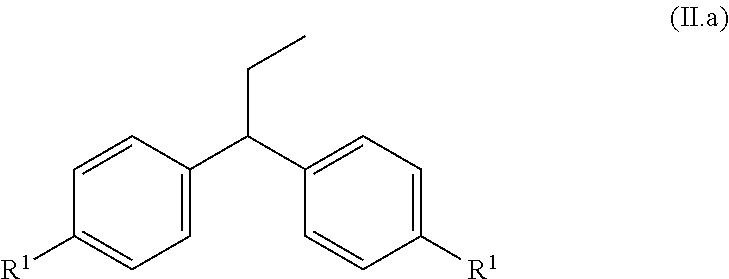
Examples
preparation examples
I) Preparation Examples
Preparation of 1-methoxy-4-(1-propenyl)benzene (anethole) from 1,1-bis(4-methoxy-phenyl)propane (examples 1-6)
[0052]Several cleavage experiments to cleave 1,1-bis(4-methoxyphenyl)propane (Dimer1) to anisole and anethole were conducted. The reactor used was a gas phase oven with an internal diameter of 4 cm and electric heating. The latter was filled first with quartz rings for a distance of 15 cm and then with catalyst strands having a strand diameter of 3 mm for a distance of 20 cm. The part of the gas phase oven filled with quartz rings serves as evaporator zone for the 1,1-bis(4-methoxyphenyl)propane supplied in trickle mode and any solvent added. The carrier gas used was nitrogen. The reaction product was condensed at a temperature of 5° C. in the bottom and in a downstream cooler. When a solvent was used, water in this case, it was run into the evaporator zone together with 1,1-bis(4-methoxyphenyl)propane in two separate feeds. The analysis of the organic...
PUM
| Property | Measurement | Unit |
|---|---|---|
| mol % | aaaaa | aaaaa |
| temperature | aaaaa | aaaaa |
| temperatures | aaaaa | aaaaa |
Abstract
Description
Claims
Application Information
 Login to View More