
Kinase inhibitors
a kinase inhibitor and inhibitor technology, applied in the field of kinase inhibitors, can solve the problems of high toxicity of inhibitors, hindering the utility of p38 map kinase inhibitors in the treatment of human chronic inflammatory diseases, and patient toxicity, and achieve good anti-inflammatory properties
- Summary
- Abstract
- Description
- Claims
- Application Information
AI Technical Summary
Benefits of technology
Problems solved by technology
Method used
Image

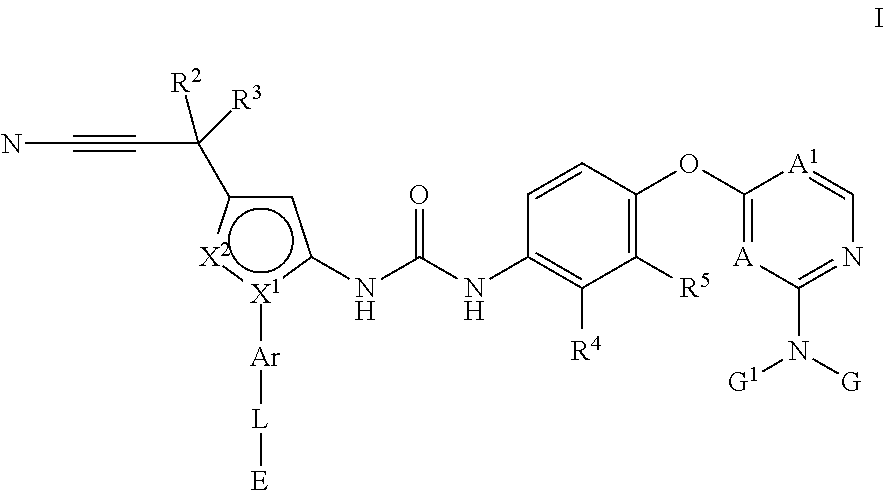
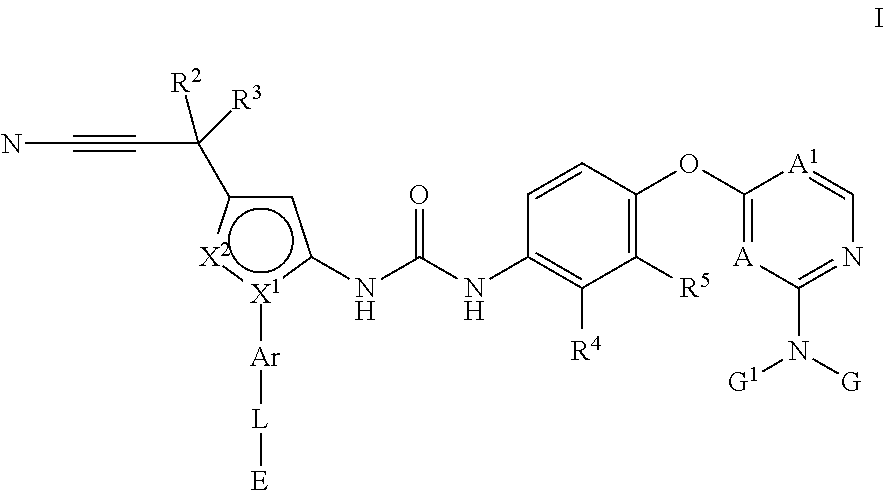
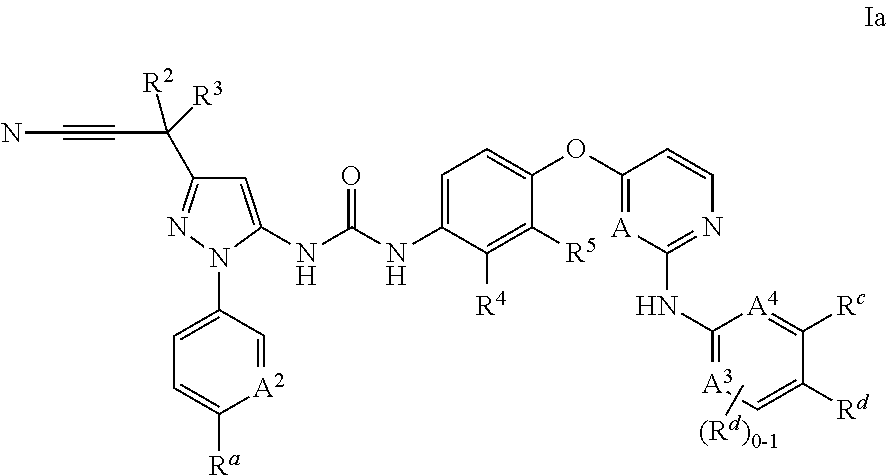
Examples
example 1
1-(3-(2-Methylbut-3-yn-2-yl)-1-(p-tolyl)-1H-pyrazol-5-yl)-3-(4-((2-(phenylamino)pyrimidin-4-yl)oxy)naphthalen-1-yl)urea
[0305]
(i) 4-((4-Aminonaphthalen-1-yl)oxy)-N-phenylpyrimidin-2-amine
[0306]p-TSA monohydrate (2.80 g, 14.72 mmol) was added to a stirred mixture of 4-((2-chloropyrimidin-4-yl)oxy)naphthalen-1-amine (see, for example, Cirillo, P. F. et al., WO 2002 / 92576, 21 Nov. 2000; 8 g, 29.4 mmol) and aniline (6.71 mL, 73.6 mmol) in THF (50 mL) at rt under N2. The mixture was heated under reflux for 2 h (reaction mixture solidified), a further 50 ml of THF was added and the mixture heated for a further 2 h. The mixture was cooled, diluted with THF (200 mL), the solid filtered and washed with THF (150 mL). The solid was suspended in DCM (100 mL) and 2M NaOH (35 mL) and the mixture stirred vigorously for 1 h, during which time the solid dissolved. The organic layer was separated, the aq. layer extracted with DCM (100 mL) and the organics combined, dried (MgSO4) and evaporated under r...
example 2
1-(4-((2-((7-Methyl-1H-indazol-5-yl)amino)pyrimidin-4-yl)oxy)naphthalen-1-yl)-3-(3-(2-methylbut-3-yn-2-yl)-1-(p-tolyl)-1H-pyrazol-5-yl)urea
[0316]
(i) Phenyl (4-((2-chloropyrimidin-4-yl)oxy)naphthalen-1-yl)carbamate
[0317]Phenyl chloroformate (2.65 ml, 21.06 mmol) was added to a stirred mixture of 4-((2-chloropyrimidin-4-yl)oxy)naphthalen-1-amine (see, for example, Cirillo, P. F. et al., WO 2002 / 92576, 21 Nov. 2000; 5.45 g, 20.06 mmol) and sodium bicarbonate (3.37 g, 40.1 mmol) in DCM (50 ml) and THF (20 ml) at rt. The mixture was stirred for 18 h then a further portion of phenyl chloroformate added (0.5 mL) and left for 2 h. The mixture was partitioned between DCM (300 mL) and brine (200 mL), the organic phase separated, dried (MgSO4) and evaporated under reduced pressure. The residue was triturated with ether / isohexane to give the sub-title compound (7.38 g) as a light pink solid.
[0318]1H NMR (DMSO-d6) 400 MHz, δ: 10.28 (s, 1H), 8.68 (d, 1H), 8.29 (d, 1H), 7.84 (d, 1H), 7.76 (d, 1H),...
example 3
1-(3-(2-Methylbut-3-yn-2-yl)-1-(p-tolyl)-1H-pyrazol-5-yl)-3-(4-((2-((2-oxoindolin-6-yl)amino)pyrimidin-4-yl)oxy)naphthalen-1-yl)urea
[0326]
[0327]To a solution of 1-(4-((2-chloropyrimidin-4-yl)oxy)naphthalen-1-yl)-3-(3-(2-methylbut-3-yn-2-yl)-1-(p-tolyl)-1H-pyrazol-5-yl)urea (see Example 2(ii) above; 254 mg, 0.473 mmol) in DMF (4 mL) and THF (2 mL) was added p-TSA monohydrate (90 mg, 0.473 mmol) followed by 6-aminoindolin-2-one (140 mg, 0.946 mmol) and the reaction heated at 60° C. for 22 h. The reaction mixture was partitioned between ethyl acetate (20 mL) and sat. aqueous sodium bicarbonate (10 mL). The organic layer was taken, dried over MgSO4, filtered and concentrated under reduced pressure to afford 150 mg of a brown solid. The MgSO4 was washed with 10% MeOH / DCM (50 mL) and the washings concentrated under reduced pressure to afford a pale yellow powder which was purified by chromatography on the Companion (12 g column, 0-10% MeOH in DCM) to afford the title compound (50 mg) as a...
PUM
| Property | Measurement | Unit |
|---|---|---|
| mass mean aerodynamic diameter | aaaaa | aaaaa |
| particle size | aaaaa | aaaaa |
| pH | aaaaa | aaaaa |
Abstract
Description
Claims
Application Information
 Login to View More