

Pore opened zeolite nanosheets and their suspensions and methods and uses related thereto
a pore-opening zeolite and nano-sheet technology, applied in the field ofpore-opening zeolite nano-sheets, can solve the problems of osda removal, lack of molecular sieve properties, and great challenge in 2d mfi zeolite without condensation of lamellar structure, and achieves simple processing, increased usefulness, and high yield
- Summary
- Abstract
- Description
- Claims
- Application Information
AI Technical Summary
Benefits of technology
Problems solved by technology
Method used
Image

Examples
Embodiment Construction
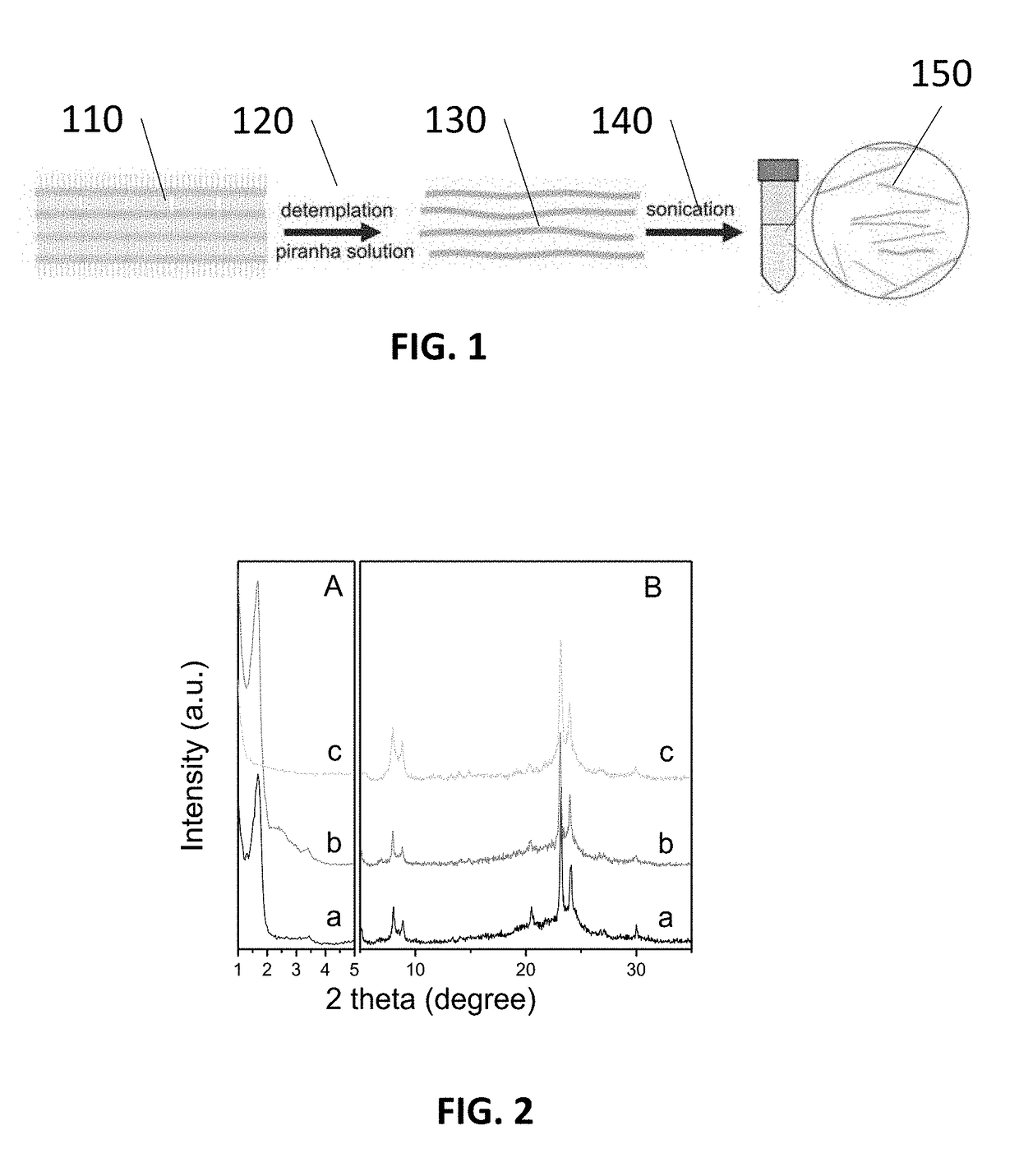
[0071]Referring to FIG. 1, solution-based methods to exfoliate multi-lamellar (ML) zeolites based on a detemplation-sonication sequence are disclosed. In a first step, a ML zeolite material (110) that includes an OSDA is first treated with a mixture of concentrated sulfuric acid and hydrogen peroxide (known as “piranha solution”) to remove the OSDA (120). The wet oxidation in a strong acid may avoid the condensation of nanosheets, which is dominant when detemplation takes place by calcination.
[0072]Afterwards, the OSDA-free zeolite (130) is placed in a suspension, which is treated with sonication (140) to obtain exfoliated 2D nanosheets (e.g., 1.5 unit-cell-thick) with basal size up to 1 pm (150) or more. Different from the polymer-melt-compounding technique, the detemplation-sonication method provides MFI nanosheets that are hydrophilic and can be dispersed in water.
[0073]A variety of techniques can be used to synthesize ML zeolites. Exemplary synthesis techniques for ML silicalite...
PUM
| Property | Measurement | Unit |
|---|---|---|
| thickness | aaaaa | aaaaa |
| thickness | aaaaa | aaaaa |
| thickness | aaaaa | aaaaa |
Abstract
Description
Claims
Application Information
 Login to View More