Check patentability & draft patents in minutes with Patsnap Eureka AI!

Preparation of peptide loaded plga microspheres with controlled release characteristics

Active Publication Date: 2017-10-05
PHARMATHEN
View PDF0 Cites 8 Cited by
  • Summary
  • Abstract
  • Description
  • Claims
  • Application Information

AI Technical Summary

Benefits of technology

The present invention relates to a method for preparing sustained-release PLGA microspheres containing peptide drugs, such as octreotide, using a single or double emulsion / solvent evaporation technique. The method controls the release of the peptide from the polymer matrix by controlling the temperature profile during the evaporation step. The resulting microspheres have a controlled release profile that can be correlated to the in vivo PK profile in rats. The method includes dissolving the peptide in a suitable solvent, mixing it with a polymer solution, and controlling the temperature during the evaporation step to control the release characteristics. The method can be used to prepare microspheres with different peptides, such as exenatide, leuprolide, goserelin, and teduglutide.

Problems solved by technology

Peptide drugs are usually administered systemically, e.g. parenterally due to their poor oral absorption and high instability in gastric fluids.
However, parenteral administration may be painful and cause discomfort, especially for repeated daily administrations.
A common drawback with injectable depot formulations is the fluctuation in plasma levels such as high peak levels which cause undesired pharmacological side reactions together with plasma levels close to zero during the entire release period.
A therapeutically relevant blood level over an extended period of time is difficult to achieve and satisfactory peptide release profiles are in practice only obtained in very few cases.
Few commercial long-acting release drug formulations of microspheres are available on the market.
The process is quite sensitive to polymer properties, and residual solvent is also an important issue.2. In spray-drying technique a polymer is dissolved in a volatile organic solvent such as dichloromethane or acetone.
Although the w / o / w microencapsulation technique seems to be conceptually simple to carry out, the particle formation process is quite complicated, and a host of process parameters are having an influence on or affect the properties of peptide / protein-loaded PLGA microspheres.

Method used

the structure of the environmentally friendly knitted fabric provided by the present invention; figure 2 Flow chart of the yarn wrapping machine for environmentally friendly knitted fabrics and storage devices; image 3 Is the parameter map of the yarn covering machine
View more

Image

Smart Image Click on the blue labels to locate them in the text.
Viewing Examples
Smart Image
  • Preparation of peptide loaded plga microspheres with controlled release characteristics
  • Preparation of peptide loaded plga microspheres with controlled release characteristics
  • Preparation of peptide loaded plga microspheres with controlled release characteristics

Examples

Experimental program
Comparison scheme
Effect test

example 1a-c (

Single Emulsion)

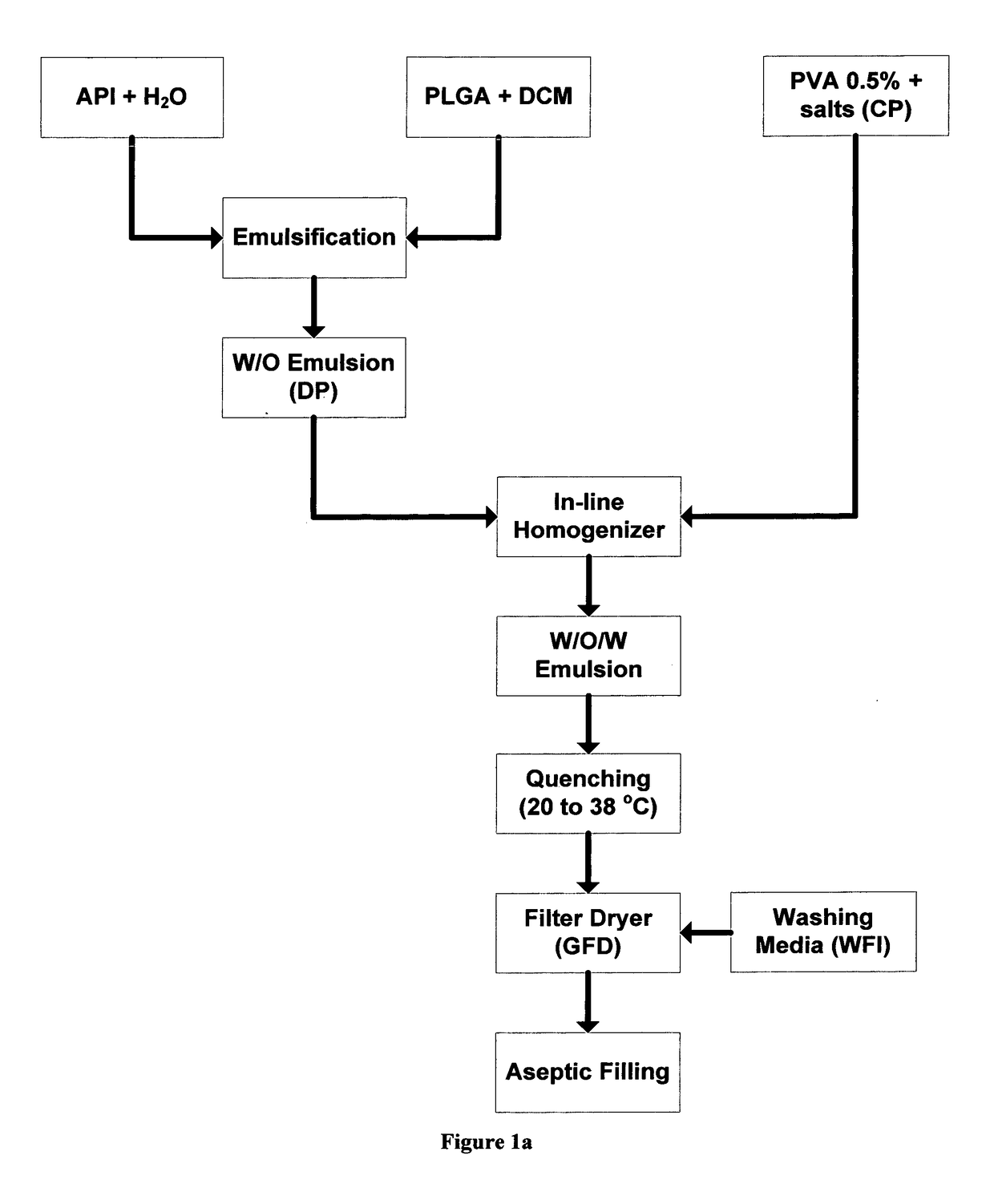
[0073]4 g of poly(D,L-lactide-co-glycolide) with a molar ratio of 50:50 (Mw=41,000 and polydispersity ca 1.65), commercially available from PURAC under the name PURASORB 5004A, was dissolved in 30 g of dichloromethane with magnetic stirring. The polymer solution is cooled down to 5° C. 0.2941 g of octreotide acetate was dissolved in 0.5882 g of water for injection with mixing. The octreotide acetate solution was added to the polymer solution and emulsified by mean of an Ultra Turrax® for 1 minute at 20,000 rpm to form the first emulsion (DP-dispersed phase). 11.5 g of poly(vinyl alcohol) EMROVE® 18-88 by Merck were dissolved in 2307 g of water for injection at 80° C. followed by the addition of 17.46 g of disodium hydrogen phosphate and 4.18 g of potassium dihydrogen phosphate. The solution was cooled down to 5° C. forming the continuous phase (CP). Microspheres of the desired particle size distribution were prepared by delivering the CP at 2.3 L / min and the DP at 15...

example 2a-c (

Double Emulsion)

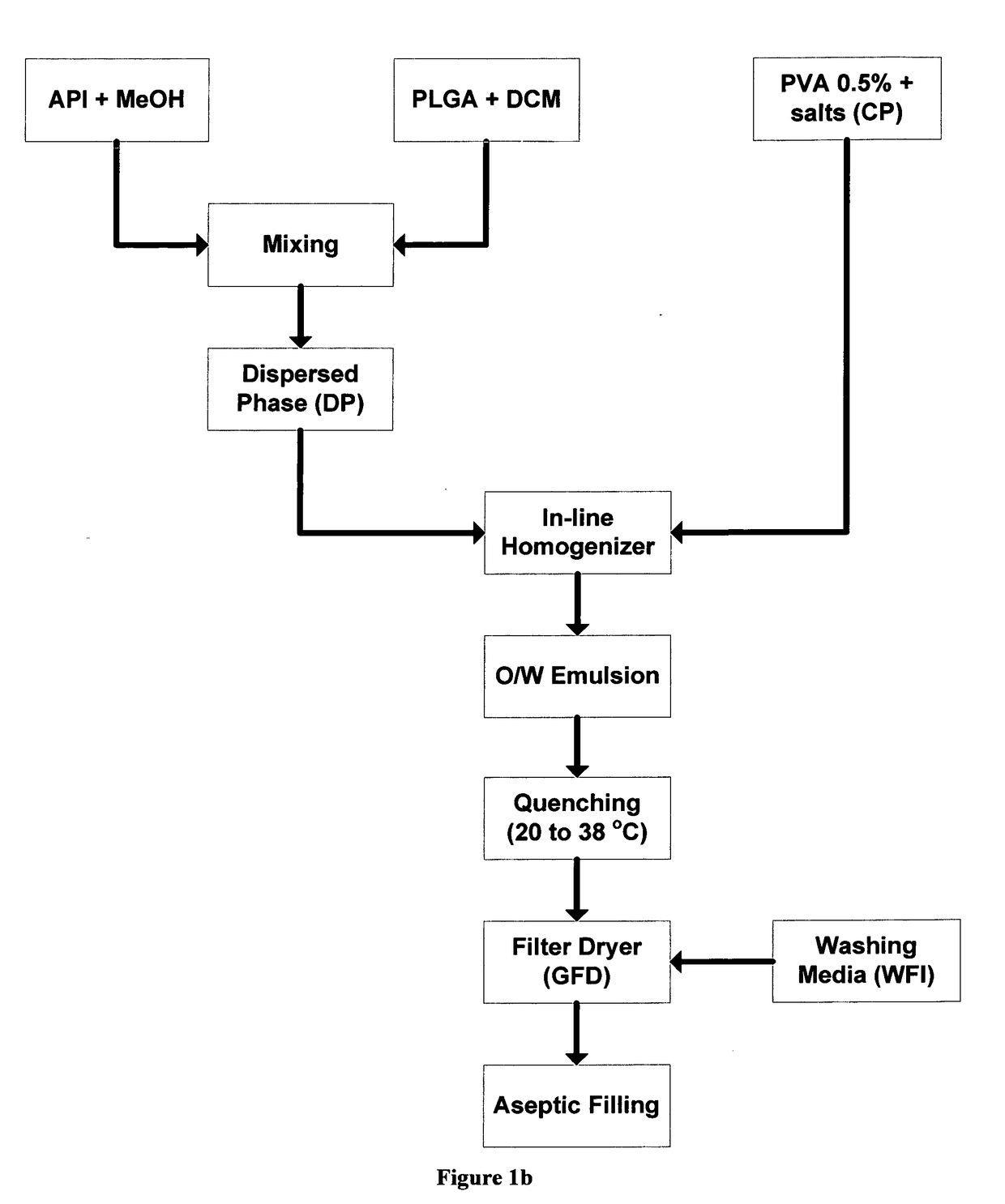
[0074]4 g of poly(D,L-lactide-co-glycolide) with a molar ratio of 50:50 (Mw=41,000 and polydispersity ca 1.65), commercially available from PURAC under the name PURASORB 5004A, was dissolved in 30 g of dichloromethane with magnetic stirring. The polymer solution is cooled down to 5° C. The polymer solution is sterilized by filtration through a syringe filter and cooled down to 5° C. 0.2941 g of octreotide acetate was dissolved in 2.941 g of methanol with mixing. The octreotide acetate solution was added to the polymer solution and mixed with stirring to form the oil phase (DP-dispersed phase). 11.5 g of poly(vinyl alcohol) EMROVE® 18-88 by Merck were dissolved in 2307 g of water for injection at 80° C. followed by the addition of 17.46 g of disodium hydrogen phosphate and 4.18 g of potassium dihydrogen phosphate. The solution was cooled down to 5° C. forming the continuous phase (CP). Microspheres of the desired particle size distribution were prepared by delivering ...

the structure of the environmentally friendly knitted fabric provided by the present invention; figure 2 Flow chart of the yarn wrapping machine for environmentally friendly knitted fabrics and storage devices; image 3 Is the parameter map of the yarn covering machine
Login to View More

PUM

PropertyMeasurementUnit
Temperatureaaaaaaaaaa
Login to View More

Abstract

A novel process for the preparation of a long acting injectable composition based on biodegradable poly(D,L-lactide-co-glycolide) microspheres comprising peptide active pharmaceutical ingredients.

Description

TECHNICAL FIELD OF THE INVENTION[0001]The present invention relates to preparation of biodegradable poly(D,L-lactide-co-glycolide) “PLGA” microspheres comprising peptide active pharmaceutical ingredients and how to achieve controlled release characteristics. In particular, the present invention relates to emulsion solvent extraction / evaporation method where the release of peptide from the polymer matrix is controlled by the temperature profile during the solvent evaporation step.BACKGROUND OF THE INVENTION[0002]Peptide drugs are usually administered systemically, e.g. parenterally due to their poor oral absorption and high instability in gastric fluids. However, parenteral administration may be painful and cause discomfort, especially for repeated daily administrations. In order to minimize the number of injections to a patient, the drug substance is advantageously administered as a depot formulation. The parenteral administration of peptide drugs as a depot formulation in a biodegr...

Claims

the structure of the environmentally friendly knitted fabric provided by the present invention; figure 2 Flow chart of the yarn wrapping machine for environmentally friendly knitted fabrics and storage devices; image 3 Is the parameter map of the yarn covering machine
Login to View More

Application Information

Patent Timeline
no application Login to View More
IPC IPC(8): A61K9/16A61K9/00A61K38/31
CPCA61K9/1647A61K9/0019A61K38/31A61K9/1694A61P1/00A61P1/12A61P5/02A61P5/06A61P9/00A61K31/00
Inventor KARAVAS, EVANGELOSKOUTRIS, EFTHYMIOSMINIOTI, KATERINACHAITIDOU, SOTIRIAPAPANIKOLAOU, GEORGIAMANTOURLIAS, THEOFANIS
Owner PHARMATHEN
Features
  • R&D
  • Intellectual Property
  • Life Sciences
  • Materials
  • Tech Scout
Why Patsnap Eureka
  • Unparalleled Data Quality
  • Higher Quality Content
  • 60% Fewer Hallucinations
Social media
Patsnap Eureka Blog
Learn More