Unlock instant, AI-driven research and patent intelligence for your innovation.

Method

Active Publication Date: 2020-06-04
JOHNSON MATTHEY PLC
View PDF0 Cites 0 Cited by
  • Summary
  • Abstract
  • Description
  • Claims
  • Application Information

AI Technical Summary

Benefits of technology

The patent describes a method of modifying the surface of a molecular sieve by reacting it with an aminosilane in an aqueous solvent. This reaction can be carried out by coating a substrate with a washcoat containing the modified molecular sieve and drying / calcing it. The modified molecular sieve can also be used in catalyst articles for the treatment of exhaust gas. The technical effect of the invention is the improvement of the properties of molecular sieve materials for use in various applications.

Problems solved by technology

This addition of a milling step, however, increases the time and difficulty of preparing molecular sieve-containing washcoat formulations.
The requirement for a milling step in a process can also introduce an undesirable amount of variability in the final product, as it can be difficult to quantify the end point for a milling process.

Method used

the structure of the environmentally friendly knitted fabric provided by the present invention; figure 2 Flow chart of the yarn wrapping machine for environmentally friendly knitted fabrics and storage devices; image 3 Is the parameter map of the yarn covering machine
View more

Image

Smart Image Click on the blue labels to locate them in the text.
Viewing Examples
Smart Image
  • Method
  • Method
  • Method

Examples

Experimental program
Comparison scheme
Effect test

example 1

[0127]A commercially available zeolite with a Chabazite structure and comprising about 3wt % copper was dispersed in water at a concentration of 30 wt % as measured by total solids. To this a commercially available solution of 30 wt % of 3-aminopropylsilane hydrolysate in water was added. The concentration of 3-aminopropylsilane hydrolysate solution was 1% by dry weight of zeolite solids. If needed, the pH of the reaction mixture was adjusted using acetic acid targeting a range of 4 to 6. Without wishing to be bound by theory, it is thought that this causes an irreversible deposition of aminosilane moiety on the surface of the zeolite.

[0128]As the surface of the zeolite was modified with an amine, a change in the isoelectric point of the system can be measured. The isoelectric point is defined as the pH at which the surface charge of the zeolite is zero. This measurement is done by adding 200 microliters of a slurry comprising the modified zeolite in 200 mL of deionized water and st...

example 2

[0130]As in Example 1, a commercially available zeolite with a Chabazite structure and comprising about 3 wt % copper was dispersed in water at a concentration of 30 wt % as measured by total solids. To this a commercially available solution of 30 wt % of 3-aminopropylsilane hydrolysate in water was added. The concentration of 3-aminopropylsilane hydrolysate solution was 1% by dry weight of zeolite solids. If needed, the pH of the reaction mixture was adjusted using acetic acid targeting a range of 4 to 6. As the surface of the zeolite has now been modified to an amine surface, this allows for conventional dispersants to be attached. Xyndisp XA168D is a functional polymer sold by Xyntra BV as a dispersant, which possesses acrylic groups that are able to interact with the amines on the zeolite. Using electrostatic interaction between the functional polymer and the modified zeolite, a more robustly dispersed system can be created using electro-steric stabilization. To the modified zeo...

example 3

[0132]Unmilled zeolites were used to coat filter substrates using the method of surface modification followed by polymer addition. The surface modified zeolites were prepared according to the following method. As in Example 1 and 2, a commercially available zeolite but with a AEI structure and comprising 3.75wt % copper was dispersed in water at a concentration of 30 wt % as measured by total solids. To this a commercially available solution of 30 wt % of 3-aminopropylsilane hydrolysate in water was added. The concentration of 3-aminopropylsilane hydrolysate solution was 1% by dry weight of zeolite solids. If needed, the pH of the reaction mixture was adjusted using acetic acid targeting a range of 4 to 6. To this washcoat a commercially available binder was added. The concentration of the binder is calculated to be 11% by weight with respect to dry zeolite solids. Final solids concentration was adjusted to 35.5% by weight using water addition. To this zeolite-binder slurry, 5 wt % ...

the structure of the environmentally friendly knitted fabric provided by the present invention; figure 2 Flow chart of the yarn wrapping machine for environmentally friendly knitted fabrics and storage devices; image 3 Is the parameter map of the yarn covering machine
Login to View More

PUM

PropertyMeasurementUnit
Percent by volumeaaaaaaaaaa
Login to View More

Abstract

A method for modifying the surface of a molecular sieve, comprising reacting a molecular sieve with an aminosilane, wherein the reaction is carried out in an aqueous solvent. A modified molecular sieve obtained by the method is also described.

Description

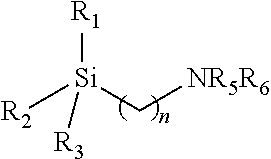
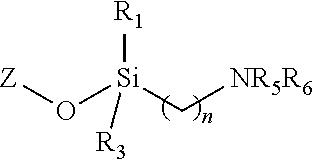
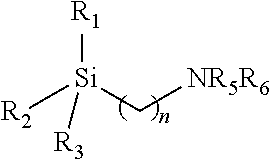
FIELD OF THE INVENTION[0001]The invention relates to a method for modifying the surface of a molecular sieve. The invention also relates to modified molecular sieves obtained or obtainable by such a method, a washcoat, a method of forming a catalyst article, and catalyst articles obtained or obtainable by such a method.BACKGROUND OF THE INVENTION[0002]Known SCR (selective catalytic reduction) catalysts include molecular sieves. Useful molecular sieves include crystalline or quasi-crystalline materials which can be, for example aluminosilicates (zeolites) or silicoaluminophosphates (SAPOs). Such molecular sieves are constructed of repeating SiO4, AlO4, and optionally PO4 tetrahedral units linked together, for example in rings, to form frameworks having regular intra-crystalline cavities and channels of molecular dimensions. The specific arrangement of tetrahedral units (ring members) gives rise to the molecular sieve's framework, and by convention, each unique framework is assigned a...

Claims

the structure of the environmentally friendly knitted fabric provided by the present invention; figure 2 Flow chart of the yarn wrapping machine for environmentally friendly knitted fabrics and storage devices; image 3 Is the parameter map of the yarn covering machine
Login to View More

Application Information

Patent Timeline
no application Login to View More
IPC IPC(8): C01B39/02B01J37/02B01J29/70B01J29/76B01J29/74B01J37/08F01N3/20
CPCB01J2229/32B01J29/7015B01J37/0236C01B39/026B01J37/0219F01N2370/04B01J29/763B01J37/08F01N3/2066B01J29/743B01D53/9418B01J29/76B01J37/0246B01J23/44B01J37/038B01J2229/34B01J37/0009B01J2229/12B01J29/74B01J23/42B01D2255/50B01D2255/20761B01D2255/1021B01D2255/1023B01D2258/012B01J20/186B01J29/70
Inventor KILMARTIN, JOHNSANKARAN, ASHWINTHOMPSETT, DAVID
Owner JOHNSON MATTHEY PLC
Features
  • R&D
  • Intellectual Property
  • Life Sciences
  • Materials
  • Tech Scout
Why Patsnap Eureka
  • Unparalleled Data Quality
  • Higher Quality Content
  • 60% Fewer Hallucinations
Social media
Patsnap Eureka Blog
Learn More