
Solid-state charge detector
- Summary
- Abstract
- Description
- Claims
- Application Information
AI Technical Summary
Benefits of technology
Problems solved by technology
Method used
Image

Examples
Embodiment Construction
[0036]Reference will now be made to the drawings in which the various embodiments of the present invention will be discussed so as to enable one skilled in the art to make and use the invention. It is to be understood that the following description illustrates embodiments of the present invention and should not be viewed as narrowing the claims which follow.
[0037]To introduce the improvement over the prior art of charge detection, it is useful to understand the areas in which greatest improvement is achieved. In the context of IDELs, there may be three common barriers to ideal charge detector performance.
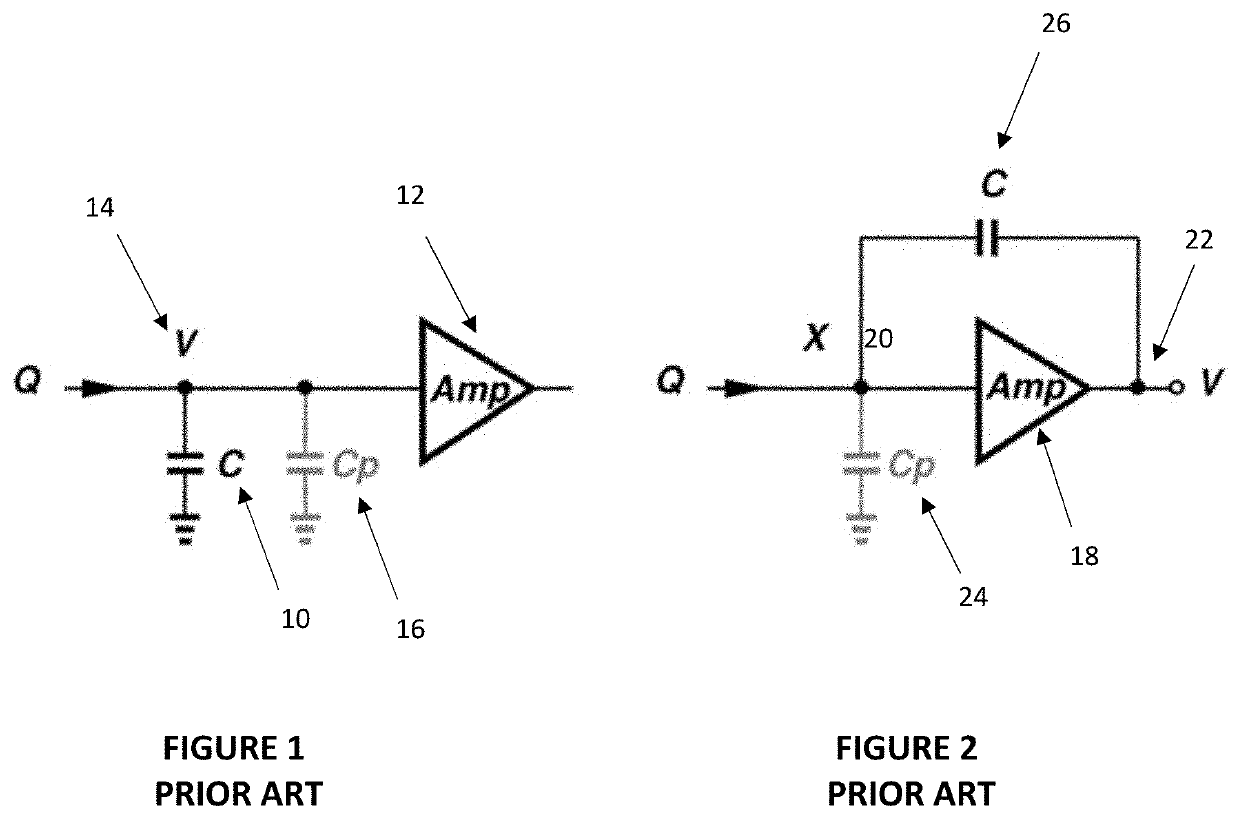
[0038]First, many amplifier circuits utilize a feedback capacitor to “collect” the incoming charge. It may be desirable to minimize the feedback capacitance so as to maximize the output voltage to thereby obtain a good signal-to-noise ratio (SNR). However, discrete capacitors available commercially are generally 0.1 pF or larger with impractically large specification tolerances of u...
PUM
 Login to View More
 Abstract
Description
Claims
Application Information
 Login to View More