
Improved process for extraction of cholesterol from fish oil waste residue
a technology for extracting cholesterol and waste residues, which is applied in the field of improving the extraction process of cholesterol from fish oil waste residues, can solve the problems of large volume of solvents, cumbersome and costly extraction process of cholesterol, and multi-step cumbersome solvent extraction process
- Summary
- Abstract
- Description
- Claims
- Application Information
AI Technical Summary
Benefits of technology
Problems solved by technology
Method used
Image

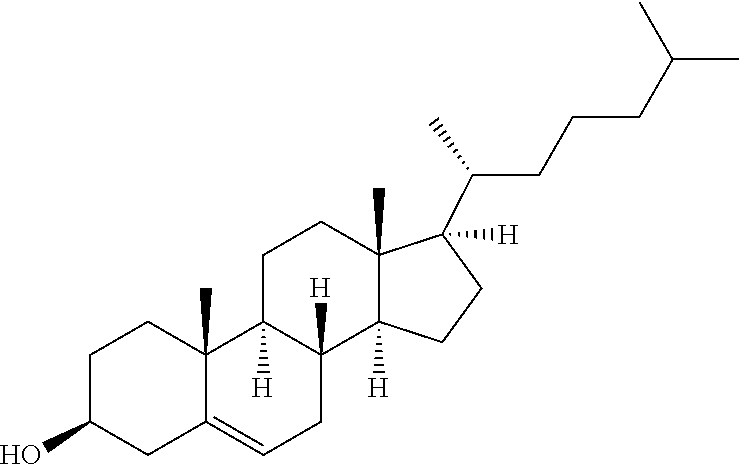
Examples
example 1
ol from Fish Oil
[0034]400 gms of Fish oil waste product (containing 0.4-0.6 gm cholesterol (free and ester form) per gm of fish oil waste product) was suspended in 400 ml of methanol. 40 gms of sodium hydroxide and 1 gm of 4-dimethylamino pyridine were added and the reaction mass was refluxed for 1 hour. After 1 hour, methanol was distilled at 70-75° C. At 75° C. 600 ml of 25% sulphuric acid and 300 ml of water were added. 600 ml of 2-butanone was added and the reaction mass was stirred for 30 minutes at 75° C. The organic and the aqueous layers were separated. The organic layer was washed with 3×100 ml of saturated salt solution. 2-butanone was evaporated at 90-95° C.
[0035]Further, 800 ml of 2-butanone was added to the above reaction mass, cooled to 65-70° C. 190 gms of calcium bromide was added and the reaction was heated at 65-70° C. for 8 hours. The reaction was cooled to 30° C., filtered, washed with 100 ml of 2-butanone. The solid residue was suspended in 600 ml of methanol, r...
PUM
 Login to View More
 Abstract
Description
Claims
Application Information
 Login to View More