Microfluidic viscometer and assembly, and methods using the same
a microfluidic and viscometer technology, applied in the field of viscometers, can solve the problems of high volume, high cost, and high cost of users, and achieve the effects of low throughput, high cost, and high cos
- Summary
- Abstract
- Description
- Claims
- Application Information
AI Technical Summary
Benefits of technology
Problems solved by technology
Method used
Image



Examples
example 1
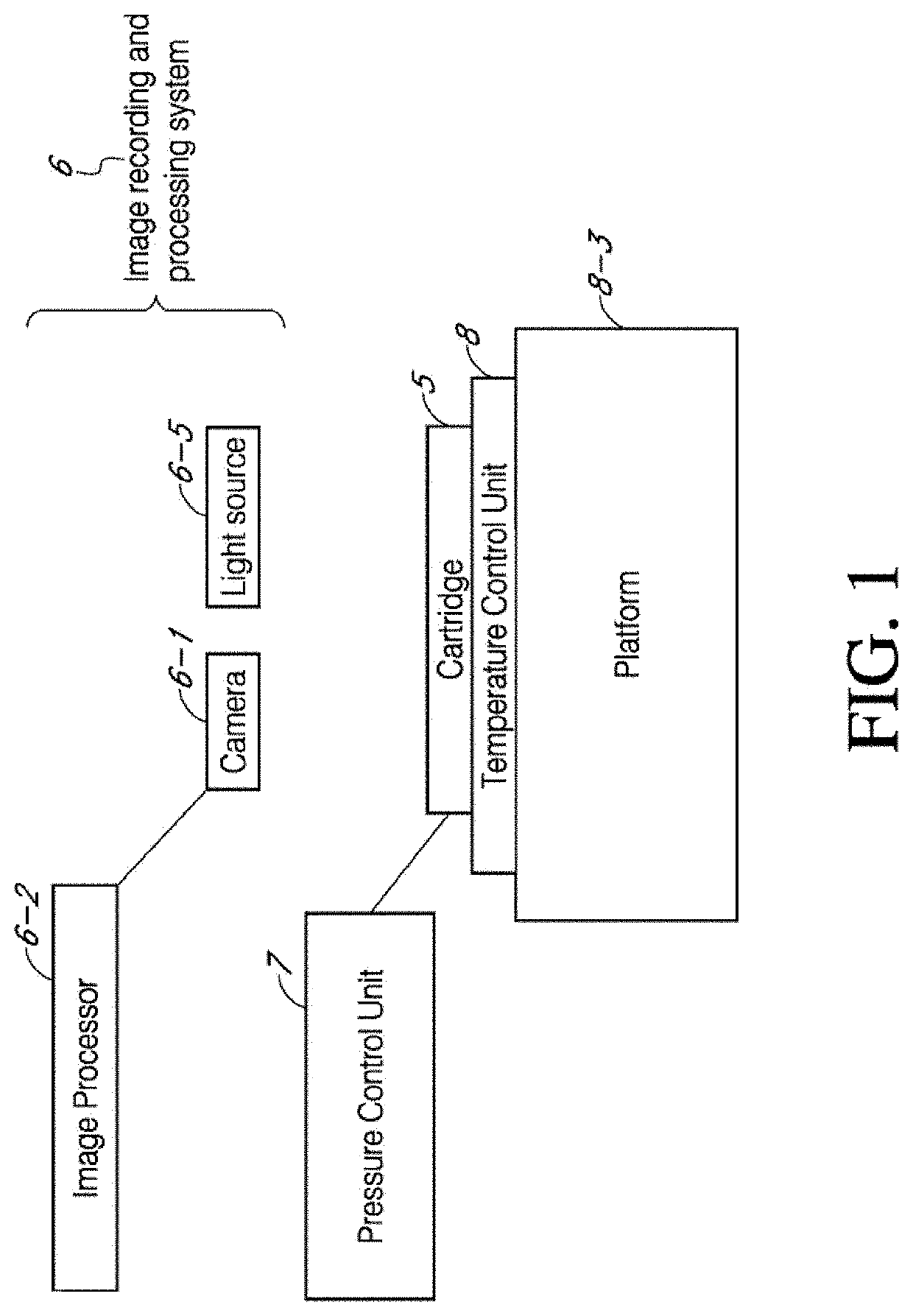
[0101]In one cartridge iteration (“Cartridge 1”, illustrated in FIG. 2A), a first channel section (1), also called a “small section”, was in fluid communication with an inlet at one end and a second channel section (2), also called a large section, at its other end. This cartridge was tested using a system as shown in FIG. 16A (called NeoVisc in this Example). In this embodiments, the first channel section had a height of about 30 um (i.e., 27-33 um), a width of about 500 um (i.e., 494-501 um), and a length of about 1 cm (i.e., 0.97 cm); the h / w aspect ratio of this exemplary microfluidic circuit was 0.06. The second channel section had a height and width of about 1000 um (i.e., height: 910-960 um and width: 980-1100 um), and a length of about 3 cm (i.e., 2.7 cm). The inlet and outlet holes were both 5 mm in diameter. Between 10 and 30 uL of fluid was loaded into the cylindrical inlet of the cartridge. In this illustrative embodiment, the fluid experiences capillary effec...
example 2
[0103]In another cartridge iteration (Cartridge 2; illustrated in FIG. 2B), the microfluidic channels included three sections: a first channel section (1), also called a small section, providing the majority of the resistance encountered by the fluid as it moved through the microfluidic circuit positioned between two larger channels, a first large channel section (2B-1), also called a first large section, and a third channel section (2B-2), sometimes called a second large channel section, sharing equal geometries and producing less resistance to the fluid than the first channel section. This cartridge was tested using a system as shown in FIG. 16A (called NeoVisc in this Example). In each of the microfluidic circuits tested here, the first channel section (1) had a height of about 30 um (i.e., 30-32 um), a width of about 500 um (i.e., 498-504 um), and a length of about 1 cm (i.e., 0.99 cm); the h / w aspect ratio of this exemplary microfluidic circuit was 0.06. And the two ...
PUM
| Property | Measurement | Unit |
|---|---|---|
| voltage | aaaaa | aaaaa |
| viscosity | aaaaa | aaaaa |
| length | aaaaa | aaaaa |
Abstract
Description
Claims
Application Information
 Login to View More
 - R&D
- Intellectual Property
- Life Sciences
- Materials
- Tech Scout
- Unparalleled Data Quality
- Higher Quality Content
- 60% Fewer Hallucinations
Browse by: Latest US Patents, China's latest patents, Technical Efficacy Thesaurus, Application Domain, Technology Topic, Popular Technical Reports.
© 2025 PatSnap. All rights reserved.Legal|Privacy policy|Modern Slavery Act Transparency Statement|Sitemap|About US| Contact US: help@patsnap.com