[0017]Note that one of the chambers could have the same combination of volume and associated total aperture area as another, for example to reinforce damping at a particular noise frequency. Typically, each chamber has an optimum sound
absorption frequency, preferably not less than 500 Hz, more preferably not less than 1500 Hz and preferably not higher than 8000 Hz, more preferably not higher than 5000 Hz. This is particularly suitable for suppression of turbo noise in an engine.
[0029]Preferably, the suppressor includes a spacer located at a gap between inner walls of adjacent modular portions. Preferably, the spacer is attachable to an end of the inner wall of one modular portion. Spacers of different axial lengths may be used. In this way, the area of the gap between inner walls of adjacent modular portions can be closed off to give a selected effective total aperture area.
[0031]The spacer may be attached to opposing faces of adjacent inner walls, for example in the case where the side walls of the modular portions are not located at either extremity of the inner walls. This has the
advantage that the inner walls can be secured to each other by ensuring that both inner walls make a tight fit with the spacer. This may reduce mechanical vibration of the free ends of the inner walls, such as may be caused by air flow or other vibration-causing sources. It may reduce
distortion of the free ends of the inner walls, for example due to temperature and / or long term loads, causing
creep, for example. In this case, the axial projections may extend across the
axial length of the spacer, so that in effect the spacer preferably forms a spacing collar between the opposing faces of adjacent inner walls, with mounting surfaces adapted to attach to the adjacent inner walls, the spacer having radial holes, slots or slits formed in it, between the axial projections. Again, the effective area of the aperture would then be controlled by the total area of apertures formed in the spacer.
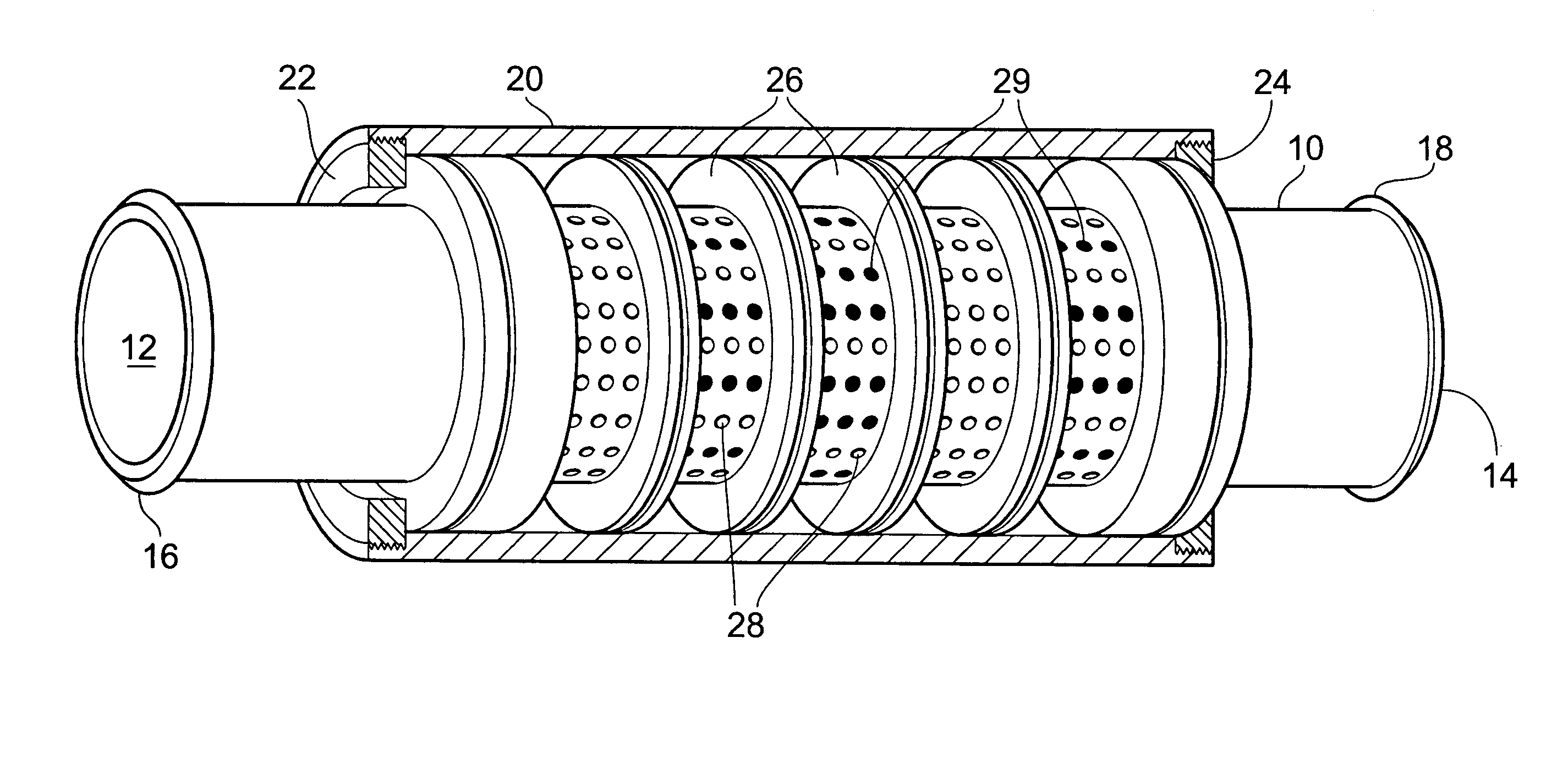
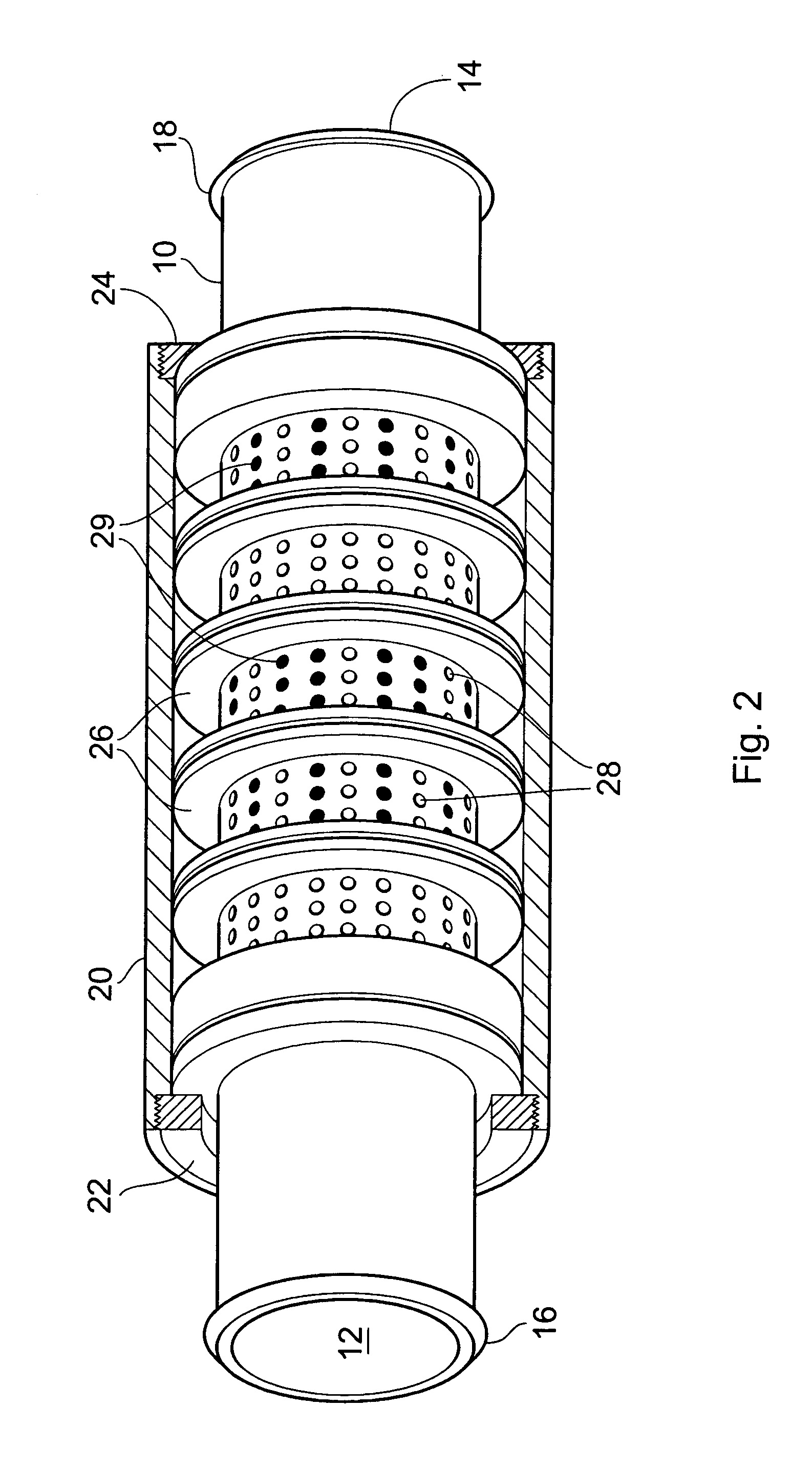
[0067]A preferred feature of the first development of the invention was the location of the modular noise suppressor within a hose. The inventors have realised that the use of a modular noise suppressor within a hose is advantageous even when the chambers are wholly contained within respective modular portions. This constitutes a second, independent development of the present invention, in which it is not necessary that each suppression chamber is bounded by parts of two of said modular portions.
[0069]The disposition of a noise suppressor within a hose reduces the mechanical demands on the noise suppressor. Firstly, the noise suppressor need not be gas-tight since the hose can define a gas-tight envelope around the noise suppressor. In use, it can be a part of the hose, rather than a part of the noise suppressor, which is attached to a noise source. Typically, this noise source is part of an engine, such as an inlet or outlet of a turbo. Such connection is usually achieved using a clip or clamp, such as a jubilee-type clip. In order to maintain connection during operation, the clamping pressures used are usually high. For this reason, no noise suppressors were usually of rugged construction, typically made of
metal. In this second development, the noise suppressor need not be so rugged since the clamping pressures can be withstood instead by the hose. For this reason, it is practicable to construct the noise suppressor from plastics materials which would not be able to withstand the clamping pressures as described above. The advantages of these materials include ease of forming (e.g. by
injection moulding) which require little or no
machining after forming to arrive at a desired shape.
[0088]Preferably, in this fifth development, the present invention provides a hose arrangement including a hose wall and an inner
mass arranged in the space enclosed by the hose wall and / or the inner bore of a turbo inlet or outlet, the inner mass being separated from the interior of the hose wall or bore by resilient means so that the inner mass has a
rest position towards which the resilient means urges the inner mass, the hose wall or bore and the inner mass being moveable relative to each other against the urging of the resilient means by a vibrational force, thereby to dampen the vibration. The inner mass may be wholly within the hose, partially within the hose and partially within the inner bore of the turbo inlet or outlet, or wholly within that hose.


 Login to View More
  Login to View More