Check patentability & draft patents in minutes with Patsnap Eureka AI!

Semiconductor storage device

a storage device and semiconductor technology, applied in the direction of information storage, static storage, digital storage, etc., can solve the problems of inability to start the read operation, the inability to perform the read/write operation in parallel, and the inability to perform the read operation in parallel. , to achieve the effect of low current consumption and high speed

Inactive Publication Date: 2006-05-16
NEC ELECTRONICS CORP
View PDF5 Cites 5 Cited by
  • Summary
  • Abstract
  • Description
  • Claims
  • Application Information

AI Technical Summary

Benefits of technology

This solution reduces current consumption in stand-by mode and minimizes wait times for read / write operations, enhancing overall performance and efficiency by synchronizing refresh operations with the internal clock signal while preventing hazards in the internal clock signal.

Problems solved by technology

It is impossible to perform the refresh operation and the read / write operation in parallel.
In a general DRAM cell array, it is impossible to perform a sequence of operations of word selection, destructive data reading, data amplification, data writing, and word unselection in parallel on one area.
Thus, the read operation cannot be started until the refresh operation ends.
As described above, the conventional semiconductor storage device shown in FIG. 15 has a problem that, when performing the read operation after the refresh operation, there can be a considerable wait time before starting the read operation depending on timing to start the refresh operation.
However, such semiconductor storage devices as shown in FIG. 15 are incapable of the high speed operation since the start of the read operation delays due to the refresh operation.
The synchronized semiconductor storage device shown in FIG. 17, however, has a problem that the higher speed operation by the synchronization causes an increase in current consumption in stand-by mode.
Though the semiconductor storage device of FIG. 17 allows the high speed operation, it has high power consumption, as described above.
This conventional technique, however, has the following problem.
Though this semiconductor storage device can stop the supply of the clock signal to the address input buffer and the data input buffer in data retention mode, it cannot stop the supply of the clock signal to the command input buffer since it is necessary to perform the refresh operation in the data retention mode, requiring the command for controlling the refresh operation.
Thus, a certain amount of current is consumed in the data retention mode.
However, this structure causes delay in receiving the command when shifting from the data retention mode to the normal operation mode, as described in DATA SHEET ELPIDA 128 M bits Mobile RAM Document No.
Consequently, the read operation delays to impede high speed operations.

Method used

the structure of the environmentally friendly knitted fabric provided by the present invention; figure 2 Flow chart of the yarn wrapping machine for environmentally friendly knitted fabrics and storage devices; image 3 Is the parameter map of the yarn covering machine
View more

Image

Smart Image Click on the blue labels to locate them in the text.
Viewing Examples
Smart Image
  • Semiconductor storage device
  • Semiconductor storage device
  • Semiconductor storage device

Examples

Experimental program
Comparison scheme
Effect test

first embodiment

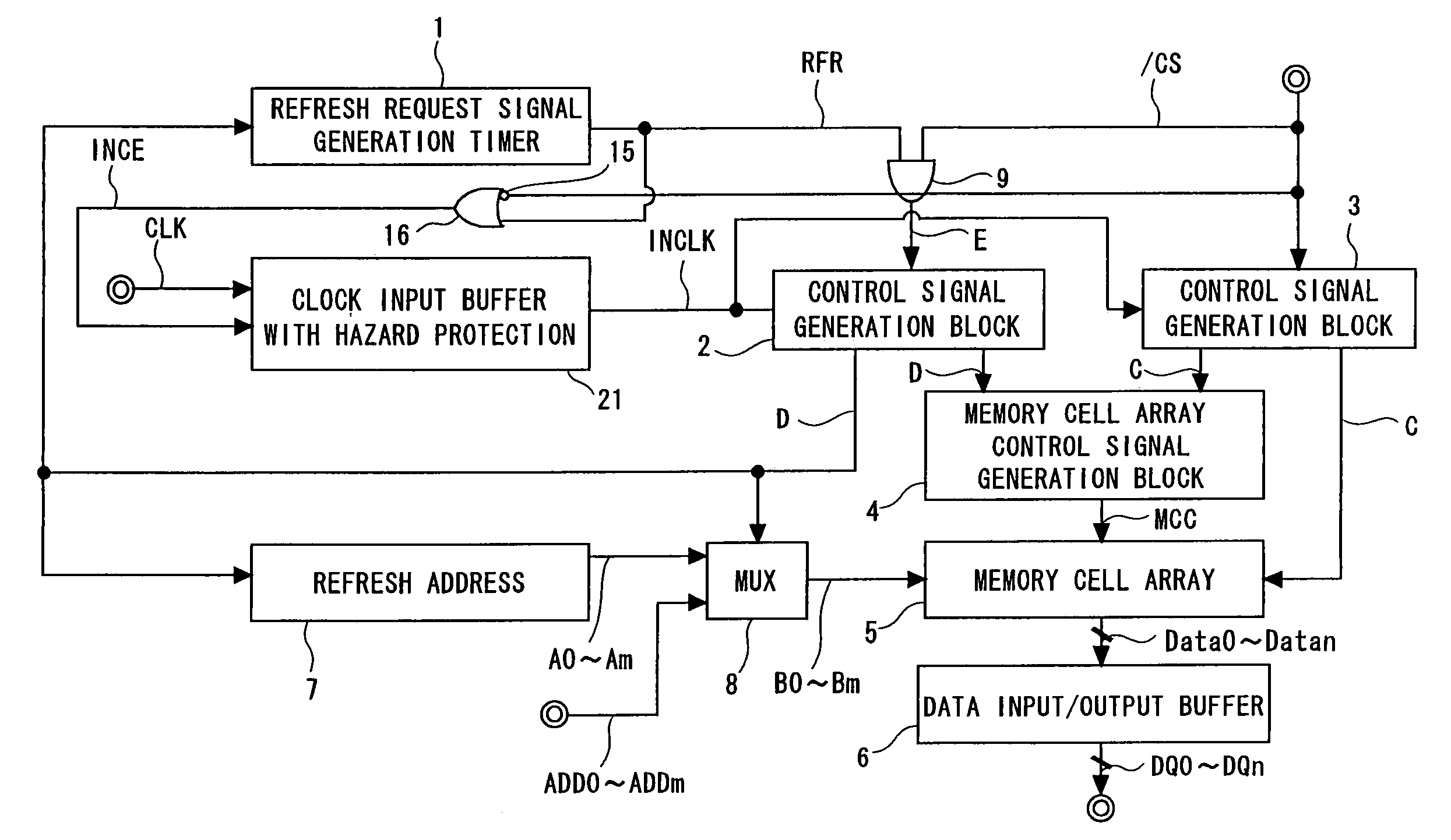
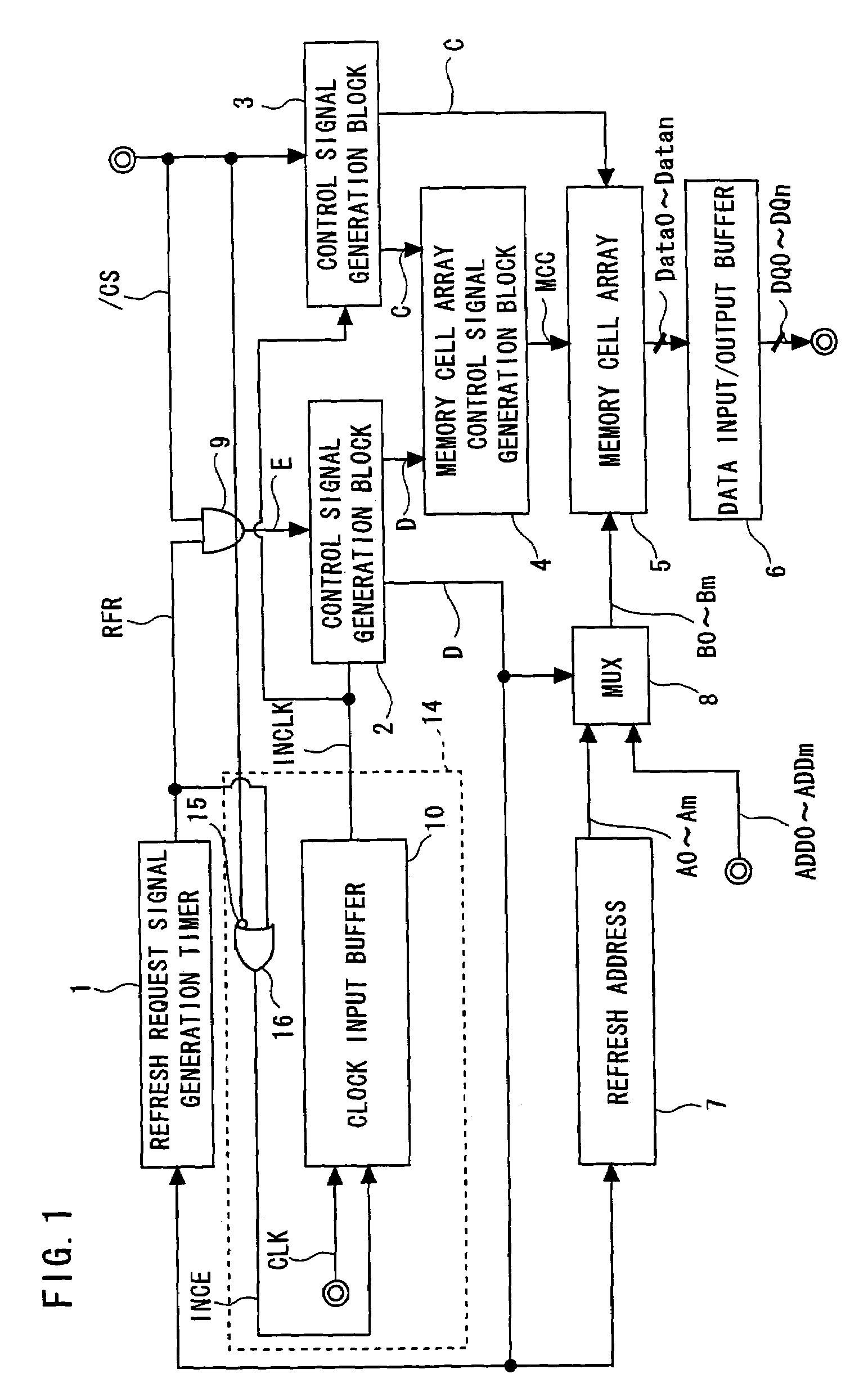
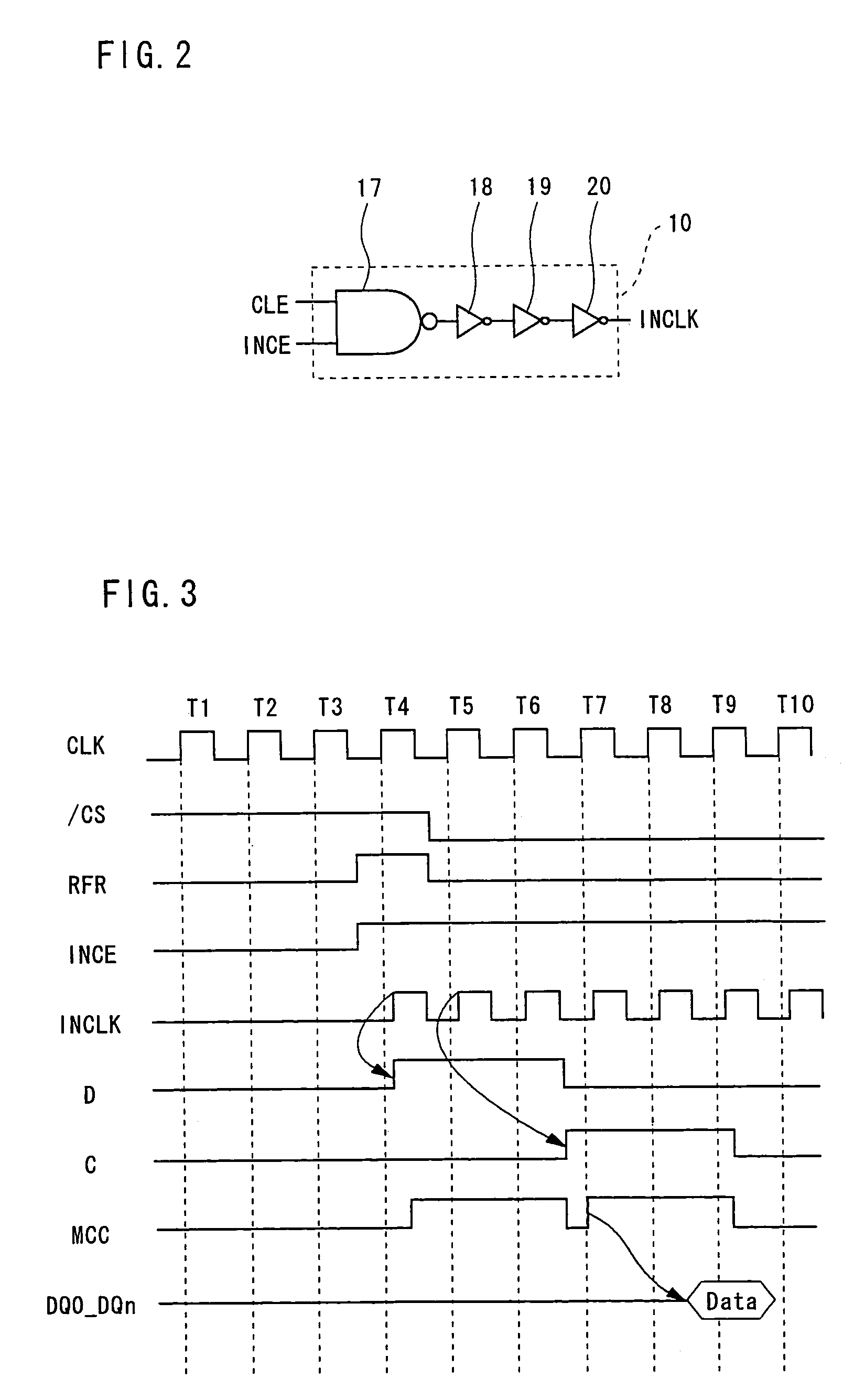
[0059]Preferred embodiments of the present invention are explained hereinafter in detail with reference to the accompanying drawings. Firstly, the present invention is explained below. FIG. 1 is a block diagram showing a semiconductor storage device according to this embodiment. FIG. 2 is a circuit diagram showing a clock input buffer 10 shown in FIG. 1. FIG. 3 is a timing chart when performing a read operation after a refresh operation in the semiconductor storage device according to this embodiment. FIG. 4 is a timing chart showing the operation between successive refresh operations in the semiconductor storage device according to this embodiment. In FIG. 1, the same elements as in FIGS. 15 and 17 are denoted by the same reference symbols and redundant description is omitted.

[0060]The semiconductor storage device of FIG. 1 is different from the conventional synchronized semiconductor storage device of FIG. 17 in the part enclosed by a frame 14. This semiconductor storage device ha...

second embodiment

[0077]Now, the operation of the semiconductor storage device having the above structure is explained below. Referring to FIGS. 7 and 8, the Q output of the D flip-flop 33 is High in the initial state. In this state, a clock signal CLK from outside and an internal clock enable signal INCE from the OR circuit 16 are input to the clock input buffer 21 with hazard protection.

[0078]The operation when the internal clock enable signal INCE is High is as follows. Since High level of internal clock enable signal INCE is input, the output of the inverter 24 is Low. If the clock signal CLK is Low, the output of the NOR circuit 23 is High to set the Reset-Set flip-flop 25. The N transistor 28 thereby turns on, and the input of the inverter 26 is Low and the output of the inverter 26 is High. Thus, the output of the inerter 30 is Low, and the output of the NAND circuit 31 is High. The output of the NAND circuit 22 is thereby High, and the internal clock signal INCLK is Low.

[0079]Even if the clo...

fourth embodiment

[0088]Finally, the present invention is explained hereinafter. FIG. 13 is a block diagram showing a semiconductor storage device according to this embodiment. FIG. 14 is a circuit diagram showing a clock input unit shown in FIG. 13. As shown in FIGS. 13 and 14, this embodiment applies the present invention to the conventional semiconductor storage device described in Japanese Unexamined Patent Application Publication 2002-184180 explained earlier, providing a self refresh SDRAM. This embodiment replaces the clock input buffer in this conventional semiconductor storage device with a clock input unit 41, and places the refresh request signal generation timer 1 between a command decoder and a command latch. The refresh request signal generation timer 1 is activated by the input of a self refresh entry signal SRE and automatically outputs a refresh request signal RFR at a constant period. The clock input unit 41 receives the self refresh entry signal SRE and the refresh request signal R...

the structure of the environmentally friendly knitted fabric provided by the present invention; figure 2 Flow chart of the yarn wrapping machine for environmentally friendly knitted fabrics and storage devices; image 3 Is the parameter map of the yarn covering machine
Login to View More

PUM

No PUM Login to View More

Abstract

The semiconductor storage device has a clock input buffer to output an internal clock signal INCLK, a NOT circuit to receive an external signal / CS, and an OR circuit to receive the output of the NOT circuit and a refresh request signal RFR and output their logical sum as an internal clock enable signal INCE to the clock input buffer. The clock input buffer has a NAND circuit to receive a clock signal CLK and the internal clock enable signal INCE and output an inverted signal of their logical product.

Description

BACKGROUND OF THE INVENTION[0001]1. Field of the Invention[0002]The present invention relates to a semiconductor storage device having a memory cell array composed of dynamic random access memory (DRAM) and a timer for executing refresh operation according to a timer period.[0003]2. Description of a Related Art[0004]As more features and functions are implemented in mobile devices such as cellular phones, a demand for higher capacity random access memory (RAM) is rapidly growing.[0005]Thus, there arises a need for using RAM with high capacity and low current consumption instead of conventionally used asynchronous static random access memory (SRAM) with relatively low current consumption. To meet this need, asynchronous pseudo-SRAM (PSRAM) that combines the best properties of the asynchronous SRAM for easy system design and DRAM for easy capacity increase is increasingly used for mobile devices (see Japanese Unexamined Patent Application Publication 2003-85970). The asynchronous PSRAM...

Claims

the structure of the environmentally friendly knitted fabric provided by the present invention; figure 2 Flow chart of the yarn wrapping machine for environmentally friendly knitted fabrics and storage devices; image 3 Is the parameter map of the yarn covering machine
Login to View More

Application Information

Patent Timeline
no application Login to View More
Patent Type & Authority Patents(United States)
IPC IPC(8): G11C8/00G11C11/403G11C7/00G11C11/401G11C11/406G11C11/407G11C11/4076G11C11/409
CPCG11C11/406G11C11/40615G11C2211/4067G11C7/222G11C11/4076G11C11/4093G11C11/4096
Inventor SUYAMA, NORIAKI
Owner NEC ELECTRONICS CORP
Features
  • R&D
  • Intellectual Property
  • Life Sciences
  • Materials
  • Tech Scout
Why Patsnap Eureka
  • Unparalleled Data Quality
  • Higher Quality Content
  • 60% Fewer Hallucinations
Social media
Patsnap Eureka Blog
Learn More