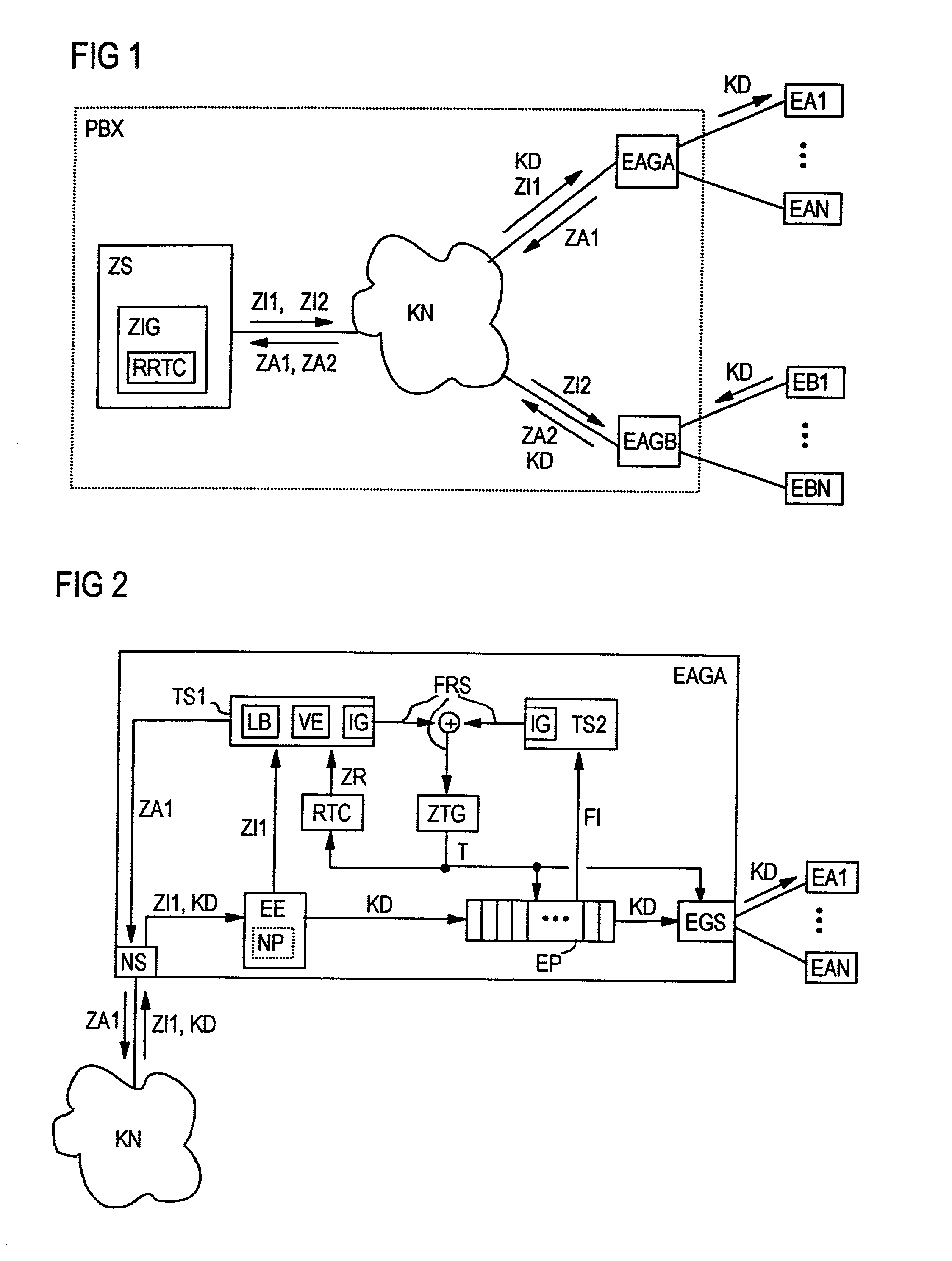
[0006]A communications system component is synchronized by readjusting the clock frequency of a
clock generator intended to prescribe the transmission
data rate for communications data whose transmission involves the communications system component in question. In this case, the clock frequency is readjusted by comparing received time information with a
current time value on a real time clock whose timing is controlled, in accordance with the present invention, by a timing pulse from the
clock generator actually provided for prescribing the transmission
data rate for communications data which are to be transmitted. The readjustment of the clock generator's clock frequency is thus indirectly used to adjust the real time clock itself on the basis of the time information received. This indirect adjustment prevents abrupt changes in the time indicated by the real time clock and attenuates effects of
delay time fluctuations in received time information.
[0008]In accordance with one advantageous embodiment of the present invention, the clock generator in a communications system component can be temperature stabilized or temperature compensated. To increase the clock accuracy, the clock generator also can be produced on the basis of the “2-oscillator concept”. In this context, a main oscillator and a temperature stabilized or temperature compensated reference oscillator which regulates the clock frequency of the main oscillator and otherwise freewheels is provided. The more accurate the clock generator in a communications system component, the longer the time intervals for which the communications system component in question remains in
sync even without receiving time information.
[0009]In accordance with another advantageous embodiment of the present invention, a communications system component can be sent the time information wirelessly; e.g., from a GPS
satellite (
global positioning system), from a
time signal transmitter, such as DCF77, or from a time information
transmitter associated with the communications system. For this purpose, the time information reception device in the communications system component in question has a
radio reception device for wirelessly receiving the time information. Due to the very short
delay time for time information transmitted by radio, this allows very accurate synchronization to be achieved.
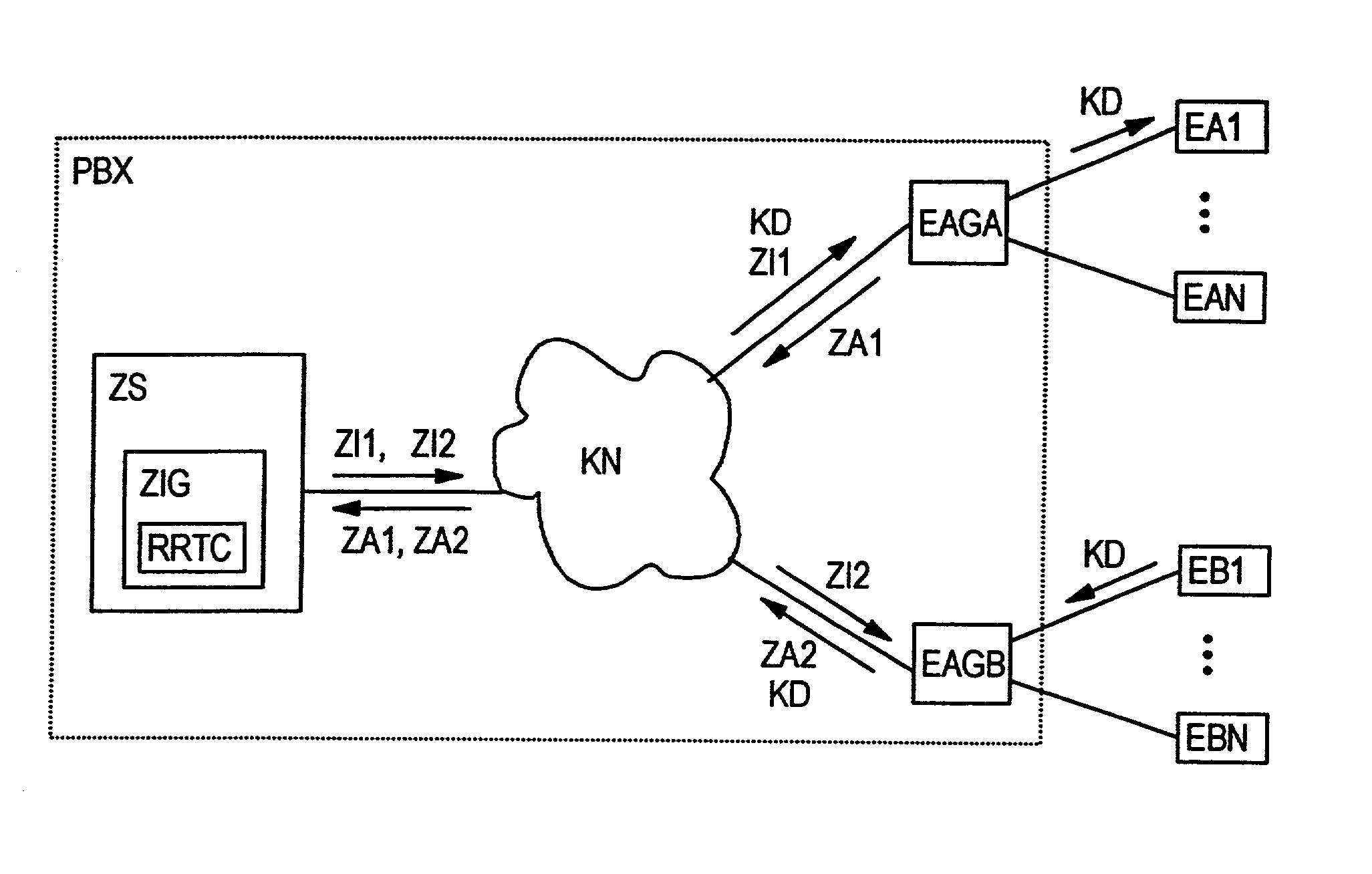
[0010]Alternatively, a communications system component also can be sent time information via the communications network from a time information transmitter, such as in the form of a time information
server, which is likewise coupled to the communications network. As such, an existing network infrastructure also can be used for
synchronizing the communications system components. This alternative allows a complex
radio reception device to be dispensed with in the communications system components which are to be synchronized. Instead, time information easily can be received by
coupling the time information reception device in a communications system component to the communications network via a
network interface and providing it with the ability to extract time information from a
data stream transmitted via the communications network.
[0012]To improve the accuracy of synchronization, a communications system component can have a timing device for measuring the
time difference between a request for and reception of time information, and a
delay time determination device for ascertaining an estimate of the
delay time for the time information from the time information transmitter to the communications system component on the basis of the measured
time difference. Assuming that the
delay time for the request approximately matches the
delay time for the time information, the delay time for the time information is then found to be half the measured
time difference. The accuracy of the estimate of the delay time for time information can be increased by determining the estimate from a mean value for time differences measured for a number of requests, or variables derived from the time differences. This makes it possible to compensate for delay time fluctuations for the data transmitted via the communications network. Accordingly, the comparison device in the communications system component can be designed such that the ascertained estimate of the delay time for the time information is taken into account in the comparison result; e.g., by correcting the time information or the time value indicated by the real time clock.
[0016]For the purposes of clock
frequency regulation, a
data stream of communications data received via the communications network, such as
voice data, preferably can be used. Since communications data, particularly
voice data, are frequently transmitted at a precisely maintained
transmission rate oriented to the timing of the transmitter for the communications data when a connection has been set up, the clock frequency of the clock generator can be stabilized fairly precisely using received communications or
voice data.


 Login to View More
  Login to View More