Such components are subject to faulty operation, degradation, and
corrosion resulting from contact with dust,
water vapor, gases, and the like, as well as from high temperature and / or pressure conditions.
Because of the differing
thermal expansion properties of the electronics housing or
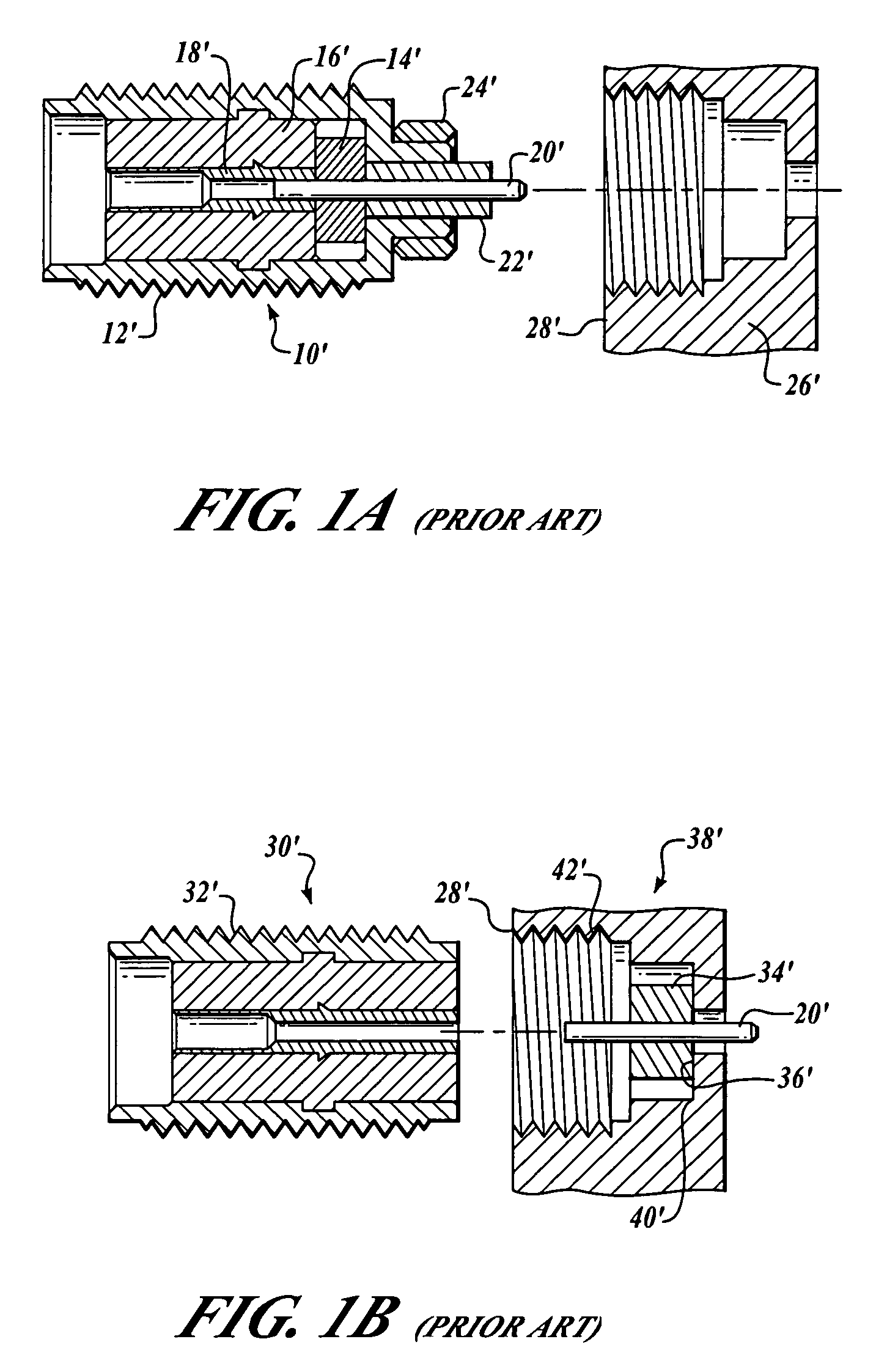
package and prior art “
spark plug” type RF connector, i.e. the externally threaded iron-based
metal and the internally threaded
aluminum metal, the seal between these components does not reliably maintain its hermeticity.
Such phenomena result in fatigue of the solder joint during thermal
cycling and cause less than intimate contact between seal ring 24 and electronics housing or package 26 as well as between seal ring 24 and RF connector 10.
Furthermore, the external solder application at 28 prevents RF connector 10 backout by providing a mechanical lock between the components, but because of
material fatigue this solder joint also does not form a reliable
hermetic seal.
And, this RF connector is not field replaceable because removal of the connector compromises the hermeticity of the package and breaks the rigid connection to the end of the pin located inside the package.
That is, RF connector 10 cannot be replaced in the field without a high risk of compromising the integrity of electronics housing or package 26 circuitry.
The resulting ground
lag impacts
signal gain and loss characteristics, thereby affecting the signal-to-
noise ratio.
This problem is exacerbated as higher frequency signals are employed.
As described above with respect to the prior art “
spark plug” type RF connector of FIG. 1A, seals using field replaceable connectors 30 are hermetic at ambient temperature, but because of the approximately 4:1
thermal expansion mismatch between
KOVAR™ and aluminum, the hermeticity of the
KOVAR™-aluminum solder seal fails due to
metal fatigue with repeated temperature variations.
Moreover, connector 30 does not meet military field replaceability standards because an iron-based
metal part may be threaded into aluminum only once, because that operation impacts subsequent torque applications by displacing the aluminum in the threaded area.
A limitation of RF connectors
stemming from the use of
laser welding that has not been adequately addressed in the art, however, is that
laser welds, unlike solder joints, do not form a suitable ground path between an RF connector and the electronics housing or package to which it is welded.
Thus, the ground
lag seen in prior art RF connectors, as described above, that results from differences in signal and ground path lengths significantly compromises the RF connector's
signal to noise ratio.


 Login to View More
  Login to View More