
Dynamic attitude measurement method and apparatus
- Summary
- Abstract
- Description
- Claims
- Application Information
AI Technical Summary
Benefits of technology
Problems solved by technology
Method used
Image

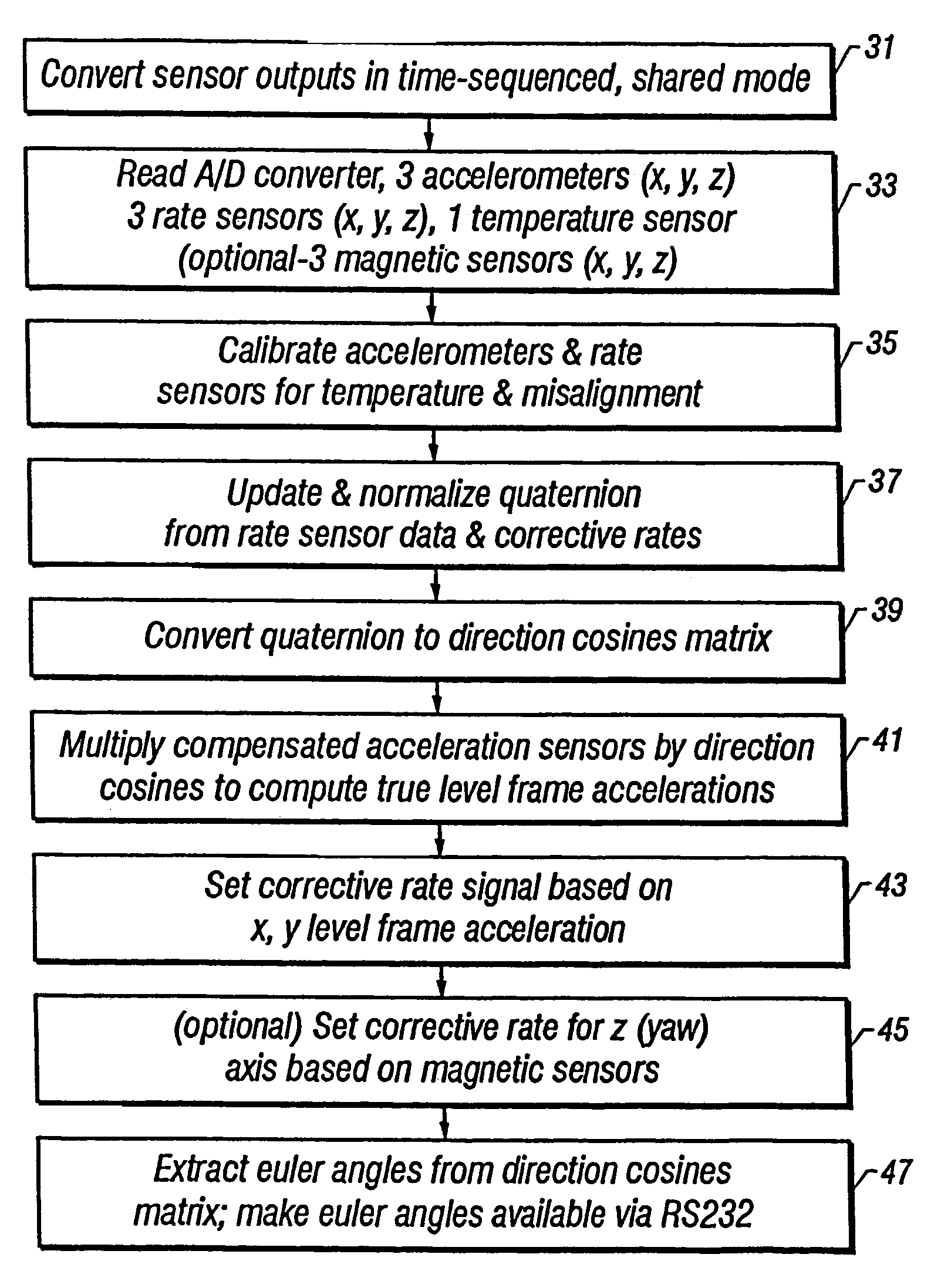
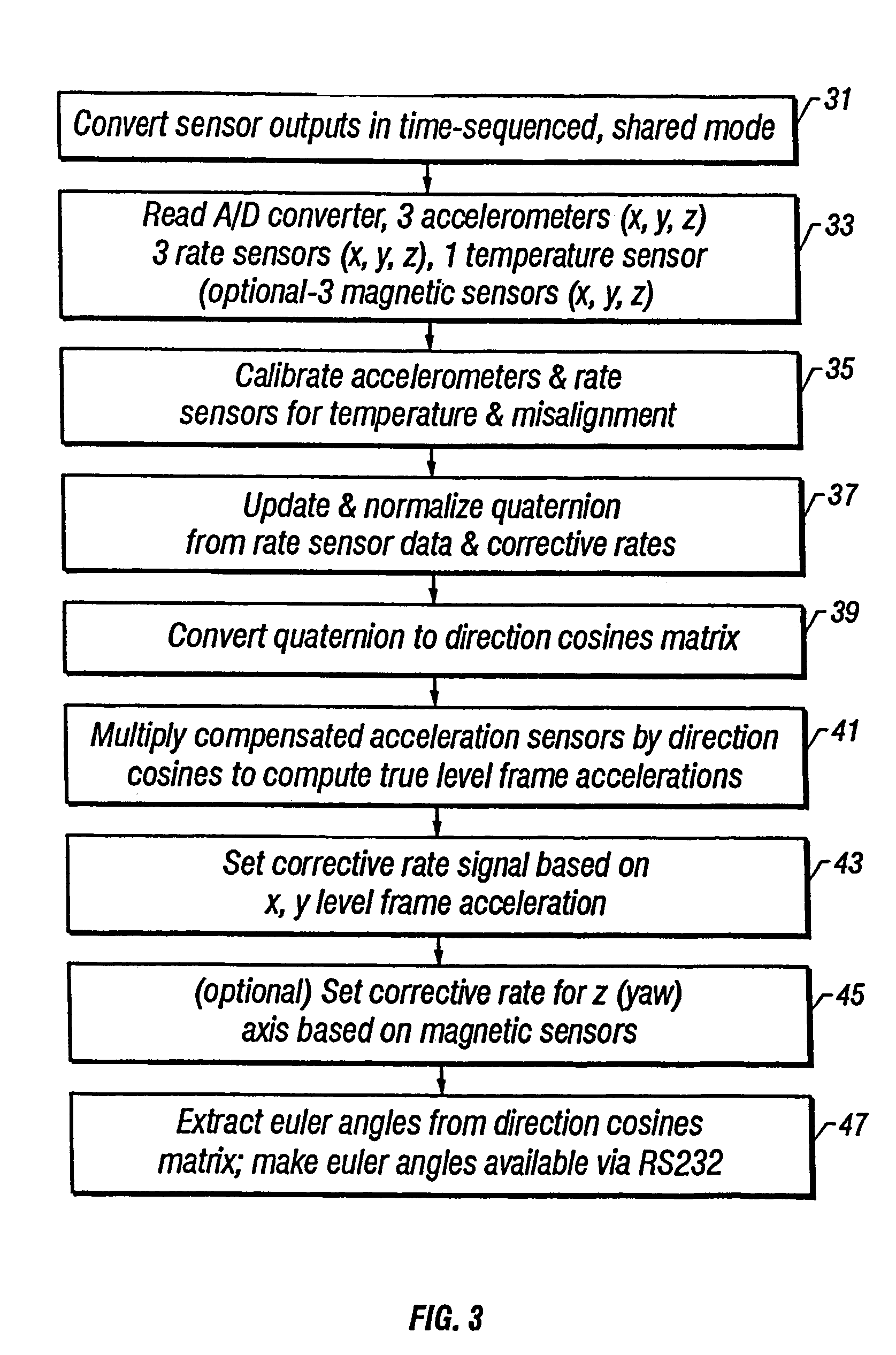
Examples
Embodiment Construction
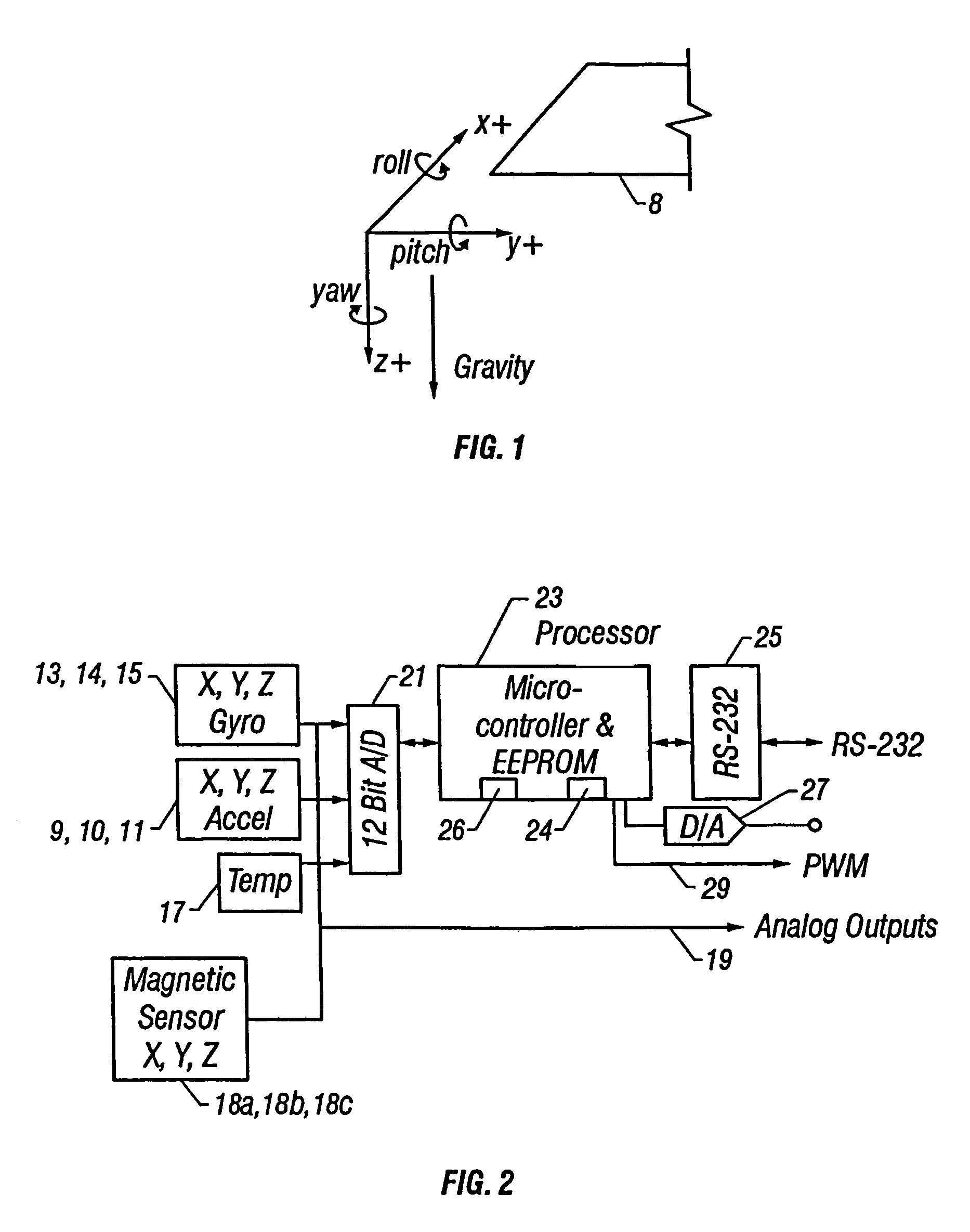
[0024]Referring now to the graph of FIG. 1, there is shown a coordinate set of axes X, Y, and Z that designate directions of movement or orientations with respect to the ‘horizon’8 as a reference plane, and about which rotational motions are specifically legend as ‘pitch’ (i.e., rotation about Y in the XZ plane), and ‘roll’ (i.e., rotation about X in the YZ plane), and ‘yaw’ (i.e., rotation about Z in the X Y plane, also referenced as ‘heading’ or ‘azimuth’).
[0025]In accordance with the present invention, as illustrated in the block diagram of FIG. 2, solid-state accelerometers 9, 10, 11 are disposed in alignment with each of the X, Y, and Z axes, respectively, and inertial elements 13, 14, 15 are disposed to sense rate of change of angular displacement about each of the X, Y, and Z axes, respectively. The accelerometers 9–11 may each comprise conventional micro-machined silicon devices that operate on differential capacitance to produce an analog output indication of axial accelera...
PUM
 Login to View More
 Abstract
Description
Claims
Application Information
 Login to View More