
Medical cock
a stopcock and sealing technology, applied in the direction of valve details, valve arrangements, other medical devices, etc., can solve the problems of insufficient sanitary procedures, difficult to wipe off the remaining solution and sterilize the tube, and the end region of the tributary tube is prone to microbial contamination, so as to reduce the length of the flow passage, facilitate the process, and prevent the effect of entry
- Summary
- Abstract
- Description
- Claims
- Application Information
AI Technical Summary
Benefits of technology
Problems solved by technology
Method used
Image

Examples
first embodiment
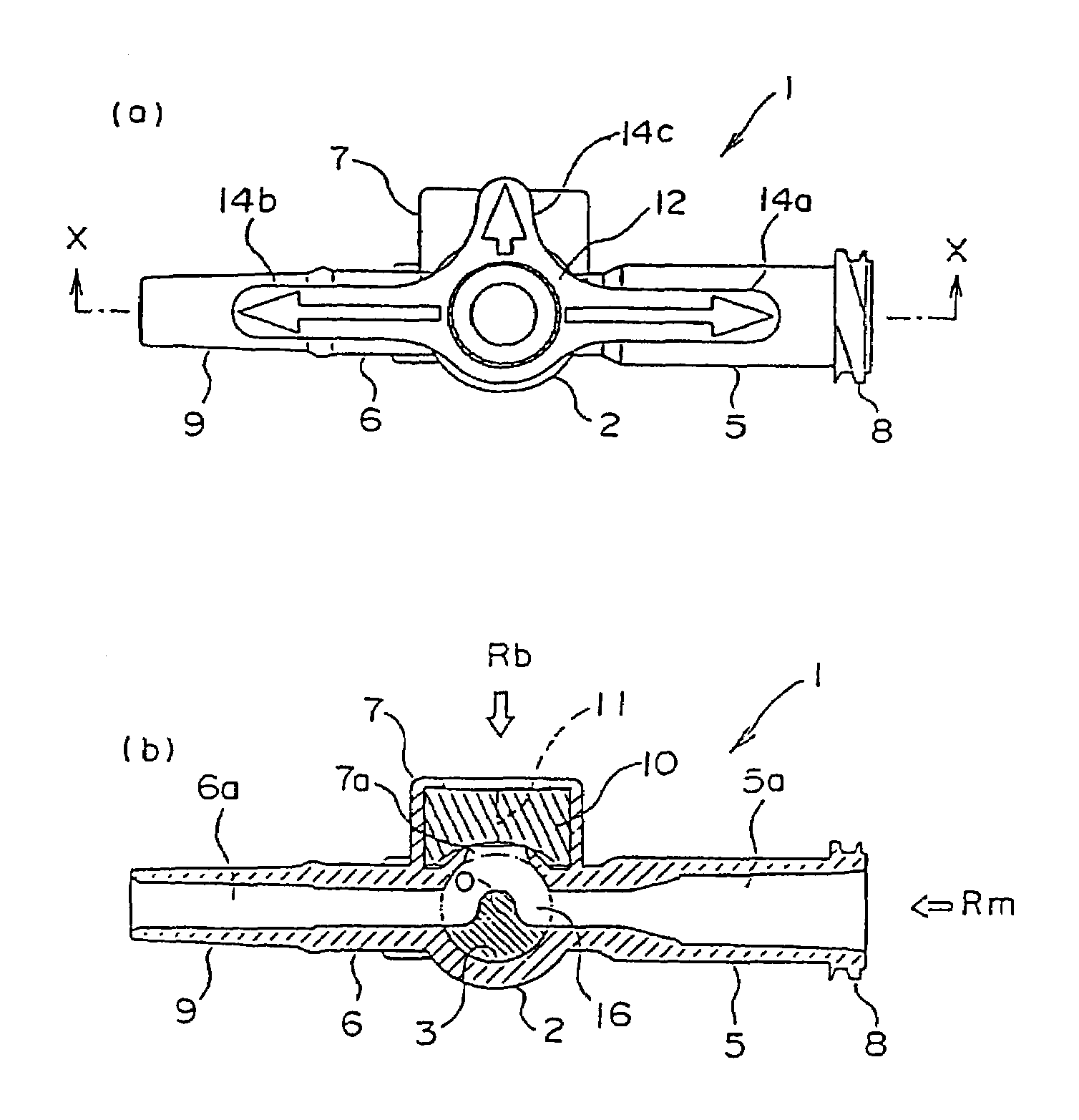
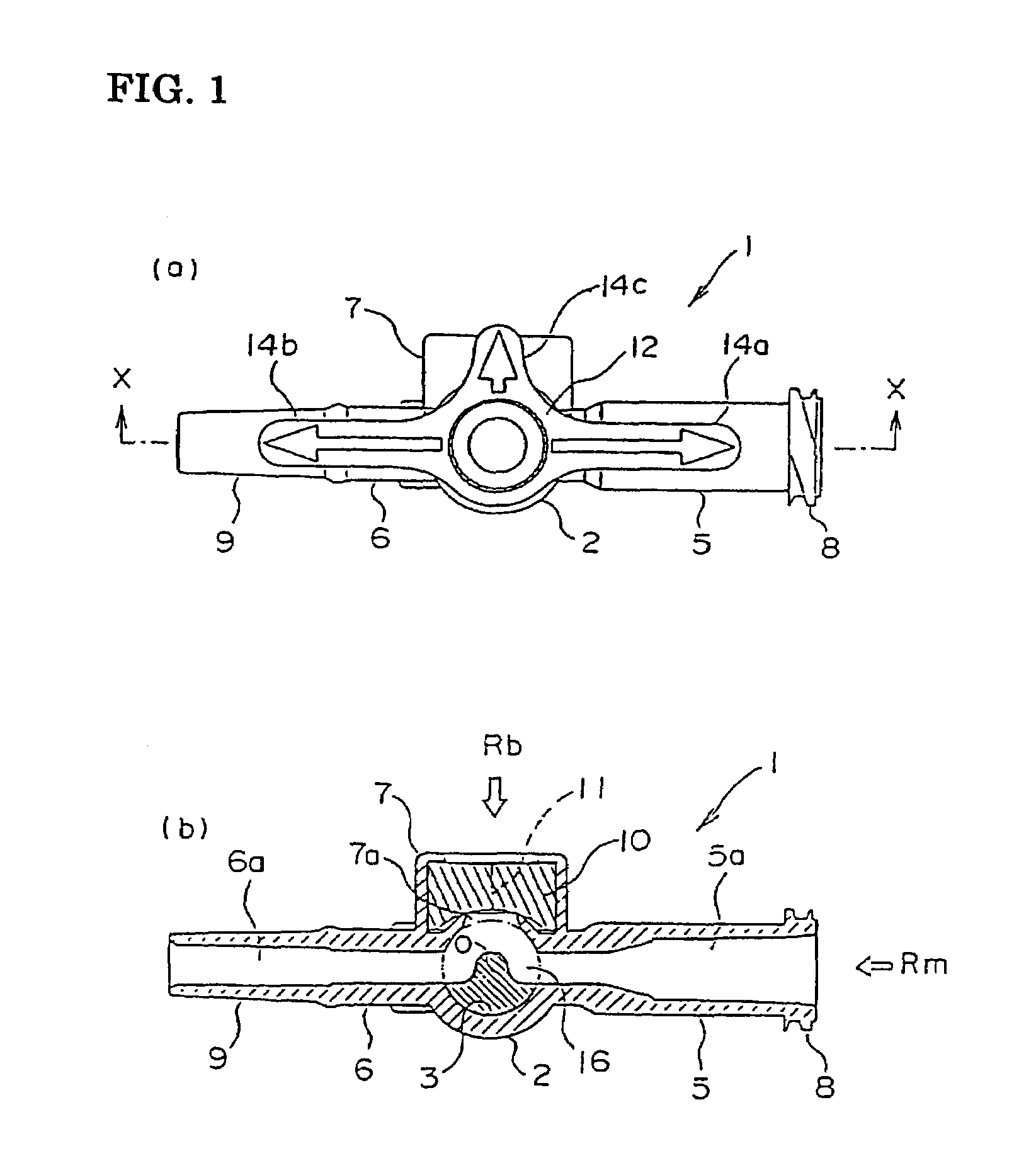
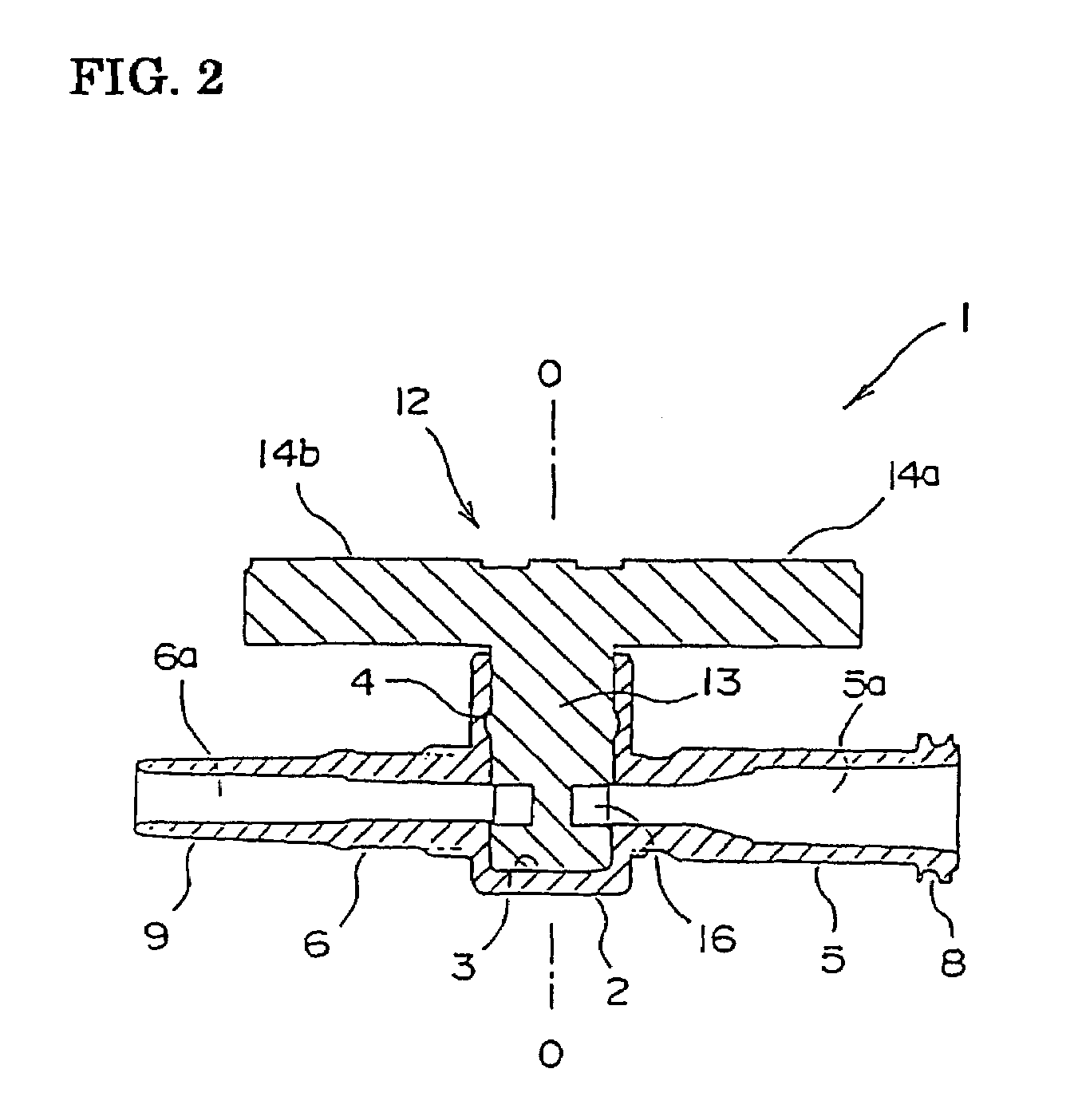
[0037]FIGS. 1(a) and 1(b) are schematic diagrams showing construction of a first embodiment of the present invention, where FIG. 1(a) is a frontal view; and FIG. 1(b) is a cross-section thereof. FIG. 2 is a cross-section taken along the line X—X in FIG. 1(a). FIGS. 3(a)–3(e) are schematic diagrams showing construction of a valve body according to the first embodiment, where FIG. 3(a) is a top view; FIG. 3(b) is a plan view; FIG. 3(c) is a frontal view; FIG. 3(d) is a right-side view; and FIG. 3(e) is a cross-section taken along the line Y—Y in FIG. 3(a).
[0038]Referring to FIGS. 1 and 2, a reference numeral 1 denotes a sealable access stopcock and a reference numeral 2 denotes a main body formed as a bottomed cylinder. The main body 2 is made of a transparent resin material such as polycarbonate (PC) and polyethylene terephthalate (PET) and PET / PC alloys. A reference numeral 3 denotes an internal chamber centered on a central axis O—O. A reference numeral 4 indicates an annular groov...
second embodiment
[0051]FIG. 8 is a cross-section of one construction of a second embodiment of the present invention showing major components thereof while FIG. 9 is an enlarged cross-section taken along the line Z—Z in FIG. 8.
[0052]In FIGS. 8 and 9, a reference numeral 30 denotes a limitation tube placed about the valve shaft 13 of the valve body 12, a reference numeral 31 denotes a limitation projection projecting from the inner surface of the limitation tube, and a reference numeral 32 denotes an arcuate cutout formed along the outer periphery of the main body 2 at the top end thereof. The angle of the cutout 32 formed on the main body 2 is substantially the same as the above-described angle θ of the arch of the switching channel 16. The limitation projection 31 on the valve body 12 engages the cutout 32.
[0053]When the valve body 12 is turned through the handles 14a and 14b to switch from one flow passage to another, the limitation projection 31 slides within the arcuate cutout 32. The valve body...
third embodiment
[0054]Referring to FIG. 10, major components of a third embodiment are shown in an enlarged perspective view. This embodiment employs a construction featuring a click function for causing the valve shaft to snap into position at different positions, in addition to the above-described function of the second embodiment for limiting the rotation angle.
[0055]In FIG. 10, a reference numeral 33 denotes a slit formed on either side of the limitation projection 31, which was described in the second embodiment above. A reference numeral 34 denotes a semicircular protrusion. The slits 33 allow the limitation projection 31 to resiliently move in the radial direction with respect to the central axis O—O. Accordingly, the protrusion 34 can be resiliently displaced in the radial direction.
[0056]Though not shown, the cutout 32 of the main body 2 shown in FIG. 9 includes three axial grooves each having a semicircular cross-section that corresponds to the protrusion 34. The grooves are formed at thr...
PUM
 Login to View More
 Abstract
Description
Claims
Application Information
 Login to View More