Unlock instant, AI-driven research and patent intelligence for your innovation.

Method of fabricating non-volatile memory

a non-volatile memory and memory technology, applied in the field of memory fabrication, can solve the problems of increasing the level of integration of the sonos device with the split-gate cell structure, and the need for more memory space in the gate structure, and achieve the effect of increasing the level of integration of memory cells

Active Publication Date: 2007-10-23
POWERCHIP SEMICON MFG CORP
View PDF4 Cites 2 Cited by
  • Summary
  • Abstract
  • Description
  • Claims
  • Application Information

AI Technical Summary

Benefits of technology

The present invention provides a method of fabricating non-volatile memory that can increase the level of integration of memory cells and simplify the fabricating process. The method involves forming a substrate with a memory cell region and a peripheral circuit region. A plurality of first memory cells is formed on the substrate in the memory cell region, with gaps between them. A gap is formed between the first memory cells and the peripheral circuit region. A conductive layer is formed over the substrate to fill the gaps. A dielectric layer is formed on the substrate in the peripheral circuit region. A source / drain region is formed in the substrate between the first memory cell column and the second memory cell column. The method includes steps of forming a second composite layer, patterning a photoresist layer, removing the second composite layer in the memory cell region, and forming a liner oxide layer and performing an ion implantation process. The method also includes steps of forming a second memory cell column and forming a second source / drain region. The distance between the first memory cell column and the second memory cell column is wider than the gap between two adjacent first memory cells. The method simplifies the fabricating process and reduces production costs.

Problems solved by technology

However, the aforementioned SONOS device with split-gate structure needs more memory space because a larger split-gate area is required to accommodate the split gate structure.
In other words, it is difficult to increase the level of integration of the SONOS device with split-gate cell structures any further.

Method used

the structure of the environmentally friendly knitted fabric provided by the present invention; figure 2 Flow chart of the yarn wrapping machine for environmentally friendly knitted fabrics and storage devices; image 3 Is the parameter map of the yarn covering machine
View more

Image

Smart Image Click on the blue labels to locate them in the text.
Viewing Examples
Smart Image
  • Method of fabricating non-volatile memory
  • Method of fabricating non-volatile memory
  • Method of fabricating non-volatile memory

Examples

Experimental program
Comparison scheme
Effect test

Embodiment Construction

[0036]Reference will now be made in detail to the present preferred embodiments of the invention, examples of which are illustrated in the accompanying drawings. Wherever possible, the same reference numbers are used in the drawings and the description to refer to the same or like parts.

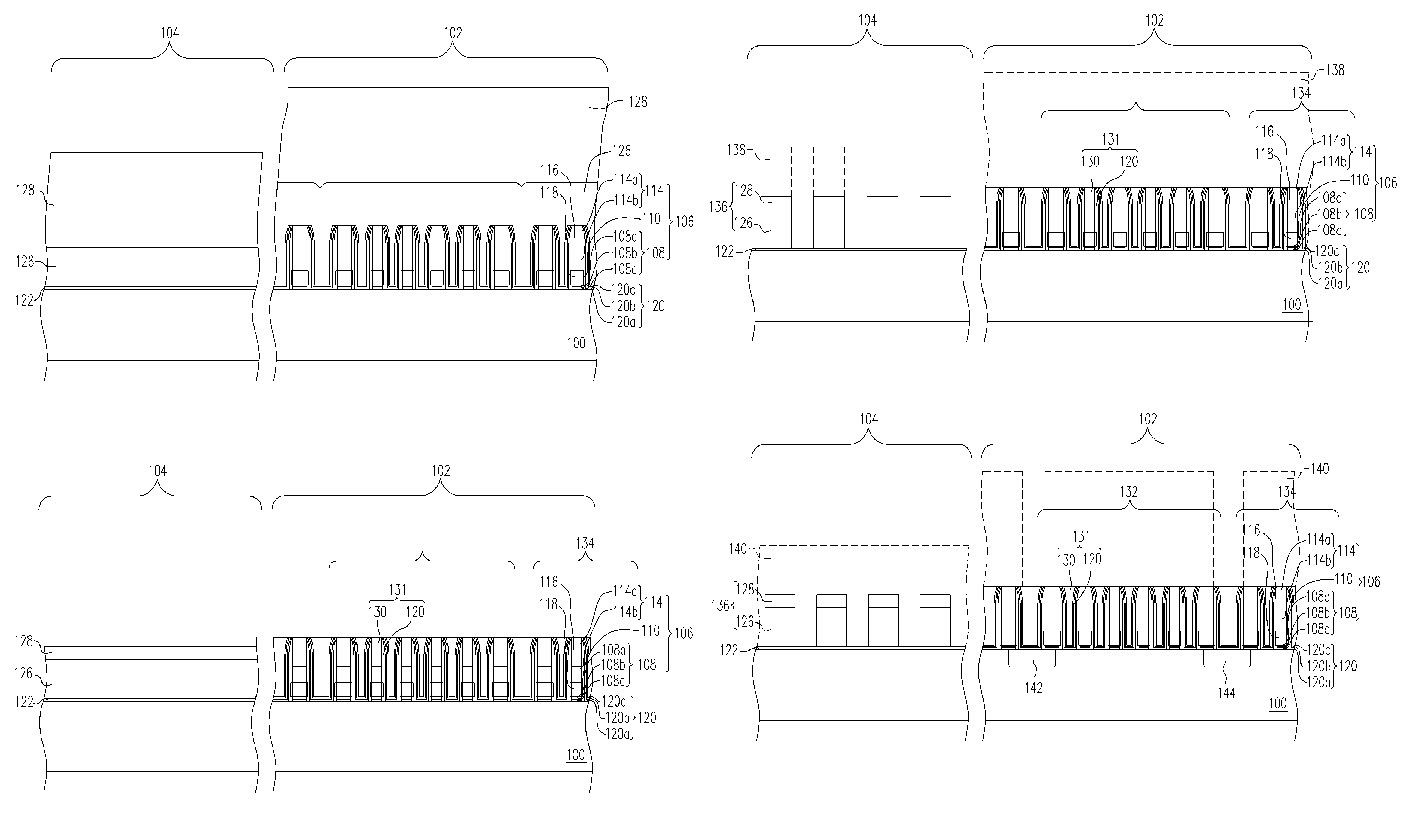
[0037]FIGS. 1A through 1G are schematic cross-sectional views showing the steps for fabricating a non-volatile memory according to one embodiment of the present invention. First, as shown in FIG. 1A, a substrate 100 such as a silicon substrate is provided. The substrate 100 can be divided at least into a memory cell region 102 and a peripheral circuit region 104. Then, a plurality of memory cells 106 is formed over the substrate 100 in the memory cell region 102. Each memory cell 106 includes a composite layer 108, a gate 110 and a cap layer 114. The method of forming the memory cells 106 includes sequentially forming a composite dielectric material layer, a conductive layer and an insulating materia...

the structure of the environmentally friendly knitted fabric provided by the present invention; figure 2 Flow chart of the yarn wrapping machine for environmentally friendly knitted fabrics and storage devices; image 3 Is the parameter map of the yarn covering machine
Login to View More

PUM

No PUM Login to View More

Abstract

A method of fabricating non-volatile memory is provided. A plurality of first memory cells is formed on the memory cell region of a substrate. Each first memory cell includes a first composite layer, a first gate and a cap layer. There is a gap between two adjacent first memory cells. Then, a plurality of gates is formed in the respective gaps. The gates together with a second composite layer form a plurality of second memory cells. The second memory cells and the first memory cells together constitute a memory cell column. In the meantime, a plurality of gate structures is also formed on the peripheral circuit region. The gates in the gaps and the gates in the peripheral circuit region are formed using the same conductive layers.

Description

CROSS-REFERENCE TO RELATED APPLICATION[0001]This application claims the priority benefit of Taiwan application Ser. No. 94119776, filed on Jun. 15, 2005. All disclosure of the Taiwan application is incorporated herein by reference.BACKGROUND OF THE INVENTION[0002]1. Field of the Invention[0003]The present invention relates to a method of fabricating memory. More particularly, the present invention relates to a method of fabricating non-volatile memory.[0004]2. Description of the Related Art[0005]Among the non-volatile memory products, electrically erasable and programmable read-only-memory (EEPROM) is a device that allows multiple data entry, reading and erasing operations. In addition, the stored data will be retained even after power to the device is removed. With these advantages, the memory device has been broadly applied in personal computer and electronic equipment.[0006]In U.S. Pat. No. 4,939,690, a flash memory structure having a floating gate and a control gate fabricated u...

Claims

the structure of the environmentally friendly knitted fabric provided by the present invention; figure 2 Flow chart of the yarn wrapping machine for environmentally friendly knitted fabrics and storage devices; image 3 Is the parameter map of the yarn covering machine
Login to View More

Application Information

Patent Timeline
no application Login to View More
Patent Type & Authority Patents(United States)
IPC IPC(8): H01L21/337
CPCH01L27/105H01L27/11534H01L27/11526H10B41/43H10B41/40H10B41/35
Inventor TSENG, WEI-CHUNGWEI, HOUNG-CHIPITTIKOUN, SAYSAMONE
Owner POWERCHIP SEMICON MFG CORP