Methods and devices to assist pulmonary decompression

a technology of pulmonary decompression and pulmonary valve, which is applied in the direction of breathing masks, breathing protection, other medical devices, etc., can solve the problems of large amount of oxygen, increased annual cost of oxygen therapy, soreness and irritation of the nose, etc., and achieves the effect of increasing the expiratory flow

a technology of pulmonary decompression and pulmonary valve, which is applied in the direction of breathing masks, breathing protection, other medical devices, etc., can solve the problems of large amount of oxygen, increased annual cost of oxygen therapy, soreness and irritation of the nose, etc., and achieves the effect of increasing the expiratory flow

US7533667B2Inactive Publication Date: 2009-05-19PORTAERO

Image

Smart Image Click on the blue labels to locate them in the text.
Viewing Examples
Smart Image
  • Methods and devices to assist pulmonary decompression
  • Methods and devices to assist pulmonary decompression
  • Methods and devices to assist pulmonary decompression

Examples

Experimental program
Comparison scheme
Effect test

Embodiment Construction

[0042]Air typically enters the mammalian body through the nostrils and flows into the nasal cavities. As the air passes through the nostrils and nasal cavities, it is filtered, moistened and raised or lowered to approximately body temperature. The back of the nasal cavities is continuous with the pharynx (throat region); therefore, air may reach the pharynx from the nasal cavities or from the mouth. Accordingly, if equipped, the mammal may breath through its nose or mouth. Generally air from the mouth is not as filtered or temperature regulated as air from the nostrils. The air in the pharynx flows from an opening in the floor of the pharynx and into the larynx (voice box). The epiglottis automatically closes off the larynx during swallowing so that solids and / or liquids enter the esophagus rather than the lower air passageways or airways. From the larynx, the air passes into the trachea, which divides into two branches, referred to as the bronchi. The bronchi are connected to the l...

the structure of the environmentally friendly knitted fabric provided by the present invention; figure 2 Flow chart of the yarn wrapping machine for environmentally friendly knitted fabrics and storage devices; image 3 Is the parameter map of the yarn covering machine
Login to View More

PUM

No PUM Login to View More

Abstract

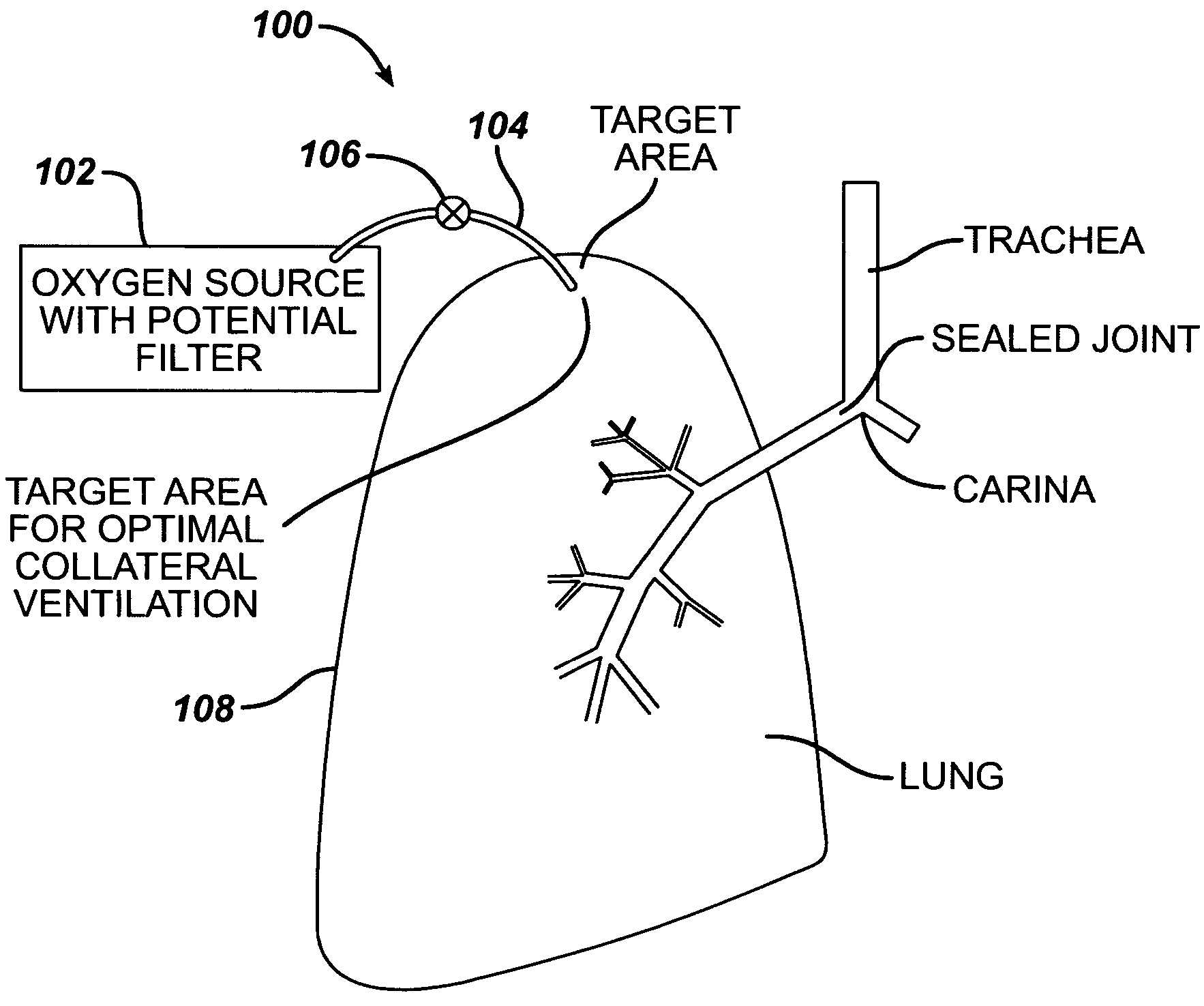
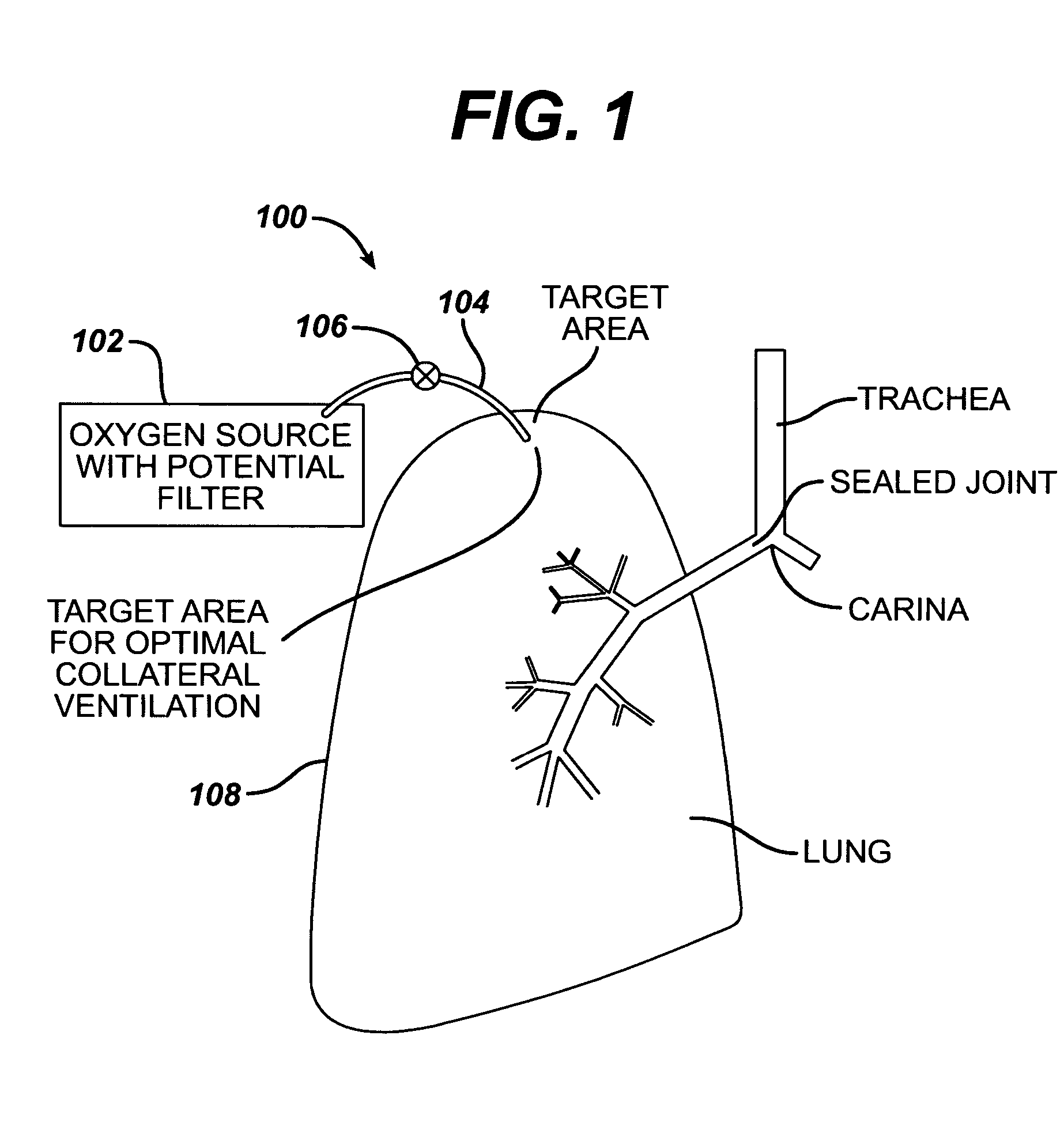
A long term oxygen therapy system having an oxygen supply directly linked with a patient's lung or lungs may be utilized to more efficiently treat hypoxia caused by chronic obstructive pulmonary disease such as emphysema and chronic bronchitis. The system includes an oxygen source, one or more valves and fluid carrying conduits. The fluid carrying conduits link the oxygen source to diseased sites within the patient's lungs. A collateral ventilation bypass trap system directly linked with a patient's lung or lungs may be utilized to increase the expiratory flow from the diseased lung or lungs, thereby treating another aspect of chronic obstructive pulmonary disease. The system includes a trap, a filter / one-way valve and an air carrying conduit. In various embodiments, the system may be intrathoracic, extrathoracic or a combination thereof. A pulmonary decompression device may also be utilized to remove trapped air in the lung or lungs, thereby reducing the volume of diseased lung tissue. In order for the system to be effective, an airtight seal between the parietal and visceral pleurae is required. Chemical pleurodesis is utilized for creating the seal.

Description

CROSS REFERENCE TO RELATED APPLICATIONS[0001]This application claims the benefit of Provisional Application No. 60 / 473,999 filed May 29, 2003.BACKGROUND OF THE INVENTION[0002]1. Field of the Invention[0003]The present invention relates to systems and methods for removing trapped air in emphysematous lungs, and more particularly, to systems and methods for removing trapped air in emphysematous hyperinflated lungs by bypassing non-patent airways via a conduit through the outer pleural layer of the lung to a containment / trap device. The present invention also relates to a collateral ventilation bypass system that utilizes the trachea for expelling trapped air rather than a containment / trap device. The present invention also relates to a device and methodology to assist in pulmonary decompression. The present invention also relates to systems and methods for chemical pleurodesis.[0004]2. Discussion of the Related Art[0005]As a result of studies that date back to the 1930's and particula...

Claims

the structure of the environmentally friendly knitted fabric provided by the present invention; figure 2 Flow chart of the yarn wrapping machine for environmentally friendly knitted fabrics and storage devices; image 3 Is the parameter map of the yarn covering machine
Login to View More

Application Information

Patent Timeline
19 May 2009
Publication
US7533667B2
IPC
A61M15/00; A61M16/00; A62B18/00; A62B7/00; A62B9/00; A62B9/06; A61M1/00; A61M16/10
CPC
A61M16/10; A61M39/0247; A61M2039/0252; A61M2039/0276; A61M2039/0297; A61M16/101; A61M16/106; A61M2202/0208
Inventors
TANAKA, DON