
Method for producing a single crystal
a single crystal and production method technology, applied in the direction of polycrystalline material growth, crystal growth process, polycrystalline material growth, etc., can solve the problems of deterioration of electric property like oxide dielectric breakdown voltage characteristics, unknown desired defect-free region, and difficulty in obtaining efficiently a single crystal with high quality
- Summary
- Abstract
- Description
- Claims
- Application Information
AI Technical Summary
Benefits of technology
Problems solved by technology
Method used
Image

Examples
example 1
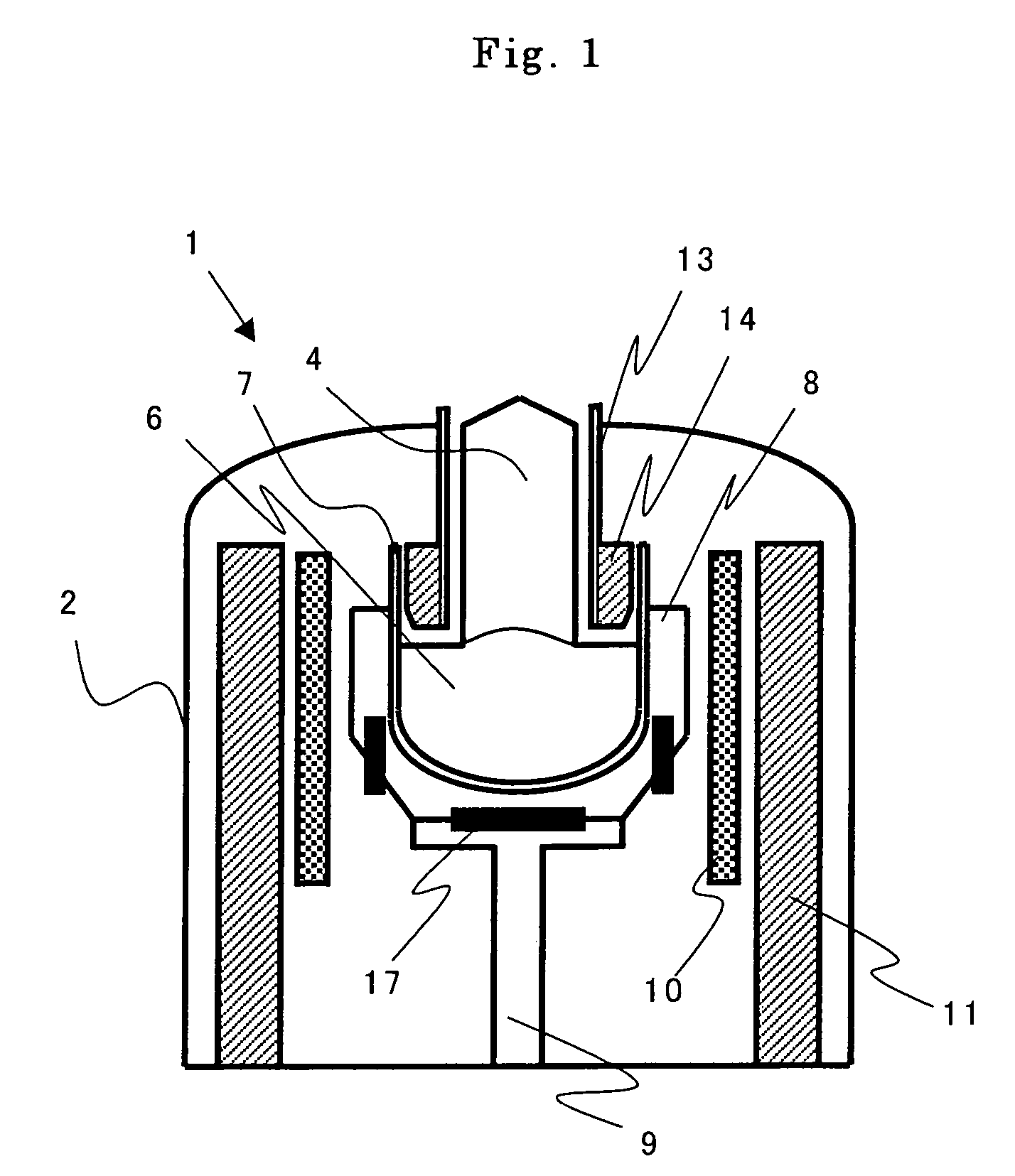
[0066]Using an apparatus for producing a single crystal, which has the crucible with a diameter of 600 mm (24 inches), as shown in FIG. 1, a silicon single crystal with a diameter of 8 inches (200 mm) was pulled so that the whole plane of the crystal would be N region without Cu deposition defect region.
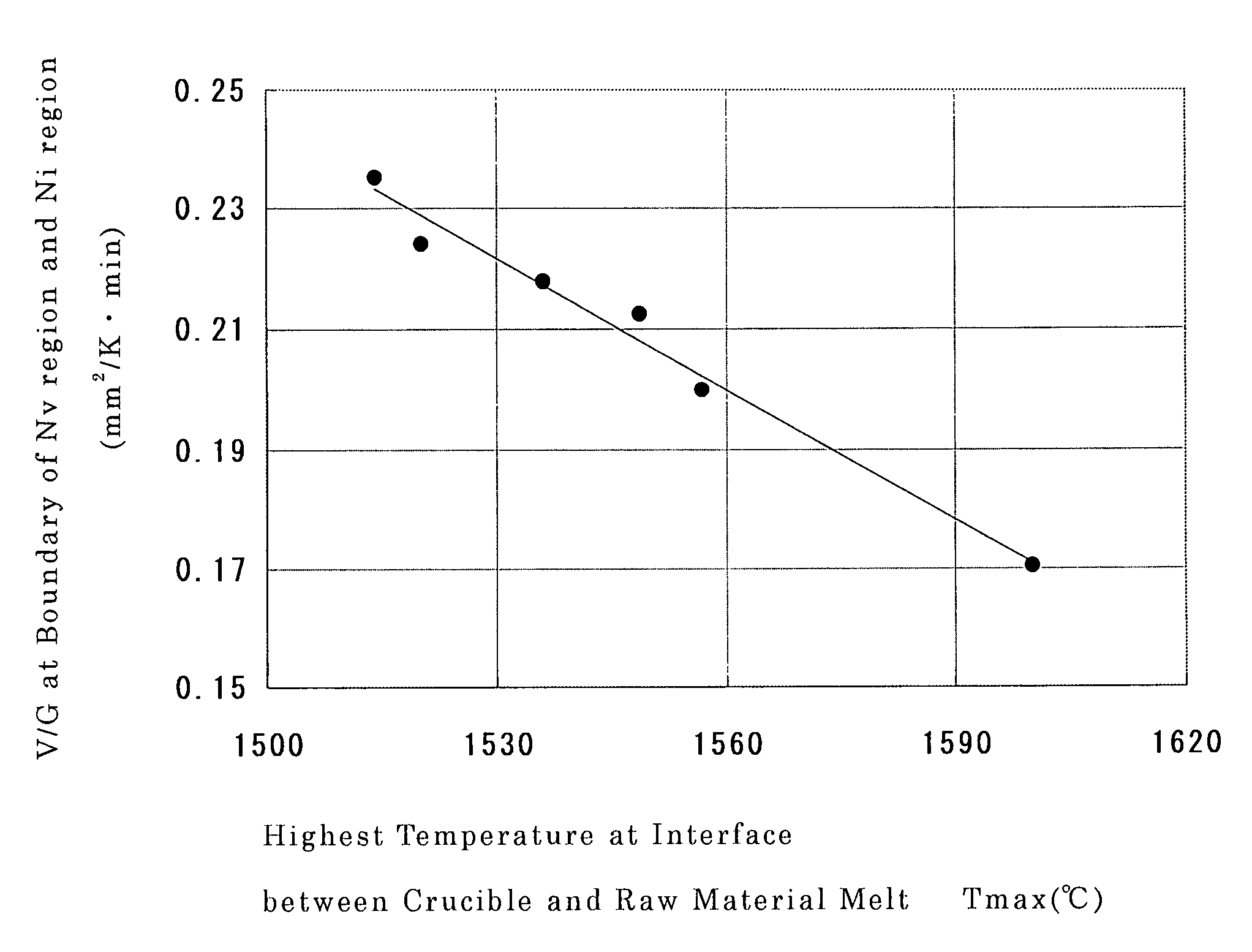
[0067]For that purpose, firstly, heat insulating materials were provided below and at the side of the crucible, the highest temperature Tmax(° C.) at an interface between the crucible and a raw material melt was set at 1514 (° C.). In order to produce a single crystal including N region without Cu deposition defect region when the Tmax(° C.) is set above, a range of a value of V / G (mm2 / K·min) should be in the range from 0.21 to 0.25 (from −0.000724×1514+1.31 to −0.000724×1514+1.35) (See FIG. 3(c)). Accordingly, the range from 0.22 to 0.24 was selected as a range of a value of V / G (mm2 / K·min) to unfailingly pull a single crystal the whole plane of which is occupied by N region without...
example 2
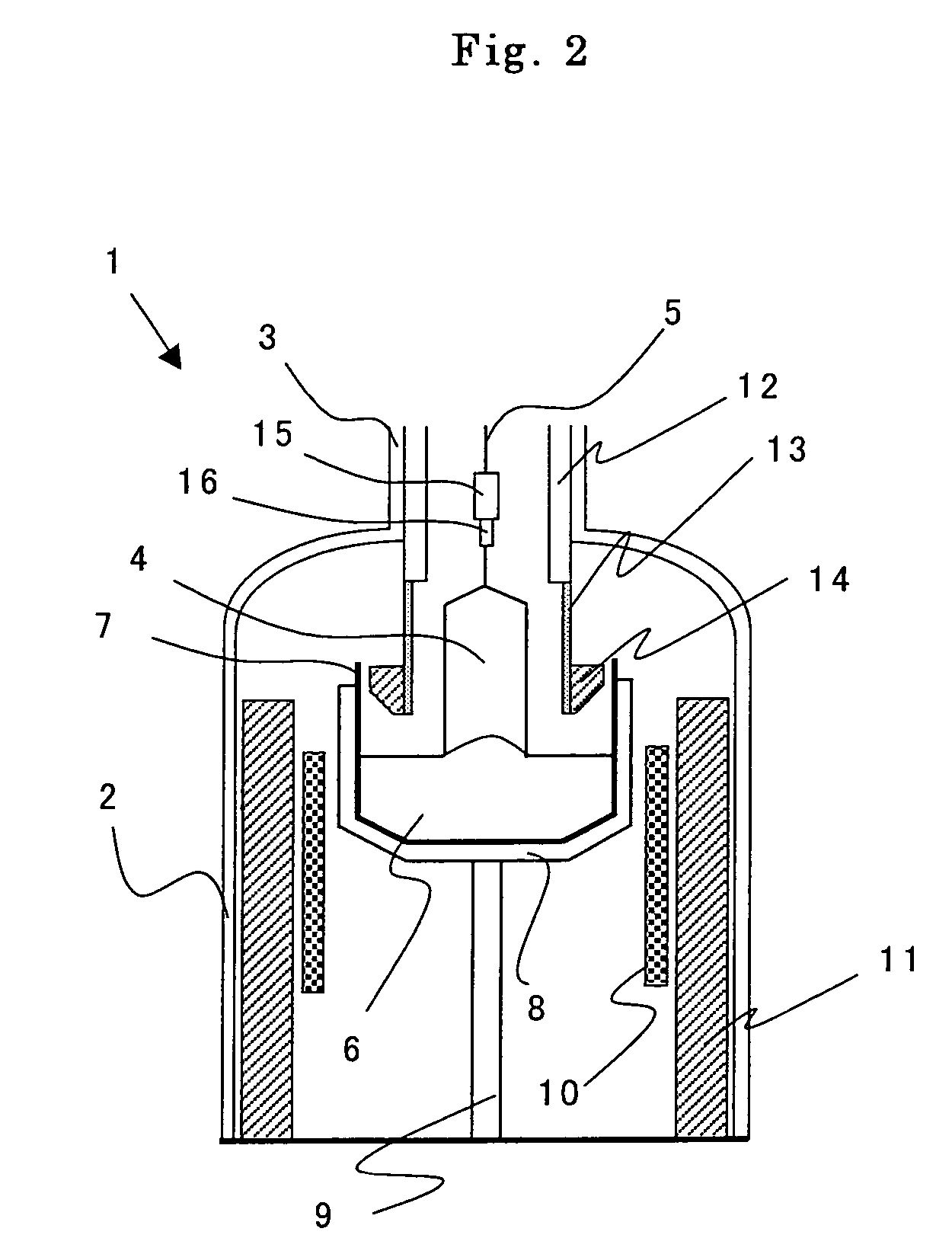
[0069]Using the same apparatus for producing a single crystal as Example 1, a silicon single crystal with a diameter of 8 inches (200 mm) was pulled so that the whole plane of the crystal would be N region without Cu deposition defect region. However, heat insulating materials which can change a highest temperature Tmax (° C.) at an interface between a crucible and a raw material melt were not provided.
[0070]In the apparatus for producing a single crystal, the highest temperature Tmax(° C.) at an interface between a crucible and a raw material melt was 1560 (° C.). In order to produce a single crystal including N region without Cu deposition defect region with the Tmax(° C.), a range of a value of V / G (mm2 / K·min) should be in the range from 0.18 to 0.22 (from −0.000724×1560+1.31 to −0.000724×1560+1.35). Accordingly, the range from 0.19 to 0.21 was selected as a range of a value of V / G (mm2 / K·min) to unfailingly pull a single crystal the whole plane of which is occupied by N region w...
example 3
[0072]Using a different apparatus for producing a single crystal, which has a crucible with a diameter of 750 mm (30 inches), from that of Example 1 and 2, a silicon single crystal with a diameter of 8 inches (200 mm) was pulled so that the whole plane of the crystal would be N region without Cu deposition defect region.
[0073]In the apparatus for producing a single crystal, the highest temperature Tmax(° C.) at an interface between the crucible and a raw material melt was 1600° C. In order to produce a single crystal including N region without Cu deposition defect region with the Tmax(° C.), a range of a value of V / G (mm2 / K·min) should be in the range from 0.15 to 0.19 (from −0.000724×1600+1.31 to −0.000724×1600+1.35). Accordingly, the range from 0.16 to 0.18 was selected as a range of a value of V / G (mm2 / K·min) to unfailingly pull a single crystal the whole plane of which is occupied by N region without Cu deposition defect region. Next, a single crystal was pulled with controlling...
PUM
| Property | Measurement | Unit |
|---|---|---|
| melting point | aaaaa | aaaaa |
| diameter | aaaaa | aaaaa |
| diameter | aaaaa | aaaaa |
Abstract
Description
Claims
Application Information
 Login to View More