Method for priority-encoding interrupts and vectoring to interrupt code
a priority-encoding and interrupt technology, applied in the field of methods, can solve the problem that the priority assignment of the original integrated circuit designer is not optimal for all systems, and achieve the effect of low latency and high flexibility
- Summary
- Abstract
- Description
- Claims
- Application Information
AI Technical Summary
Benefits of technology
Problems solved by technology
Method used
Image



Examples
Embodiment Construction
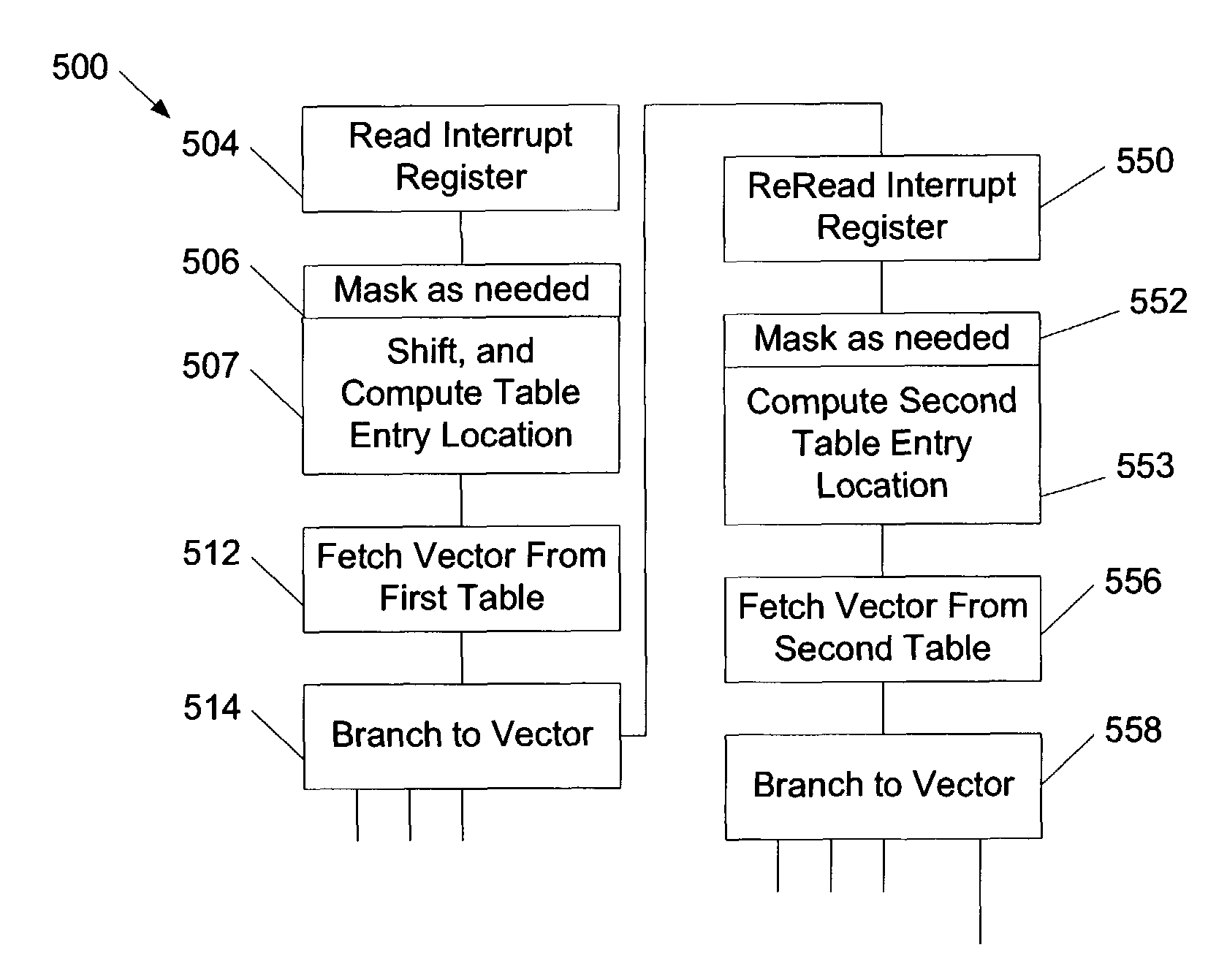
[0017]With reference to FIGS. 1 and 2, an interrupt processing routine incorporating an interrupt encoder is activated upon occurrence of a triggering event, such as an interrupt-pending bit becoming set in an interrupt status register 102. The interrupt status register 102 is read 104, and any required masking operation performed 106 with interrupt mask registers 108. The masked bit pattern is then used to compute an address 107 in an interrupt vector table 110. On an eight-bit microcontroller having sixteen-bit addresses, computing the address 107 is done by left shifting the bit pattern by one bit and adding the base address of the table.
[0018]A vector is fetched 112 from vector table 110, and used as a destination address in a branch-to-vector operation 114. The branch to vector operation 114 results in loading the vector into a program pointer 116 of the processor. The steps of computing the vector address 107, fetching the vector 112, and branching to the vector 114 may be acc...
PUM
 Login to View More
 Abstract
Description
Claims
Application Information
 Login to View More