Device and method for tacking plaque to a blood vessel wall

a blood vessel wall and plaque technology, applied in blood vessels, prostheses, manufacturing tools, etc., can solve the problems of plaque disruption, balloon angioplasty is not always controlled, and the lumen of the blood vessel at the site of treatment is usually somewhat larger, so as to achieve a ‘stent-free’ environment

a blood vessel wall and plaque technology, applied in blood vessels, prostheses, manufacturing tools, etc., can solve the problems of plaque disruption, balloon angioplasty is not always controlled, and the lumen of the blood vessel at the site of treatment is usually somewhat larger, so as to achieve a ‘stent-free’ environment

US8128677B2Active Publication Date: 2012-03-06INTACT VASCULAR

Image

Smart Image Click on the blue labels to locate them in the text.
Viewing Examples
Smart Image
  • Device and method for tacking plaque to a blood vessel wall
  • Device and method for tacking plaque to a blood vessel wall
  • Device and method for tacking plaque to a blood vessel wall

Examples

Experimental program
Comparison scheme
Effect test

third embodiment

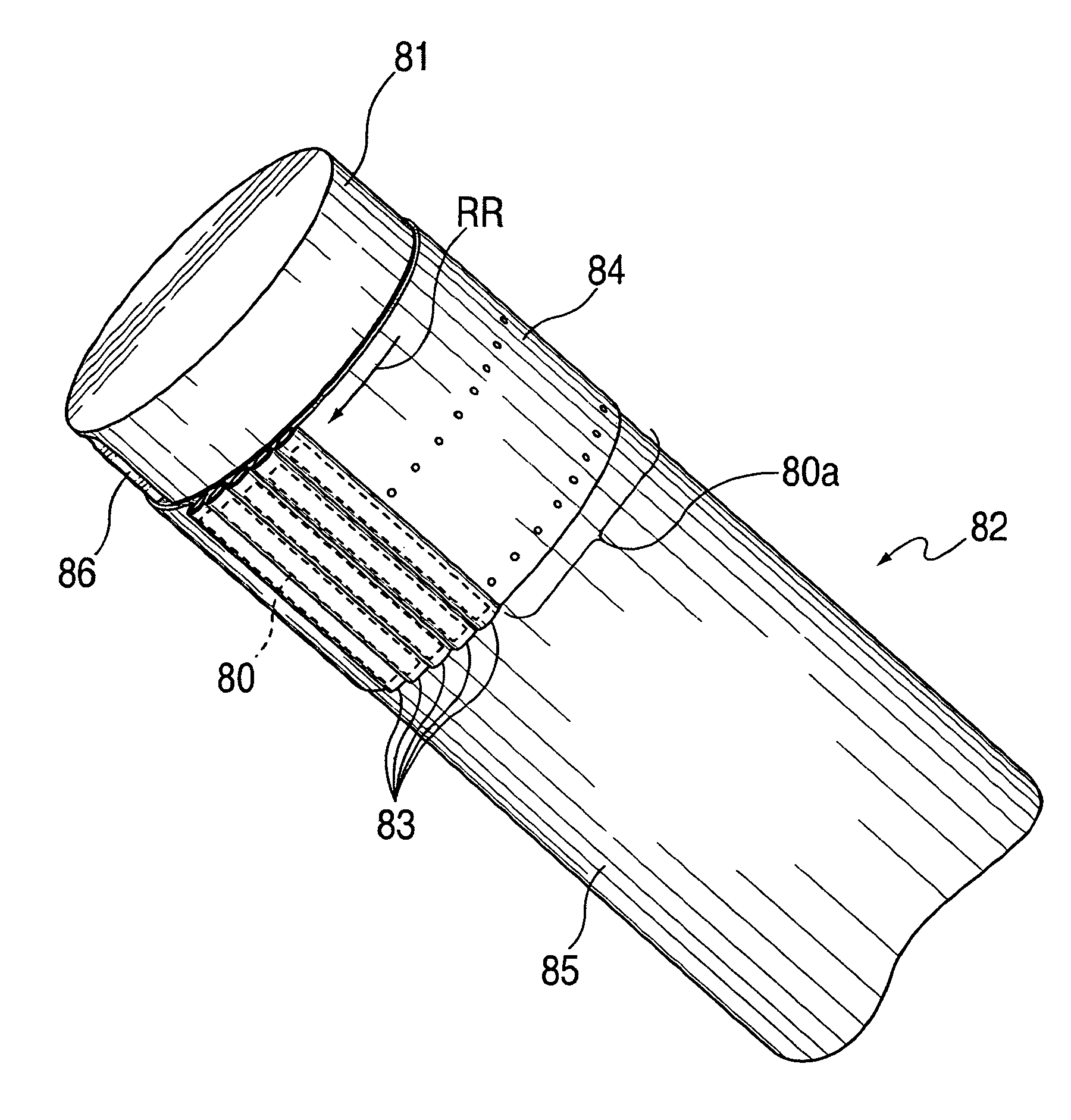
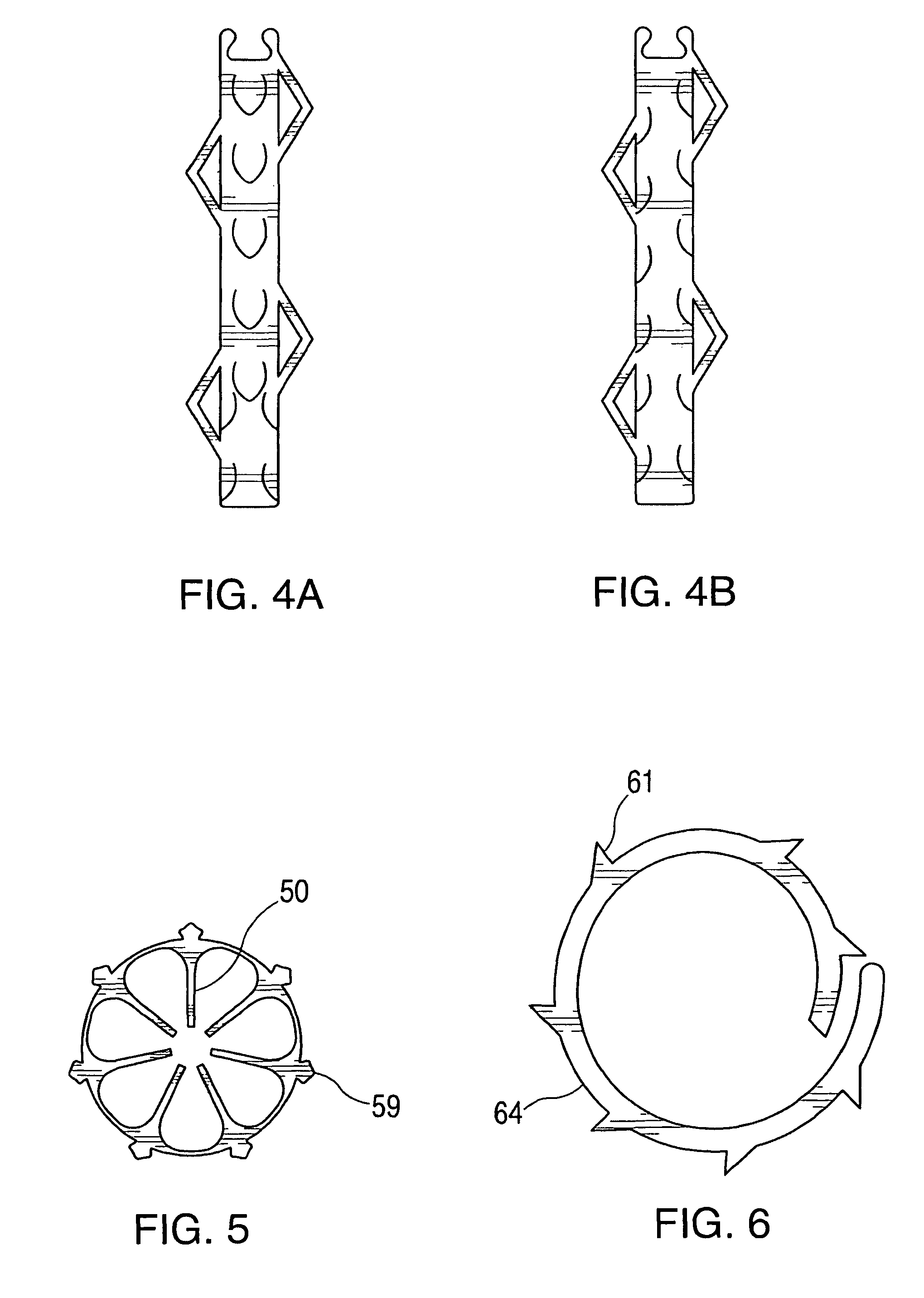
[0057]FIGS. 7A-7D show alternative shapes for FIG. 5 with a variety of different anchoring designs 72, 73, 78, 80. The fingers 76, 77 for bending the points flat for insertion are included with any of the designs. When the fingers are removed after pre-loading, and the flexible ring tack has been deployed, the inner area 74, 75 within the annular ring 79, 82 is left unobstructed.

[0058]Referring to FIG. 6, a fourth preferred embodiment of the plaque tack device is formed in a coil shape 64 with ends unjoined and with barbs or points 61 on its outer periphery. The ends are pulled longitudinally in opposite directions to flatten the annular band to a spiral shape extending linearly so that it can be carried around or inside the length of a tubular sheath into the blood vessel held in place by a retainer element. At the desired position in the blood vessel, the retainer element is released to allow the tack to expand back to its full-diameter annular shape against the plaque.

[0059]FIGS....

fifth embodiment

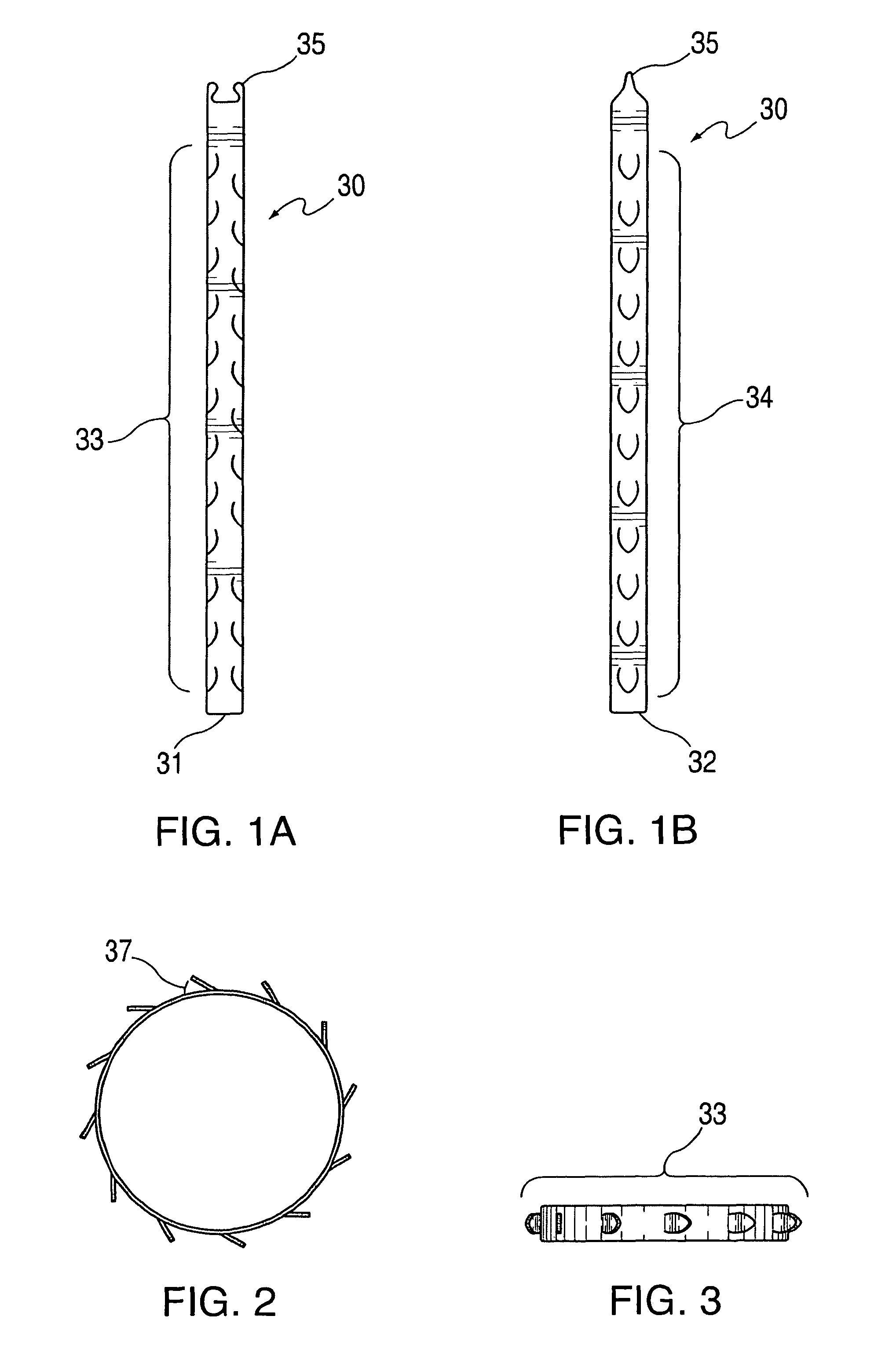
[0062]the plaque tack in the form of a metallic mesh tack is illustrated in FIGS. 19A-D, and its manner of deployment in FIGS. 20 and 21. In FIG. 19A, the metallic mesh tack is shown in end view having an annular band 100a formed of interleaved mesh, and outer points or barbs 100b. The metallic mesh tack may be laser cut or etched out of a metal tube form or made of thin metal wire which is looped and interleaved in a mesh that is welded, soldered, looped and / or linked together into the desired mesh shape. FIG. 19B shows the metallic mesh tack in side view with barbs projecting from the annular band 100a. The barbs on its outward surface will contact and embed into the wall of the blood vessel. FIG. 19C shows the metallic mesh tack at rest in its fully expanded state in perspective view, and FIG. 19D shows a section of the metallic mesh tack in a detailed view. The mesh pattern is specifically designed so that it can be compressed radially inward to a smaller-volume size for loading...

the structure of the environmentally friendly knitted fabric provided by the present invention; figure 2 Flow chart of the yarn wrapping machine for environmentally friendly knitted fabrics and storage devices; image 3 Is the parameter map of the yarn covering machine
Login to View More

PUM

No PUM Login to View More

Abstract

A tack device for holding plaque against blood vessel walls in treating atherosclerotic occlusive disease is formed as a thin, annular band of durable, flexible material having a plurality of barbs or anchoring points on its outer annular periphery. The annular band has a length in the axial direction of the blood vessel walls that is about equal to or less than its diameter as installed in the blood vessel. In a preferred embodiment, the tack device is formed as a compressible metallic mesh band having outer barbs on outer sides of the mesh structure. Another embodiment may have a plurality of compressible mesh bands may be formed spaced apart coaxially from each other and connected by longitudinally extending bridge members. A preferred method is to perform angioplasty with a drug eluting balloon as a first step, and if there is any dissection to the blood vessel caused by the balloon angioplasty, one or more tack devices may be installed to tack down the dissected area of the blood vessel surface, in order to avoid the need to install a stent and thereby maintain a ‘stent-free’ environment.

Description

[0001]This U.S. patent application is a continuation-in-part of U.S. patent application Ser. No. 11 / 955,331 of the same inventors, filed Dec. 12, 2007 now U.S. Pat. No. 7,896,911.TECHNICAL FIELD[0002]This invention relates to treatment of atherosclerotic occlusive disease by intravascular procedures for pushing and holding plaque accumulated on the blood vessel walls out of the way for reopened blood flow.BACKGROUND OF INVENTION[0003]Atherosclerotic occlusive disease is the primary cause of stroke, heart attack, limb loss, and death in the US and the industrialized world. Atherosclerotic plaque forms a hard layer along the wall of an artery and is comprised of calcium, cholesterol, compacted thrombus and cellular debris. As the atherosclerotic disease progresses, the blood supply intended to pass through a specific blood vessel is diminished or even prevented by the occlusive process. One of the most widely utilized methods of treating clinically significant atherosclerotic plaque i...

Claims

the structure of the environmentally friendly knitted fabric provided by the present invention; figure 2 Flow chart of the yarn wrapping machine for environmentally friendly knitted fabrics and storage devices; image 3 Is the parameter map of the yarn covering machine
Login to View More

Application Information

Patent Timeline
06 Mar 2012
Publication
US8128677B2
IPC
A61F2/06; A61F2/82; A61F2/86; A61F2/92
CPC
A61F2/86; A61L31/16; A61F2/848; A61F2/844; A61F2/88; A61F2/91; A61F2/92; A61F2/95
Inventors
SCHNEIDER, PETER; GIASOLLI, ROBERT