
Composite heat treatment method for 30CrMnSiA steel thin wall spinning cylinder-shape element
A composite heat treatment and thin-walled technology, applied in heat treatment furnaces, heat treatment equipment, furnace types, etc., to achieve the effect of improving tissue stability and machinability, and solving high processing accuracy and hydraulic strength requirements
- Summary
- Abstract
- Description
- Claims
- Application Information
AI Technical Summary
Problems solved by technology
Method used
Image

Examples
Embodiment Construction
[0013] Below in conjunction with accompanying drawing, the present invention will be further described:
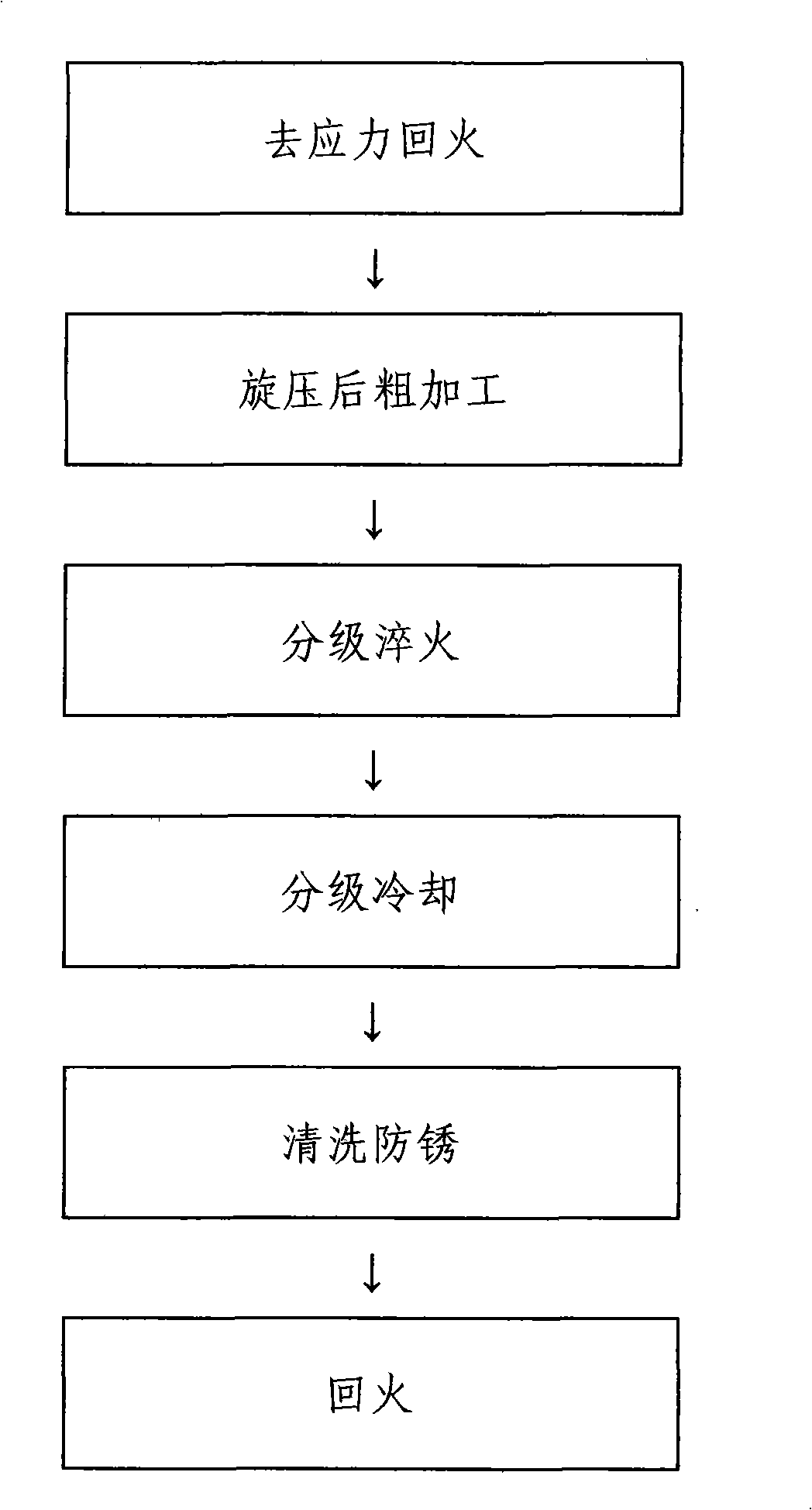
[0014] Referring to the accompanying drawings, after spinning 30CrMnSiA steel, inspect the size of the formed workpiece and whether there are cracks, etc., and carry out appropriate stress relief and tempering for the qualified workpiece (temperature 400-480°C, time 120-360 minutes) , so that the residual stress generated by the workpiece through spinning can be released to a certain extent, rough machining the workpiece after stress relief and tempering, and quenching the workpiece in stages (preheating 200-500°C, heating in a salt bath furnace 870-910°C) , and then carry out graded cooling of the workpiece (nitrate salt isothermal tank or alkali bath isothermal tank cooling 180 ~ 280 ℃, air cooling or water cooling below 50 ℃), after the workpiece is cooled, wash off the residual salt or lye attached to the surface of the workpiece, Passivation and anti-rust treatment ar...
PUM
 Login to View More
 Abstract
Description
Claims
Application Information
 Login to View More