Check patentability & draft patents in minutes with Patsnap Eureka AI!

Polypropylene resin composition for forming microporous film

一种聚丙烯树脂、多微孔的技术,应用在电池组零部件、混合电容器隔板、隔板/薄膜/膜片/间隔元件等方向,能够解决得不到耐热性、效果不充分、热收缩率不能说是充分等问题,达到热收缩率低、耐热性优异的效果

Active Publication Date: 2011-12-07
MITSUI CHEM INC +1
View PDF10 Cites 7 Cited by
  • Summary
  • Abstract
  • Description
  • Claims
  • Application Information

AI Technical Summary

Problems solved by technology

[0011] In Patent Document 7, a microporous membrane (separator) composed of two kinds of polyolefins having a weight average molecular weight (Mw) of 500,000 or more is described, but the examples are all HDPE, and the desired heat resistance cannot be obtained.
In addition, the heat shrinkage rate of the obtained film cannot be said to be sufficient.
[0012] Thus, until now, the use of high molecular weight polypropylene has been used to improve the heat resistance of the microporous membrane, but the effect is not sufficient.

Method used

the structure of the environmentally friendly knitted fabric provided by the present invention; figure 2 Flow chart of the yarn wrapping machine for environmentally friendly knitted fabrics and storage devices; image 3 Is the parameter map of the yarn covering machine
View more

Image

Smart Image Click on the blue labels to locate them in the text.
Viewing Examples
Smart Image
  • Polypropylene resin composition for forming microporous film
  • Polypropylene resin composition for forming microporous film
  • Polypropylene resin composition for forming microporous film

Examples

Experimental program
Comparison scheme
Effect test

preparation example Construction

[0111] When preparing the solid titanium catalyst component (a), it is preferable to use, for example, a tetravalent titanium compound represented by the following formula (1) as the titanium compound (a-2).

[0112] Ti(OR) g x 4-g …(1)

[0113] (In formula (1), R is a hydrocarbon group, X is a halogen atom, and g is a number of 0≤g≤4.)

[0114] Specifically, TiCl 4 、TiBr 4 、TiI 4 Titanium tetrahalide; Ti(OCH 3 ) Cl 3 , Ti(OC 2 h 5 ) Cl 3 , Ti(O-n-C 4 h 9 ) Cl 3 , Ti(OC 2 h 5 )Br 3 , Ti(O-iso-C 4 h 9 )Br 3 and other alkoxytitanium trihalides; Ti(OCH 3 ) 2 Cl 2 , Ti(OC 2 h 5 ) 2 Cl 2 , Ti(O-n-C 4 h 9 ) 2 Cl 2 , Ti(OC 2 h 5 ) 2 Br 2 Dialkoxytitanium dihalides; Ti(OCH 3 ) 3 Cl, Ti(OC 2 h 5 ) 3 Cl, Ti(O-n-C 4 h 9 ) 3 Cl, Ti(OC 2 h 5 ) 3 Trialkoxytitanium monohalides such as Br; Ti(OCH 3 ) 4 , Ti(OC 2 h 5 ) 4 , Ti(O-n-C 4 h 9 ) 4 , Ti(O-iso-C 4 h 9 ) 4 , Ti(O-2-ethylhexyl) 4 And so on tetraalkoxytitanium and so on.

[0115]...

Embodiment

[0178] Hereinafter, the present invention will be more specifically described based on examples, but the present invention is not limited by these examples. However, the measurement methods of the physical properties in Examples and Comparative Examples are as follows.

[0179] (m1) Intrinsic viscosity [η]

[0180] The intrinsic viscosity [η] of the propylene homopolymer was measured at 135° C. using a decahydronaphthalene solvent as follows.

[0181] Dissolve about 20 mg of the sample in 15 ml of decahydronaphthalene, and measure the specific viscosity η in an oil bath at 135°C sp . After diluting by adding 5 ml of decalin solvent to the decalin solution, the specific viscosity η was measured in the same manner. sp . This dilution operation was repeated 2 more times, and the concentration (C) was extrapolated to η at 0 sp The value of / C was obtained as an intrinsic viscosity.

[0182] [η]=lim(η sp / C)(C→0).

[0183] (m2) Isotactic pentad fraction

[0184]The isotact...

Synthetic example 1

[0235] (Synthesis of Propylene Homopolymer (PP1))

[0236] (1) Manufacture of solid catalyst carrier

[0237] Load SiO in a 1 L branched flask 2 (AGC Si-Tech Sunsphere H121) 300g was added to 800mL of toluene to make a slurry. Next, the liquid was transferred to a 5 L 4-neck flask, and 260 mL of toluene was added thereto. 2830 mL of a methylaluminoxane (hereinafter, MAO)-toluene solution (10 wt % solution) was introduced. Keep stirring at room temperature for 30 minutes. The temperature was raised to 110° C. over 1 hour, and the reaction was performed for 4 hours. After the reaction, cool to room temperature. After cooling, the supernatant toluene was removed and replaced with fresh toluene until the replacement rate reached 95%.

[0238] (2) Manufacture of solid catalyst (loading of metal catalytic component on carrier)

[0239] In the glove box, weigh 1.0 g of isopropyl (3-tert-butyl-5-methylcyclopentadienyl) (3,6-di-tert-butylfluorenyl) zirconium dichloride in a 5L 4...

the structure of the environmentally friendly knitted fabric provided by the present invention; figure 2 Flow chart of the yarn wrapping machine for environmentally friendly knitted fabrics and storage devices; image 3 Is the parameter map of the yarn covering machine
Login to View More

PUM

PropertyMeasurementUnit
melting pointaaaaaaaaaa
densityaaaaaaaaaa
Login to View More

Abstract

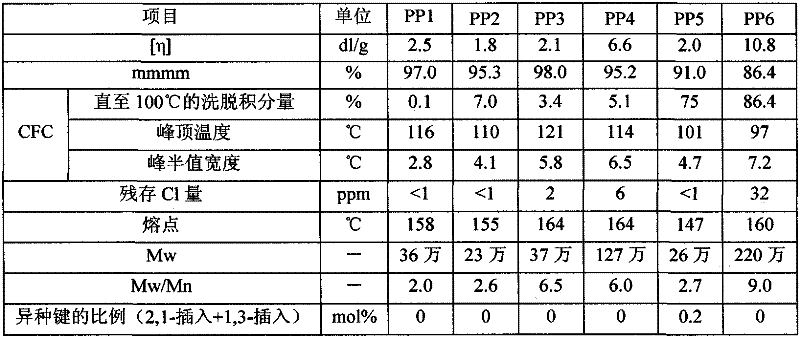
Provided is a polypropylene resin composition for microporous film formation having excellent heat resistance and a low heat-shrinkage ratio. This polypropylene resin composition for microporous film formation has as an essential component a propylene monopolymer (A) which meets the following conditions (1)-(4) and (7). (1) The limiting viscosity [Eta] is 1 dl / g or greater but less than 7 dl / g. (2) The mesopentad fraction is in the range of 94.0-99.5%. (3) When the temperature increases, the integral elution quantity up to 100 DEG C is 10% or less. (4) The melting point is 153-167 DEG C. (7) For the elution temperature-elution quantity curve, the peak top temperature of the maximum peak is 105-130 DEG C and the half-value width of said peak is 7.0 DEG C or less.

Description

technical field [0001] The present invention relates to a polypropylene resin composition for forming a microporous film having excellent heat resistance and low heat shrinkage rate. Background technique [0002] Microporous membranes made of polymer materials are used in various applications such as medical and industrial filtration membranes, separation membranes, separators for batteries, separators for capacitors, and the like. [0003] In particular, the demand for secondary batteries, which are used as power sources for mobile phones, notebook computers, and automobiles, is increasing, and the demand for separators for batteries is also increasing. However, battery separators made of conventional polymer materials are insufficient in various properties, and satisfactory performance cannot be obtained particularly in terms of heat resistance and thermal shrinkage rate. [0004] In order to improve the characteristics of battery separators, polyethylene (PE) and polypro...

Claims

the structure of the environmentally friendly knitted fabric provided by the present invention; figure 2 Flow chart of the yarn wrapping machine for environmentally friendly knitted fabrics and storage devices; image 3 Is the parameter map of the yarn covering machine
Login to View More

Application Information

Patent Timeline
no application Login to View More
Patent Type & Authority Applications(China)
IPC IPC(8): C08J9/26C08K3/00C08L23/06C08L23/12H01G9/02H01M2/16H01M50/417
CPCY02E60/12C08F4/65916C08L23/04H01M10/0525C08F4/65927C08L2314/06Y02E60/13H01G9/155H01G9/02C08L23/12C08F4/65912H01M2/1653C08F110/06C08L2666/06Y02E60/10H01G11/52H01M50/417C08F2/14C08F2/001C08F2500/17C08J9/26H01M50/409H01M50/411H01M50/489H01M50/491
Inventor 田村聪板仓启太津乘良一桥诘聪
Owner MITSUI CHEM INC
Features
  • R&D
  • Intellectual Property
  • Life Sciences
  • Materials
  • Tech Scout
Why Patsnap Eureka
  • Unparalleled Data Quality
  • Higher Quality Content
  • 60% Fewer Hallucinations
Social media
Patsnap Eureka Blog
Learn More