
2-phenyl-1h-benzimidazole-4-formic ether derivative serving as PARP (poly(ADP-ribose)polymerase) inhibiting agent
A technology of benzimidazole and methyl formate, applied in the field of medicinal chemistry, can solve problems such as no drugs
Patent Information
- Authority / Receiving Office
- CN · China
- Current Assignee / Owner
- Publication Date
- 2012-04-18
- Estimated Expiration
- Not applicable · inactive patent
Smart Images
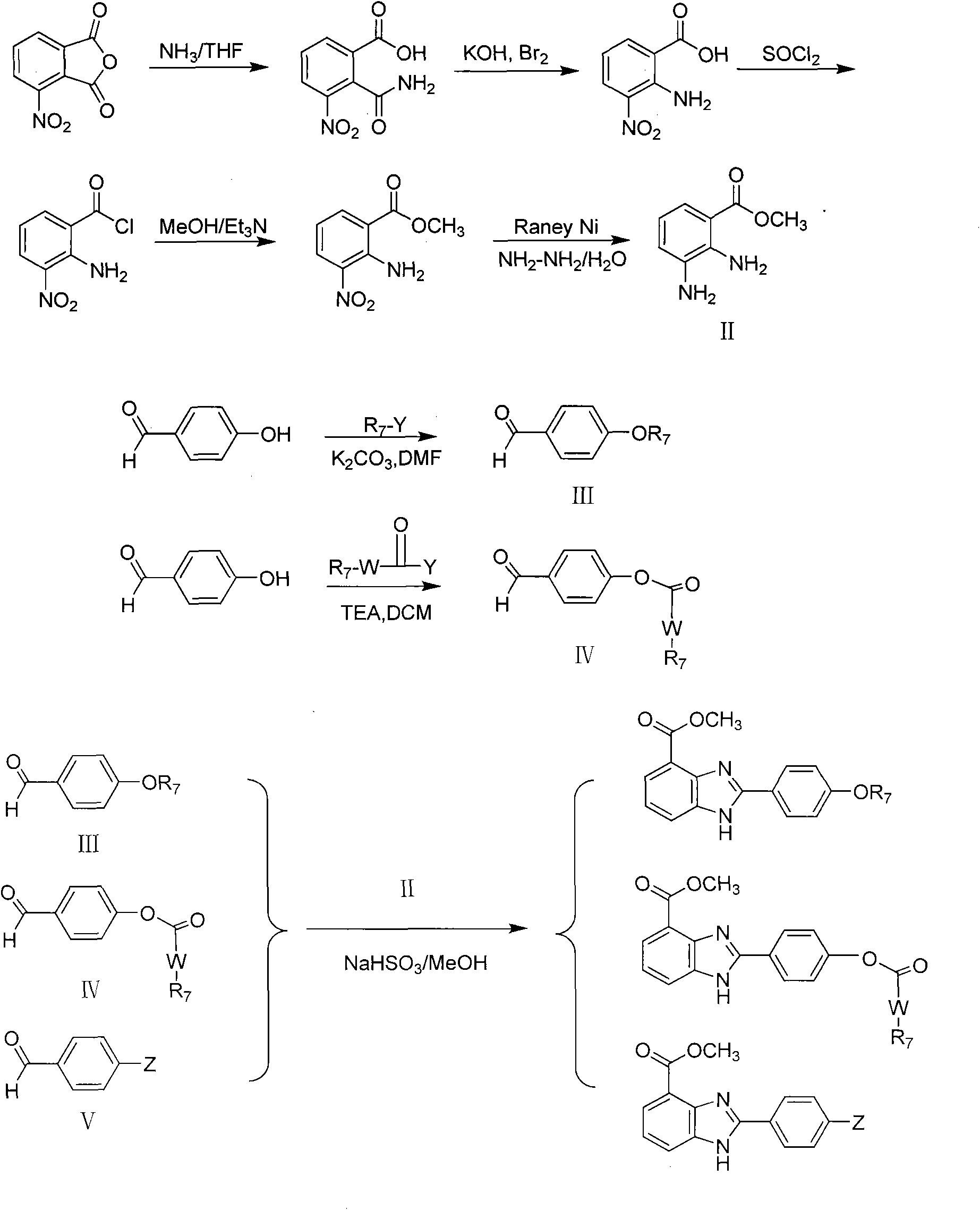
Figure 1 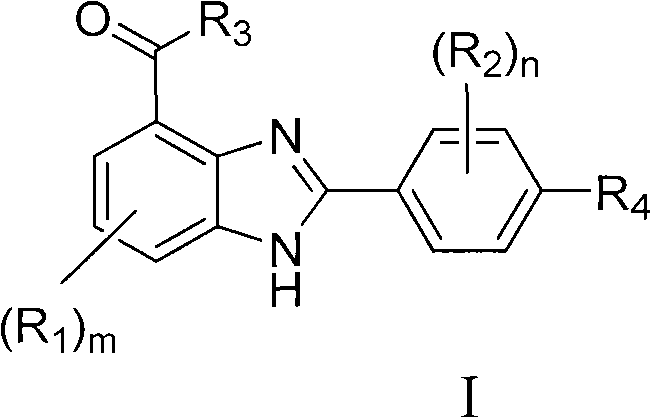
Figure 2 
Figure 3
Abstract
Description
technical field
[0001] The invention relates to the field of medicinal chemistry, in particular to a novel class of 2-phenyl-1H-benzimidazole-4-carboxylate PARP inhibitors. The invention also discloses the preparation method and medical application of the compound. Background technique
[0002] Poly ADP-ribose polymerases (poly(ADP-ribose) polymerases, PARPs) are a protein superfamily in eukaryotic cells, containing at least 18 subtypes. Their common feature is that the catalytic region at the C-terminus can catalyze the cleavage of the substrate NAD + to nicotinamide and ADP-ribose, and use the latter to poly-ADP-ribosylate itself and other target proteins. PARP enzyme is involved in many physiological processes of the body, such as DNA repair, gene transcription, cell cycle progression, cell death, chromosome stability, etc. (Pharmacological Research, 2005, 52: 25-33). Among them, PARP-1 and PARP-2 are mainly involved in DNA damage repair, and the function of PARP-2 is ...
Examples
Embodiment 1
[0068] Synthesis of key intermediate 2,3-diaminobenzoic acid methyl ester (II)
[0069] (a) 3-nitro-2-carbamoylbenzoic acid
[0070] Dissolve 3-nitrophthalic anhydride (1.0g, 5.2mmol) in 20ml of dry tetrahydrofuran, stir at room temperature to dissolve, slowly add an appropriate amount of ammonia water dropwise, a white solid precipitates, continue to stir at room temperature for 4h, let stand for 20min, filter A white solid was obtained, left to stand, the residual solvent was evaporated to dryness, and recrystallized with dilute hydrochloric acid (10%) to obtain 0.9 g of a white solid, yield 87%, mp 208-208.5°C. 1 H-NMR (DMSO-d 6 )d: 7.56 (1H, brs, -NH 2 ), 7.68-7.73 (1H, t, Ar-H), 7.79 (1H, brs, -NH 2 ), 8.10-8.13 (1H, m, Ar-H), 8.16-8.19 (1H, m, Ar-H), 13.45 (1H, brs, -COOH); MS m / z: 211.0 [M+H] + , 233.0[M+Na] + , 249.0[M+K] + ; IR(KBr, cm -1 ): 3463, 3188, 1668, 1529.
[0071] (b) 2-Amino-3-nitrobenzoic acid
[0072] Dissolve 5g of KOH in 20ml of water to prepar...
Embodiment 2
[0079] Synthesis of 2-(4-hydroxyphenyl)-1H-benzimidazole-4-carboxylic acid methyl ester
[0080] Methyl 2,3-diaminobenzoate (0.28g, 1.6mmol) and p-hydroxybenzaldehyde (0.18g, 1.5mmol) were dissolved in 20ml of methanol and an appropriate amount of NaHSO was added 3 , Heated to reflux for 6h, filtered the reaction solution, and distilled off methanol. Add appropriate amount of silica gel to make sand and apply column chromatography (petroleum ether: ethyl acetate = 1:2) to separate about 0.4 g of light yellow homologue, yield 81%, mp 257-258°C. 1 H-NMR (CDCl 3 )d: 3.98 (3H, s, -OCH 3 ), 6.93-6.95 (2H, m, Ar-H), 7.30-7.33 (1H, m, Ar-H), 7.79-7.81 (1H, m, Ar-H), 7.90-7.91 (1H, m, Ar-H) -H), 8.13-8.14 (2H, m, Ar-H); MS m / z: 269.3 [M+H] + ; IR(KBr, cm -1 ): 3417, 1695, 1440, 1280; Elementary Analysis: C 15 h 12 N 2 o 3 0.3H 2 O, calcd (C 65.8, H 4.64, N 10.23), Found (C 66.10, H 4.48, N 9.84).
Embodiment 3
[0082] Synthesis of 2-(4-bromophenyl)-1H-benzimidazole-4-carboxylic acid methyl ester
[0083] Refer to Example 2 for the method. Yield: 72%, mp 123-124°C. 1 H-NMR (CDCl 3 )d: 4.04 (3H, s, -CH 3 ), 7.26-7.37 (1H, m, Ar-H), 7.67-7.70 (2H, m, Ar-H), 7.92-7.97 (1H, m, Ar-H), 8.01-8.02 (2H, m, Ar-H -H), 8.03-8.05 (1H, m, Ar-H); MS m / z: 333.0 [M+H] + , 353.0[M+Na] + ; IR(KBr, cm -1 ): 3446, 1703, 1282, 750; Elementary Analysis: C 15 h 11 N 2 o 2 , calcd (C 54.40, H 3.34, N 8.45), Found (C 54.00, H 3.67, N 8.23).