
Transition metal sulfide/graphene composite material, and preparation method and application thereof
A transition metal and composite material technology, applied in electrical components, battery electrodes, circuits, etc., can solve the problems of capacity decay and large volume change, and achieve the effects of small particle size, simple process and low energy consumption
- Summary
- Abstract
- Description
- Claims
- Application Information
AI Technical Summary
Problems solved by technology
Method used
Image

Examples
Embodiment 1
[0035] with CoCl 2 ·6H 2 O as a raw material was dissolved in deionized water to prepare 80 ml of Co 2+ The concentration is 0.015mol / L solution, then add 45 mg GO and make mixed solution after fully stirring and dispersing; 2 ·6H 2 (2 times of molar weight) joins above-mentioned mixed solution, then transfers to capacity and is in the autoclave (filling degree 80%, percent by volume) of 100 milliliters, then reactor is sealed, reacts 24 hours at 180 ℃, naturally Cool to room temperature; collect the solid reaction product, wash the product alternately and repeatedly with deionized water and absolute ethanol, and dry it under vacuum at 60°C to obtain 0.16g CoS 2 / graphene composite material, wherein the weight percentage of graphene is 10.6%.
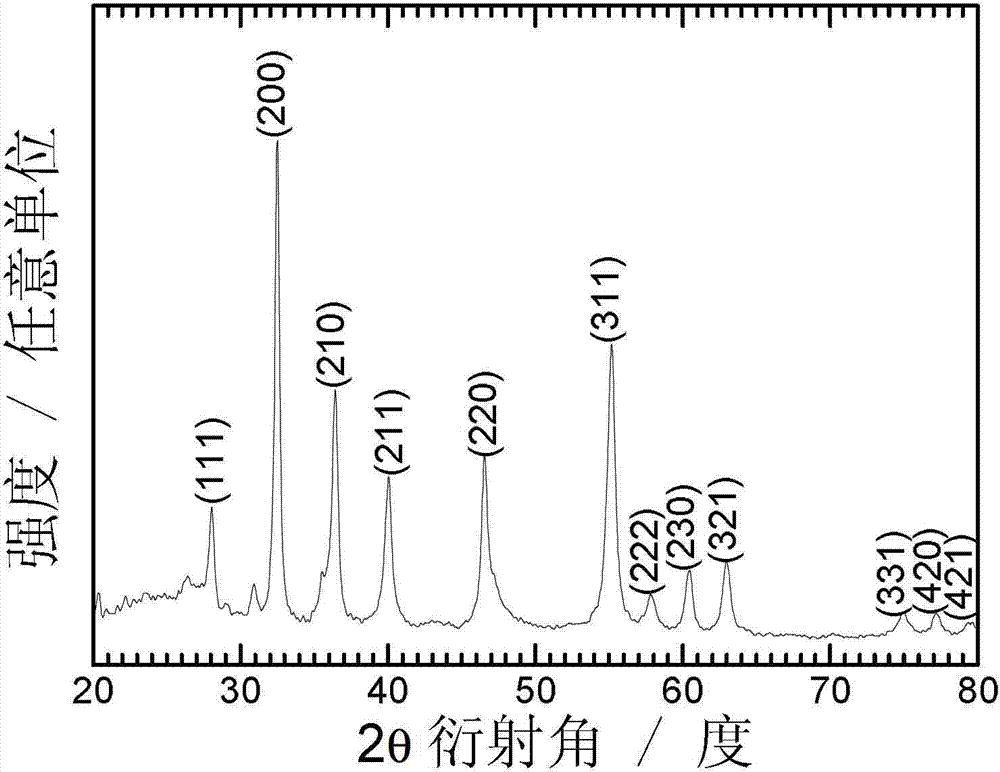
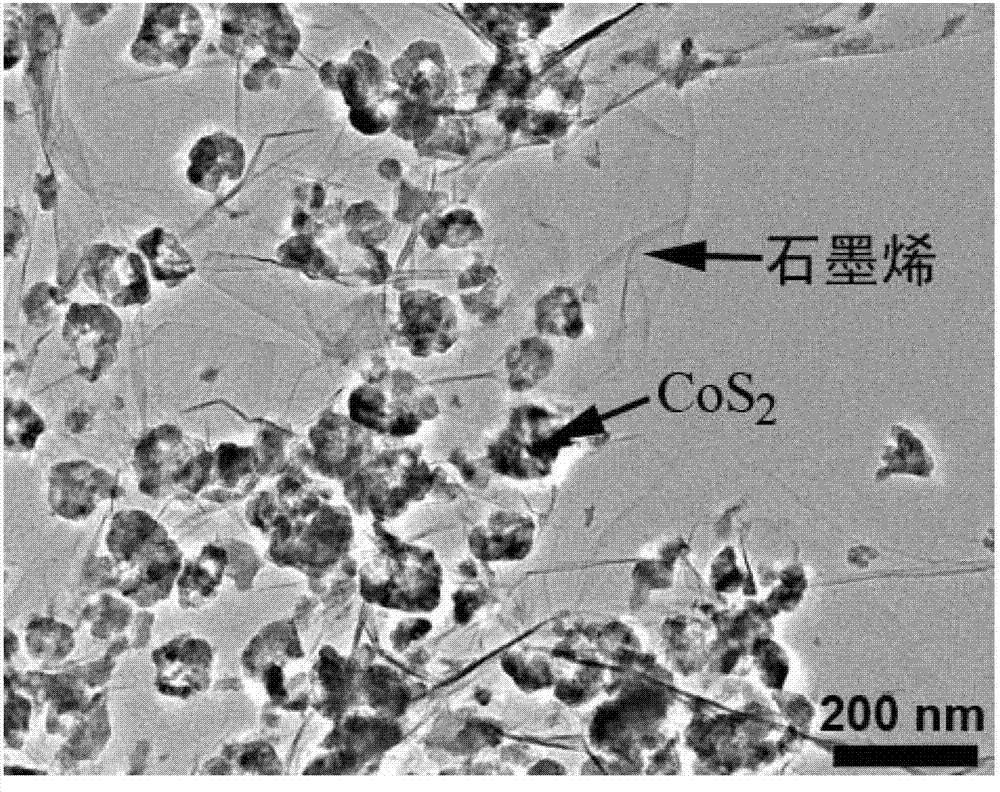
[0036] The X-ray diffraction spectrum and transmission electron microscope photograph of the composite material of gained are respectively as follows figure 1 and figure 2 , it can be seen that the obtained composite material is ...
Embodiment 2
[0039] FeC 2 o 4 2H 2 O is the raw material, which is dissolved in ethylene glycol and prepared into 80 ml of Fe 2+ A solution with a metered concentration of 0.03mol / L, and then add 42 mg of GO to prepare a mixed solution after fully stirring and dispersing; then add Na 2 S (the amount used is FeC 2 o 4 2H 2 (2.5 times of molar weight) joins above-mentioned mixed solution, then transfers to capacity and is in the autoclave (filling degree 80%, percent by volume) of 100 milliliters, then reactor is sealed, reacts 12 hours at 220 ℃, naturally Cool to room temperature; collect the solid reaction product, wash the product alternately and repeatedly with deionized water and absolute ethanol, and dry it under vacuum at 60°C to obtain 0.23g FeS / graphene composite material, wherein the weight percentage of graphene is 7.2 %.
[0040] It can be seen from the X-ray diffraction pattern and the transmission electron microscope photo of the obtained composite material that the obta...
Embodiment 3
[0043] With Mn(NO 3 ) 2 4H 2 O is the raw material, which is dissolved in absolute ethanol to make 80 ml of Mn 2+ A solution with a concentration of 0.09mol / L was added, and then 85 mg of GO was added to obtain a mixed solution after fully stirring and dispersing; then CS 2 (Use amount is Mn(NO 3 ) 2 4H 2 (3 times of molar weight) joins above-mentioned mixed solution, then transfers to capacity and is in the autoclave (filling degree 80%, percent by volume) of 100 milliliters, then reactor is sealed, reacts 48 hours at 170 ℃, naturally Cool to room temperature; collect the solid reaction product, wash the product alternately and repeatedly with deionized water and absolute ethanol, and dry it under vacuum at 60°C to obtain 0.89g MnS 2 / graphene composite material, wherein the weight percentage of graphene is 3.8%.
[0044] It can be seen from the X-ray diffraction pattern and transmission electron microscope photo of the composite material obtained that the composite ma...
PUM
| Property | Measurement | Unit |
|---|---|---|
| diameter | aaaaa | aaaaa |
Abstract
Description
Claims
Application Information
 Login to View More