Synthetic method for indole-3-carboxaldehyde compounds
What is AI technical title?
AI technical title is built by Patsnap AI team. It summarizes the technical point description of the patent document.
A technology of indole formaldehyde and synthesis method, applied in the direction of organic chemistry, etc.
Active Publication Date: 2012-11-21
FUJIAN TIANFU BIOTECH DEV CO LTD
View PDF3 Cites 0 Cited by
Summary
Abstract
Description
Claims
Application Information
AI Technical Summary
This helps you quickly interpret patents by identifying the three key elements:
Problems solved by technology
Method used
Benefits of technology
Problems solved by technology
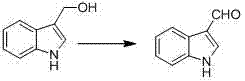
[0005] literature (Synlett, 2008 (13), 2023-2027) reported that 3-indole carbinol was oxidized by PCC as raw material to obtain 3-indole formaldehyde. Post-processing is difficult, not suitable for industrial production
Method used
the structure of the environmentally friendly knitted fabric provided by the present invention; figure 2 Flow chart of the yarn wrapping machine for environmentally friendly knitted fabrics and storage devices; image 3 Is the parameter map of the yarn covering machine
View more
Image
Smart Image Click on the blue labels to locate them in the text.
Viewing Examples
Smart Image
Click on the blue label to locate the original text in one second.
Reading with bidirectional positioning of images and text.
Smart Image
Examples
Experimental program
Comparison scheme
Effect test
Embodiment 1
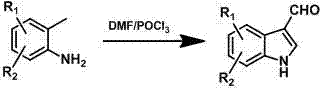
[0034] Add o-methylaniline (10 g, 93 mmol) and 10 ml of DMF into the flask, and slowly add 20 ml of Vilsmeier reagent prepared dropwise at 0°C. After the dropwise addition, stir at room temperature (about 25°C) for 1 hour. Then the temperature was raised to 85° C., and the reaction was heated for 5 hours. After the completion of the detection reaction, a saturated sodiumcarbonate solution was added until it was alkaline, and a large amount of solids were precipitated, filtered, and dried to obtain 12.4 grams of solids, with a yield of 96%. The resulting product had a melting point of 198-199°C.
[0038] 4-Amino-3-methylphenol (15 g, 121.8 mmol) and 10 ml of DMF were added to the flask, and 20 ml of the prepared Vilsmeier reagent was slowly added dropwise at 0°C. After the dropwise addition was complete, stir at room temperature for 1 hour. Then the temperature was raised to 85° C., and the reaction was heated for 7 hours. After completion of the reaction, saturated sodiumcarbonate solution was added until it was alkaline, and a large amount of solids were precipitated. After filtration and drying, 18 grams of solids were obtained, with a yield of 92%. The resulting product had a melting point of 235°C.
[0042] 2,3-Dimethyl-aniline (10 g, 82.5 mmol) and 10 ml of DMF were added to the flask, and 25 ml of the prepared Vilsmeier reagent was slowly added dropwise at 0°C. After the dropwise addition was complete, stir at room temperature for 1 hour. Then the temperature was raised to 85° C., and the reaction was heated for 7 hours. After the reaction was complete, saturated sodium carbonate solution was added until it was alkaline, and a large amount of light yellow solids were precipitated, which were filtered and dried to obtain 11.8 g of solids, with a yield of 90%. The resulting product had a melting point of 198-199°C.
the structure of the environmentally friendly knitted fabric provided by the present invention; figure 2 Flow chart of the yarn wrapping machine for environmentally friendly knitted fabrics and storage devices; image 3 Is the parameter map of the yarn covering machine
Login to View More
PUM
Login to View More
Abstract
The invention discloses a synthetic method for indole-3-carboxaldehyde compounds. The synthetic method comprises the following steps: (1) using anhydrousdimethylformamide as a solvent, and slowly adding phosphorus oxychloride, and agitating for 30 minutes at 0 to 5 DEG C so as to obtain a Vilsmeier agent; (2) using the anhydrousdimethylformamide as the solvent, adding 2-methylaniline compounds shown in the formula (I), dropping the Vilsmeier agent prepared in step (1) at 0 to 5 DEG C, agitating for 1 to 2 hours at room temperature after dropping, and heating for reflux to react for 5 to 8 hours; and (3) cooling after the reaction, adding a saturated sodiumcarbonate solution to adjust to alkalinity, filtering the precipitated solid, an drying to obtain a product, and finally recrystallizing the product to obtain the indole-3-carboxaldehyde compounds as shown in the formula (II). The method disclosed by the invention is simple to operate, and low in cost of production, and is not only suitable for small-scale preparation in a laboratory, but also suitable for large-scale industrial production.
Description
technical field [0001] The invention relates to a synthesis method of a class of 3-indole formaldehyde heterocyclic compounds, in particular to a synthesis method of 3-indole formaldehyde compounds. Background technique [0002] In the prior art, some of the disclosed 3-indole formaldehyde heterocyclic compounds are important intermediates for the synthesis of many drugs, such as sumatriptan, naratriptan, zolmitriptan, ritriptan, etc. for the treatment of neurological diseases. Zatriptan; the lipid-lowering drugfluvastatin; ondansetron for the treatment of carcinoid syndrome, etc. 3-Indolecarboxaldehyde is one of the best-selling benzo five-membered heterocyclic compounds on the market. [0003] 3-Indolecarboxaldehyde has been reported in the literature and has a variety of synthetic methods, the most important of which is to synthesize indole as a raw material. First, some substituted anilines are used as raw materials to synthesize indole by high-temperature and high-pr...
Claims
the structure of the environmentally friendly knitted fabric provided by the present invention; figure 2 Flow chart of the yarn wrapping machine for environmentally friendly knitted fabrics and storage devices; image 3 Is the parameter map of the yarn covering machine
Login to View More
Application Information
Patent Timeline
Application Date:The date an application was filed.
Publication Date:The date a patent or application was officially published.
First Publication Date:The earliest publication date of a patent with the same application number.
Issue Date:Publication date of the patent grant document.
PCT Entry Date:The Entry date of PCT National Phase.
Estimated Expiry Date:The statutory expiry date of a patent right according to the Patent Law, and it is the longest term of protection that the patent right can achieve without the termination of the patent right due to other reasons(Term extension factor has been taken into account ).
Invalid Date:Actual expiry date is based on effective date or publication date of legal transaction data of invalid patent.



 Login to View More
  Login to View More