Graphite material for negative electrodes of lithium secondary battery, manufacturing method for said material, and lithium secondary battery using same

A technology of graphite material and secondary battery, applied in secondary batteries, battery electrodes, graphite, etc., can solve the problems of increased reduction and decomposition of electrolyte, capacity deterioration, etc., and achieves inhibition of capacity deterioration, high reliability, and inhibition of capacity maintenance. rate reduction effect

A technology of graphite material and secondary battery, applied in secondary batteries, battery electrodes, graphite, etc., can solve the problems of increased reduction and decomposition of electrolyte, capacity deterioration, etc., and achieves inhibition of capacity deterioration, high reliability, and inhibition of capacity maintenance. rate reduction effect

CN103155245AInactive Publication Date: 2013-06-12JX NIPPON OIL & ENERGY CORP +1

Image

Smart Image Click on the blue labels to locate them in the text.
Viewing Examples
Smart Image
  • Graphite material for negative electrodes of lithium secondary battery, manufacturing method for said material, and lithium secondary battery using same
  • Graphite material for negative electrodes of lithium secondary battery, manufacturing method for said material, and lithium secondary battery using same
  • Graphite material for negative electrodes of lithium secondary battery, manufacturing method for said material, and lithium secondary battery using same

Examples

Experimental program
Comparison scheme
Effect test

Embodiment

[0419] Hereinafter, based on examples and comparative examples, the first to third embodiments of the present invention will be described more specifically, but the present invention is not limited to the following examples.

[0420] 1. Raw material carbon composition and production method thereof

[0421] (1) Raw carbon composition A-1

[0422] Hydrodesulfurize the atmospheric distillation residue with a sulfur content of 3.1% by mass in the presence of a catalyst until the hydrocracking rate reaches 25% or less to obtain hydrodesulfurized oil. The hydrodesulfurization conditions are total pressure 180MPa, hydrogen partial pressure 160MPa, temperature 380°C. In addition, desulfurized vacuum light oil (with a sulfur content of 500 mass ppm and a density of 0.88 g / cm at 15°C 3 ) fluid catalytic cracking to obtain fluid catalytic cracking residue. The fluidized catalytic cracking residual oil is selectively extracted with dimethylformamide to be separated into aromatic compon...

Embodiment 1

[0648] In Examples 16 to 31 and Comparative Examples 19 to 46, the powders of raw carbon compositions A-3 to U-3 were mixed with calcined coke, and compressive shear stress was applied to obtain composite powders. Carry out carbonization and graphitization under the same conditions to obtain graphite material. Table 3 shows the average particle size of the calcined coke, the blending amount, and the conditions for applying compressive shear stress. Here, for Examples 16 to 28 and Comparative Examples 19 to 46, "NOBILTA Model 130" manufactured by HOSOKAWA MICRON CORPORATION was used as a device for applying compressive shear stress, and NIPPON COKE & ENGINEERING CO., LTD. was used in Examples 29 and 30. "COMPOSI CP-15" manufactured by HOSOKAWA MICRON CORPORATION and "Mechano Fusion AMS-Lab" manufactured by HOSOKAWA MICRON CORPORATION were used in Example 31. In addition, in Table 3, "NOBILTA130 type" is abbreviated as "N", "COMPOSI CP-15" is abbreviated as "C", and "Mechano Fu...

the structure of the environmentally friendly knitted fabric provided by the present invention; figure 2 Flow chart of the yarn wrapping machine for environmentally friendly knitted fabrics and storage devices; image 3 Is the parameter map of the yarn covering machine
Login to View More

PUM

PropertyMeasurementUnit
sizeaaaaaaaaaa
particle sizeaaaaaaaaaa
sizeaaaaaaaaaa
Login to View More

Abstract

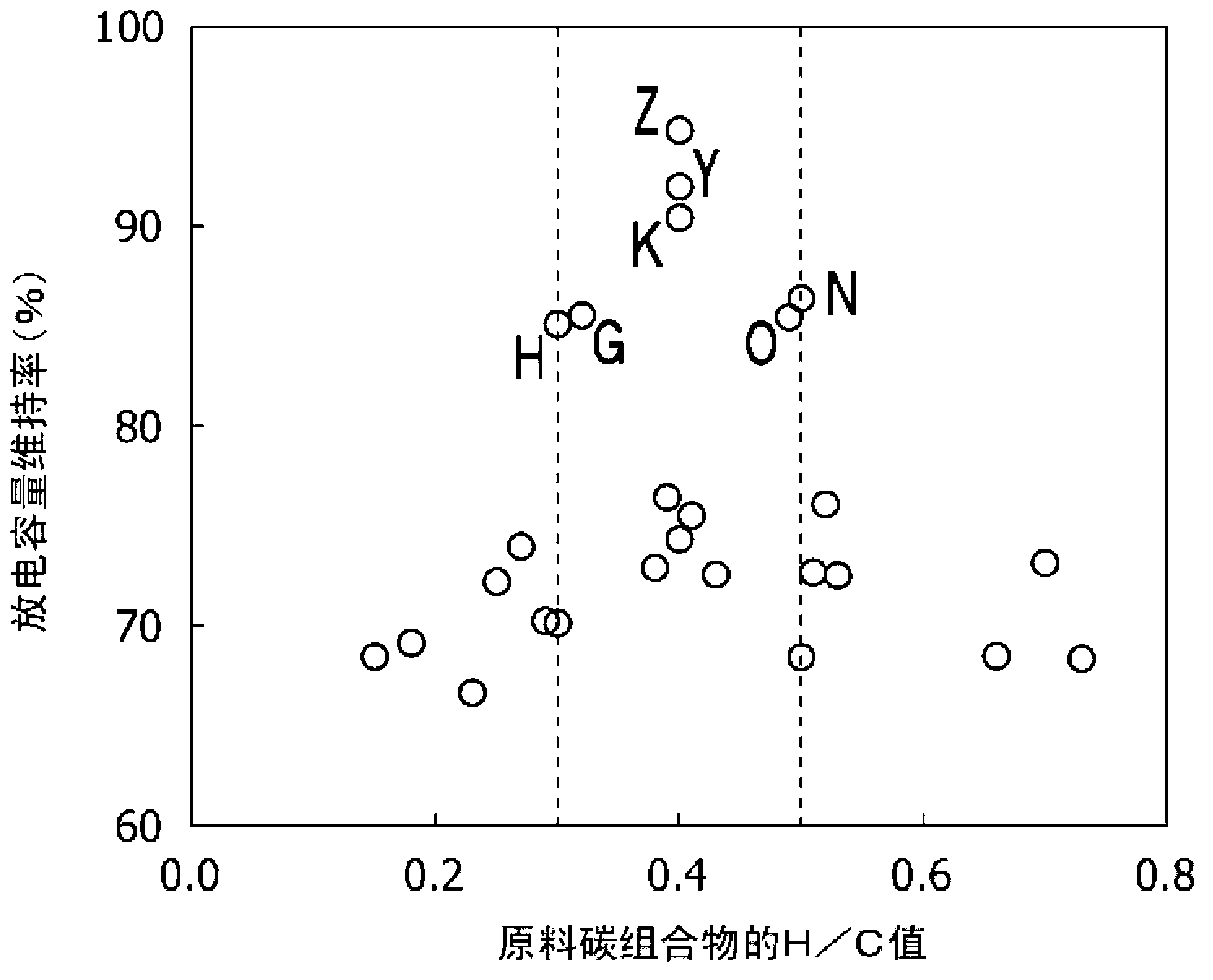
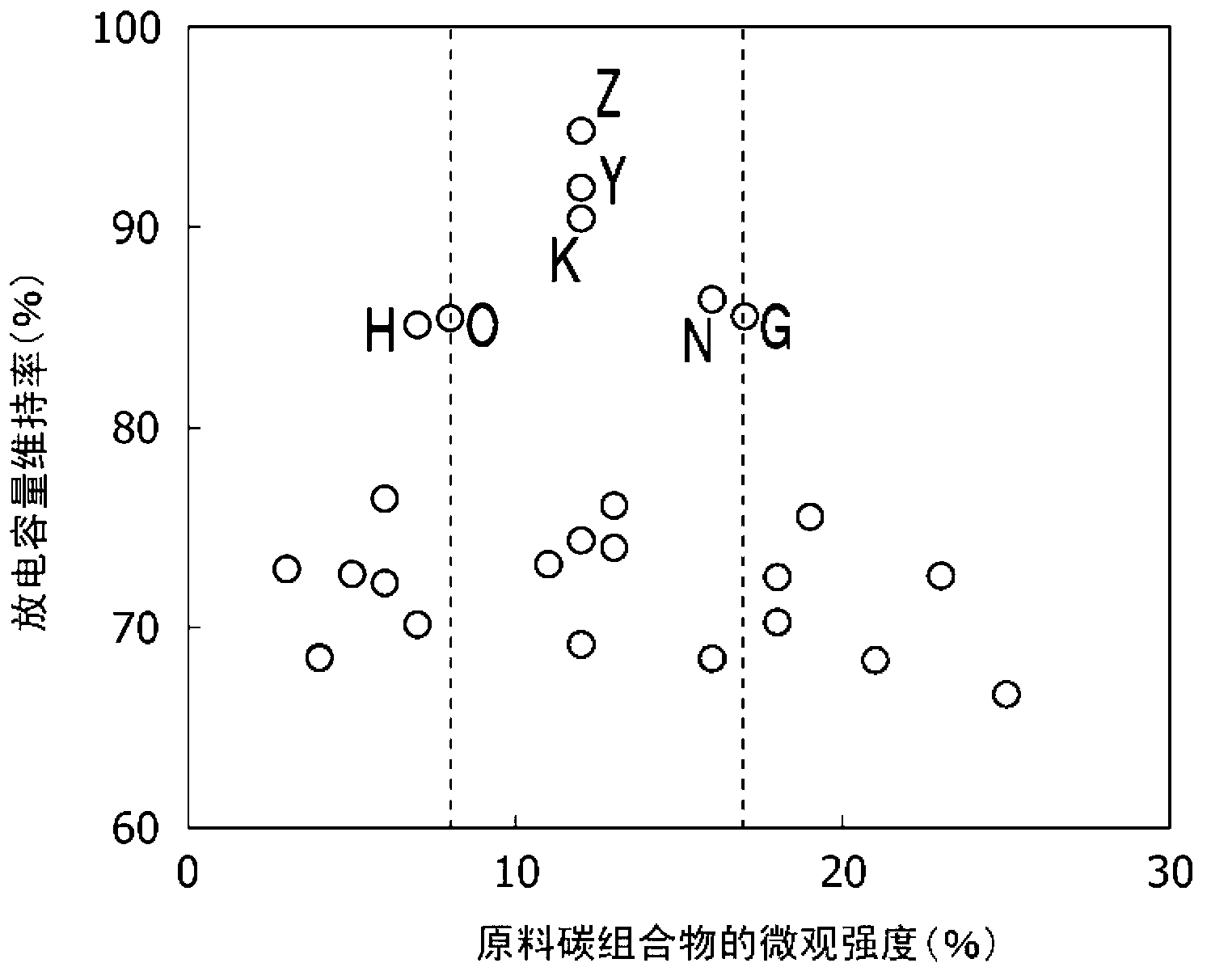
Provided is an graphite material for negative electrodes, which is capable of mitigating the capacitance degradation that accompanies repeated charge / discharge cycles, storage in a charged state, and float charging. Provided is a manufacturing method for a graphite material for the negative electrode of a lithium ion secondary battery, wherein the starting material carbon composition has an hydrogen atom to carbon atom atomic ratio (H / C) of 0.30-0.50, and a microstrength of 7-17 mass%.

Description

technical field [0001] The invention relates to a graphite material used as a negative electrode of a lithium secondary battery and a manufacturing method thereof. Specifically, it relates to a method for producing a graphite material used in a negative electrode of a lithium ion secondary battery having high durability while suppressing capacity degradation, and a lithium ion secondary battery including a negative electrode using the graphite material. Background technique [0002] Lithium-ion secondary batteries are lighter in weight and have higher input and output characteristics than conventional secondary batteries such as nickel-cadmium batteries, nickel-metal hydride batteries, and lead batteries. Therefore, in recent years, they have been prepared as power sources for electric vehicles and hybrid vehicles. expected. Generally, such a battery is constructed by opposing a lithium-containing positive electrode capable of reversibly intercalating lithium and a negative...

Claims

the structure of the environmentally friendly knitted fabric provided by the present invention; figure 2 Flow chart of the yarn wrapping machine for environmentally friendly knitted fabrics and storage devices; image 3 Is the parameter map of the yarn covering machine
Login to View More

Application Information

Patent Timeline
12 Jun 2013
Publication
CN103155245A
IPC
H01M4/587; C01B31/04
CPC
C01B32/20; C01B32/205; H01M4/587; H01M10/0525; H01M10/0583; Y02E60/10; Y02P70/50
Inventors
铃木贵志; 石丸纪代