
Ethylene propylene diene monomer and preparation method thereof
A technology of EPDM rubber and ethylene, which is applied in the field of EPDM rubber and its preparation, can solve the problems of environmental pollution and vulcanization speed, and achieve the effect of good processing performance
Patent Information
- Authority / Receiving Office
- CN · China
- Patent Type
- Applications(China)
- Current Assignee / Owner
- Publication Date
- 2013-07-31
- Estimated Expiration
- Not applicable · inactive patent
Smart Images
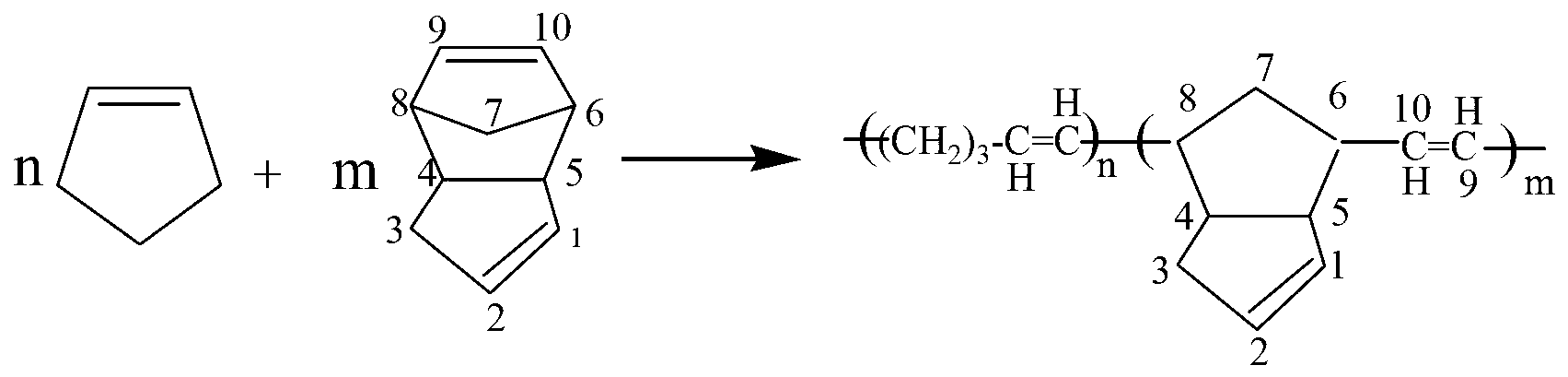
Figure 1 
Figure 2 
Figure 3
Abstract
Description
technical field
[0001] The present invention relates to a kind of ethylene-propylene-diene rubber and its preparation method, more specifically, to a kind of ethylene-propylene-diene rubber with cyclopentene-dicyclopentadiene liquid low molecular weight copolymer as the third monomer and its preparation method . Background technique
[0002] Ethylene-propylene rubber (EPR) is a general term for a binary polymer (EPM) obtained by copolymerizing ethylene and propylene or a terpolymer (EPDM) obtained by copolymerizing ethylene, propylene and a non-conjugated diene monomer. Compared with other rubber varieties, EPR has the following advantages: First, the main chain does not contain or contain a small amount of double bonds, making it an ozone-resistant, aging-resistant, chemical-resistant, high-temperature resistant hydrocarbon rubber; second, the specific gravity It is the lightest among elastomers, which helps to use the least material in a certain volume; third, it has exce...
Examples
preparation example 1
[0029] Preparation of Cyclopentene-Dicyclopentadiene Liquid Low Molecular Weight Copolymer 1
[0030] In a 0.5L reactor replaced with nitrogen, 54g of cyclopentene, 10g of dicyclopentadiene, 256g of toluene, 0.03MWCl 6 Toluene solution 7.5mL, 0.1M tetrachlorophenol toluene solution 3.7mL, 1.0M 1-butene hexane solution 15.7mL, stir evenly and keep the reaction material temperature at 0°C, then add 0.1M triisobutyl Aluminum toluene solution 6.7mL, keep the temperature and react for 3.0hr, add 32mL ethanol solution containing 1% 2,6-di-tert-butyl-4-methylphenol into the reactor after the polymerization reaction to terminate the reaction, and then release the glue Coagulate with ethanol, and dry the obtained polymer in a vacuum oven at 50° C. to a constant weight for use. The weight of the polymer is 52 g.
[0031] Obtaining cyclopentene content in cyclopentene-dicyclopentadiene liquid low molecular weight copolymer is 84.5% (wt), and dicyclopentadiene content is 15.5% (wt), and ...
preparation example 2
[0033] Preparation of cyclopentene-dicyclopentadiene liquid low molecular weight copolymer 2
[0034] Preparation Example 1 was basically repeated, except that 48 g of cyclopentene and 16 g of dicyclopentadiene were added respectively, the polymerization reaction temperature was 15° C., and the 1.0 M 1-butene hexane solution was 6.7 mL.
[0035] Obtaining cyclopentene content in cyclopentene-dicyclopentadiene liquid low molecular weight copolymer is 79.5, and dicyclopentadiene content is 21.5% (wt), and trans structure content is 90% in polycyclopentene, polymer molecular weight is 9500, the molecular weight distribution is 1.8.
preparation example 3
[0037] Preparation of cyclopentene-dicyclopentadiene liquid low molecular weight copolymer 3
[0038] Preparation Example 1 was basically repeated, except that 60 g of cyclopentene and 4 g of dicyclopentadiene were added respectively, the polymerization reaction temperature was -10° C., and the 1.0 M 1-butene hexane solution was 30 mL.
[0039] Obtaining cyclopentene content in cyclopentene-dicyclopentadiene liquid low molecular weight copolymer is 93.0, and dicyclopentadiene content is 7.0% (wt), and trans polymerization structure content is 70% in the polycyclopentene, polymer molecular weight It is 1800, and the molecular weight distribution is 1.8.