
Method for detecting manganese content in graphene oxide and graphene samples
A manganese content and graphene technology, which is applied in the field of new energy materials, can solve the problems of reduced manganese content accuracy, loss, sample scattering, etc., and achieves the effect of simple method, easy implementation, and satisfactory detection accuracy.
- Summary
- Abstract
- Description
- Claims
- Application Information
AI Technical Summary
Problems solved by technology
Method used
Image

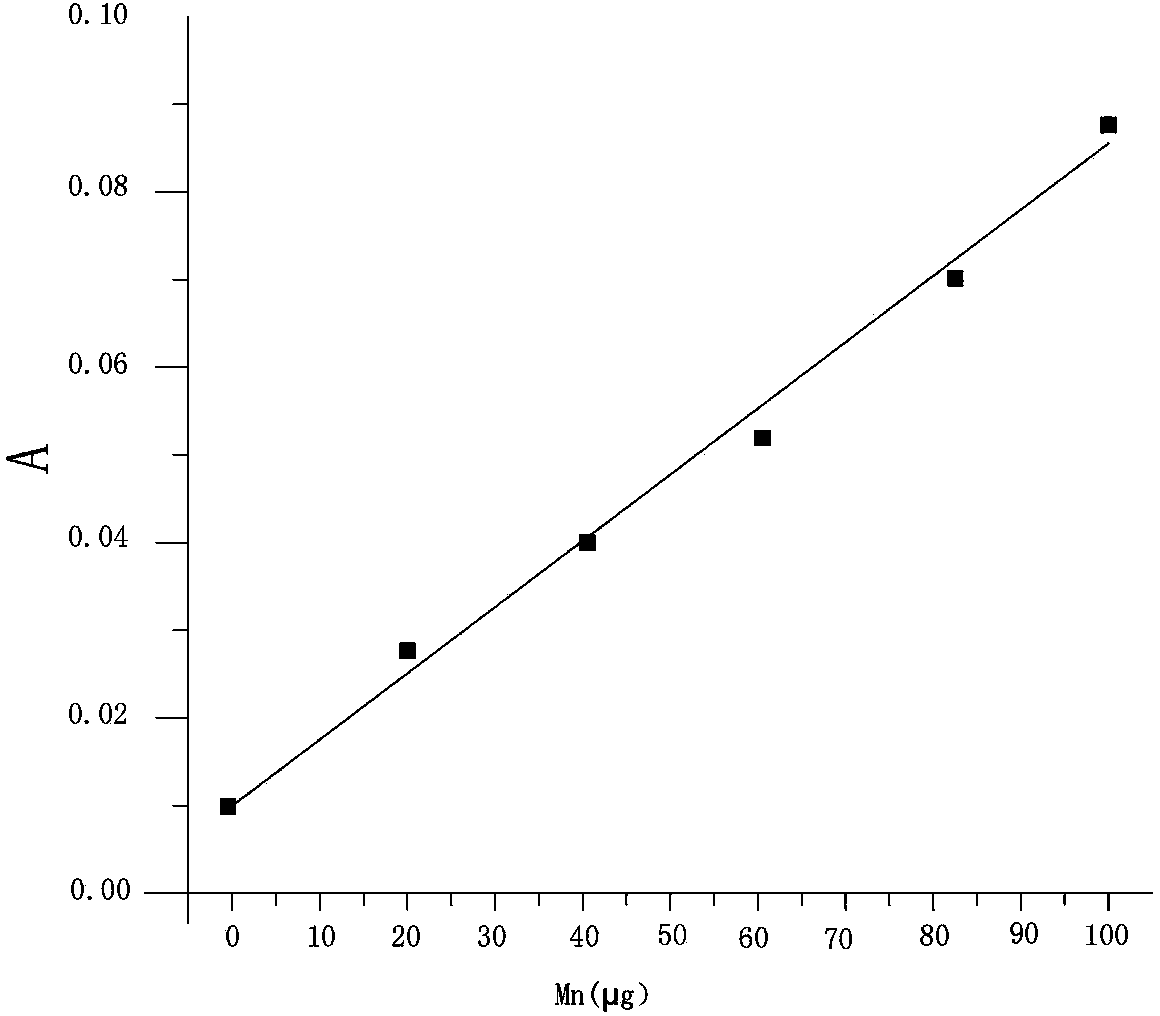
Examples
Embodiment 1
[0022] (1) Accurately weigh 0.5000g of graphene oxide, accurate to 0.0001g;
[0023] (2) Place the sample in a quartz crucible, spread it flat, and add concentrated sulfuric acid dropwise until the sample is completely covered and blackened;
[0024] (3) Place the quartz crucible in an electric furnace and heat it until the yellow smoke dissipates;
[0025] (4) Take it out and place it in a muffle furnace and burn it at 900°C for 4 hours until the sample is completely burned and cooled;
[0026] (5) Add 10 mL of sulfuric acid with a density of 1.84 g / mL and 5 g of ammonium sulfate, cover with a watch glass, heat in an electric furnace until the residue is completely dissolved, cool, and rinse the watch glass and the crucible wall with distilled water;
[0027] (6) Add 1.5mL of nitric acid, add 40mL of distilled water, heat to near boiling, remove, add 0.3g of potassium periodate, heat and boil for 12min, cool, transfer to a 50mL volumetric flask, add distilled water to dilute...
Embodiment 2
[0030] (1) Accurately weigh 0.5000g of graphene, accurate to 0.0001g;
[0031] (2) Place the sample in a quartz crucible, spread it flat, and add concentrated sulfuric acid dropwise until the sample is completely covered and blackened;
[0032] (3) Place the quartz crucible in an electric furnace and heat it until the yellow smoke dissipates;
[0033] (4) Take it out and place it in a muffle furnace and burn it at 900°C for 4 hours until the sample is completely burned and cooled;
[0034] (5) Add 10 mL of sulfuric acid with a density of 1.84 g / mL and 5 g of ammonium sulfate, cover with a watch glass, heat in an electric furnace until the residue is completely dissolved, cool, and rinse the watch glass and the crucible wall with distilled water;
[0035] (6) Add 1.5mL of nitric acid, add 40mL of distilled water, heat to near boiling, remove, add 0.3g of potassium periodate, heat and boil for 12min, cool, transfer to a 50mL volumetric flask, add distilled water to dilute to th...
PUM
 Login to View More
 Abstract
Description
Claims
Application Information
 Login to View More