AI technical title is built by Patsnap AI team. It summarizes the technical point description of the patent document.
A compound, optionally a technology, applied in the field of medicine to achieve the effect of high yield, high purity and simple operation
Active Publication Date: 2014-01-01
HUBEI BIO PHARMA IND TECHCAL INST
View PDF8 Cites 8 Cited by
Summary
Abstract
Description
Claims
Application Information
AI Technical Summary
This helps you quickly interpret patents by identifying the three key elements:
Problems solved by technology
Method used
Benefits of technology
Problems solved by technology
[0004] However, the current method for preparing lapatinib still needs to be improved.
Method used
the structure of the environmentally friendly knitted fabric provided by the present invention; figure 2 Flow chart of the yarn wrapping machine for environmentally friendly knitted fabrics and storage devices; image 3 Is the parameter map of the yarn covering machine
View more
Image
Smart Image Click on the blue labels to locate them in the text.
Viewing Examples
Smart Image
Click on the blue label to locate the original text in one second.
Reading with bidirectional positioning of images and text.
Smart Image
Examples
Experimental program
Comparison scheme
Effect test
Embodiment 1
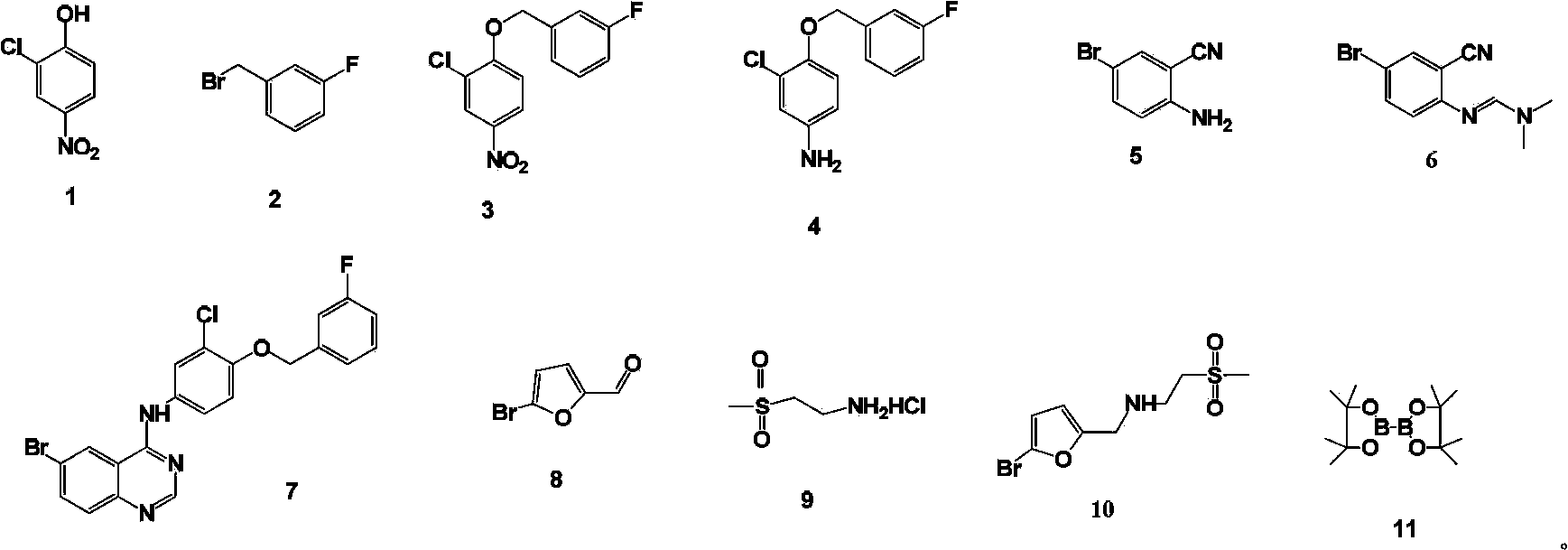
[0049] Weigh 100g of compound 1 in a 2L three-neck flask, stir mechanically, add 1000mL acetone and 76gK 2 CO 3 , heated to 20°C. After reacting for half an hour, 104 g of compound 2 was slowly added dropwise. After the addition, the reaction was carried out at 60°C for 4 hours. After the reaction, cool to room temperature, add water into the reaction bottle, stir, filter with suction, and wash the solid with ethanol to obtain compound 3, with a mass of 132 g and a yield of 94%.
Embodiment 2
[0051] Weigh 100g of compound 1 in a 2L three-neck flask, stir mechanically, add 1000mL CH 3 CN and 76g K 2 CO 3 , react at room temperature, react for half an hour and then slowly add 104g of compound 2 dropwise, after the addition, heat to reflux for 4 hours. After the reaction, cool to room temperature, add a large amount of water into the reaction bottle, stir, filter with suction, and wash the solid with a small amount of ethanol to obtain compound 3, with a mass of 134 g and a yield of 95%. 1 H-NMR (CDCl 3 )δ: 5.25(s,2H),7.00~7.07(m,2H),7.17~7.23(m,1H),7.26(s,1H),7.36~7.41(m,1H),8.11~8.14(m, 1H),8.29(d,J=3.2HZ,1H). 13 C-NMR (CDCl 3 )δ: 70.45(d, J=6.8HZ), 112.43, 113.85(d, J=88.8HZ), 115.38(d, J=83.6HZ), 122.41(d, J=12HZ), 123.83(d, J= 40HZ),126.16,130.47(d,J=32.8HZ),137.48(d,J=29.2HZ),141.53,158.89,161.82,164.27.MS(m / z):280.0[M-H] - .
Embodiment 3
[0053] Put 132g of compound 3 into a 2L three-neck flask, add 50mL of water and 1000mL of glacial acetic acid, stir, and heat to 50°C. After compound 3 is dissolved, slowly add 131g of iron powder in batches. After the addition, keep at 50°C for 30min to reduce When the temperature reached 25°C, the raw material disappeared, and the reaction was stopped. Add EA and water, separate the layers, and extract. The organic phase was washed three times with water, washed three times with saturated brine, dried, concentrated, and then added 6N~12N concentrated hydrochloric acid to make the product salted out, filtered, and then the solid and aqueous phase were adjusted to a basic pH, extracted with ethyl acetate, and dried. Spin-dried to obtain compound 4 with a mass of 82 g and a yield of 70%.
the structure of the environmentally friendly knitted fabric provided by the present invention; figure 2 Flow chart of the yarn wrapping machine for environmentally friendly knitted fabrics and storage devices; image 3 Is the parameter map of the yarn covering machine
Login to View More
PUM
Login to View More
Abstract
The present invention provides a preparation method of lapatinib. The method comprises contacting a compound shown as a formula 1 with a compound shown as a formula 2 to produce a compound shown as a formula 3; reducing the compound shown as the formula 3 to produce a compound shown as a formula 4; contacting a compound shown as a formula 5 with N,N-dimethylformamidedimethyl acetal to produce a compound shown as a formula 6; contacting the compound shown as the formula 6 with the compound shown as the formula 4 to produce a compound shown as a formula 7; in the presence of an acid, an alkali and NaNH(OAc)3, contacting a compound shown as a formula 8 with a compound shown as a formula 9 to produce a compound shown as a formula 10; in the presence of a catalyst and an alkali, contacting the compound shown as the formula 10 with a compound shown as a formula 11 to produce a transition intermediate, and contacting the transition intermediate with the compound shown as the formula 7 and p-toluenesulfonic acid to produce a compound shown as a formula I; through use of the method, the lapatinib can be effectively prepared.
Description
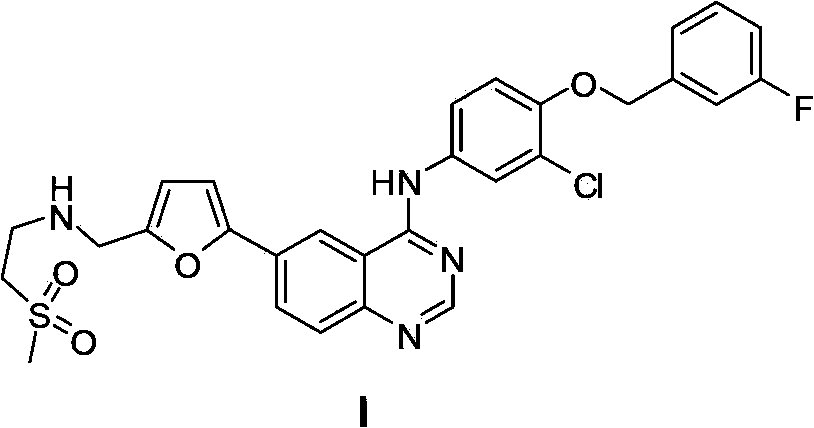
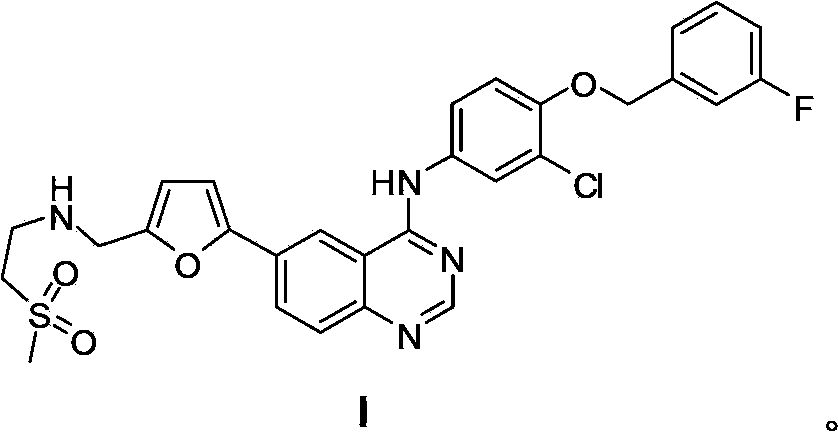
technical field [0001] The invention relates to the field of medicine, in particular, the invention relates to a preparation method of lapatinib. Background technique [0002] Lapatinib (Formula I) is a small moleculekinase inhibitor capable of simultaneously targeting human epidermal growth factorreceptor (EGFR) and human epidermal growth factorreceptor-2 (HER2), which was developed by GlaxoSmithKline and has been It was approved by the US FDA in March 2007 for the combined use of Roche's capecitabine (capecitabine / Xeloda) treatment. It has already received an anthracycline, a taxane and trastuzumab (trastuzumab / Herceptin) for progressive or metastatic breast cancer with tumors overexpressing HER2 treated with prior therapy. [0003] [0004] However, the current method for preparing lapatinib still needs to be improved. Contents of the invention [0005] The present invention aims at solving one of the above technical problems at least to a certain extent or at l...
Claims
the structure of the environmentally friendly knitted fabric provided by the present invention; figure 2 Flow chart of the yarn wrapping machine for environmentally friendly knitted fabrics and storage devices; image 3 Is the parameter map of the yarn covering machine
Login to View More
Application Information
Patent Timeline
Application Date:The date an application was filed.
Publication Date:The date a patent or application was officially published.
First Publication Date:The earliest publication date of a patent with the same application number.
Issue Date:Publication date of the patent grant document.
PCT Entry Date:The Entry date of PCT National Phase.
Estimated Expiry Date:The statutory expiry date of a patent right according to the Patent Law, and it is the longest term of protection that the patent right can achieve without the termination of the patent right due to other reasons(Term extension factor has been taken into account ).
Invalid Date:Actual expiry date is based on effective date or publication date of legal transaction data of invalid patent.


 Login to View More
  Login to View More