Refining process of hydrogen chloride

A hydrogen chloride and process technology, applied in the direction of chlorine/hydrogen chloride, chlorine/hydrogen chloride purification, chemical industry, etc., can solve problems affecting the purity of hydrogen chloride gas, troublesome operation, high cost, etc.

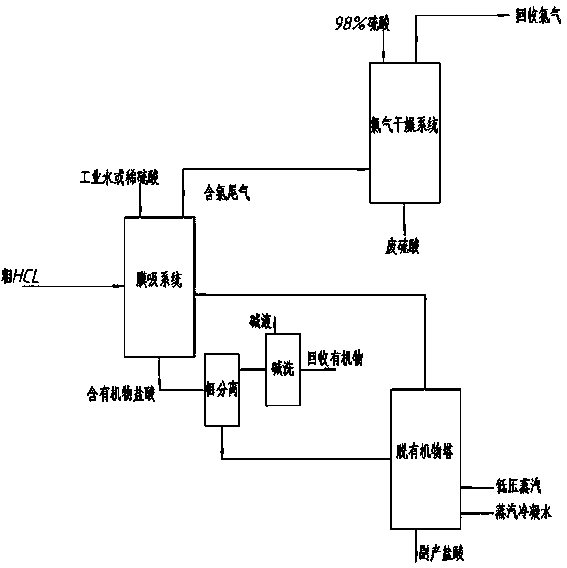
CN103508419AActive Publication Date: 2014-01-15NINGBO JUHUA CHEM TECH CO LTD
5 Cites 18 Cited by

Patent Information

Authority / Receiving Office
CN · China
Current Assignee / Owner
Publication Date
2014-01-15

Smart Images

  • Figure 1
    Figure 1
  • Figure 2
    Figure 2
Patent Text Reader

Abstract

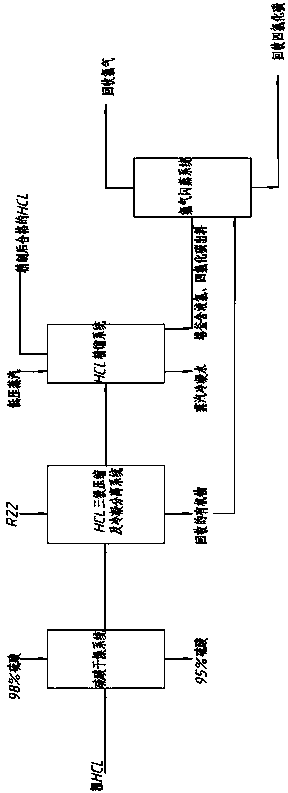
A refining process of hydrogen chloride comprises the following steps: allowing coarse hydrogen chloride to pass a sulfuric acid drying system for drying so as to remove moisture at room temperature; allowing the coarse hydrogen chloride to pass a three-stage compression and condensation separation system so as to enable the coarse hydrogen chloride to be compressed for three times, performing condensation, performing liquification separation to separate out part of impurities, allowing the coarse hydrogen chloride to pass a rectification system to enable high-purity hydrogen chloride to be extracted out by a vapor phase at the top of a tower, allowing the high-purity hydrogen chloride to pass a condenser for condensation and then to enter a backflow tank, and conveying hydrogen chloride gas which is positioned at the top of the backflow tank and subjected to pressure regulation to a user; heating a tower kettle of a float valve tower through low pressure steam, and extracting out chlorine and carbon tetrachloride according to a liquid phase of the liquid level. According to the process, purification of hydrogen chloride containing impurities such as chlorine and organic materials is realized, and the chlorine and the carbon tetrachloride can be separated out and extracted out; after the completion of the first stage compression and the second stage compression, condensation and separation are performed to remove the organic materials in advance so as to ensure long-term stable operation of a compressor; the high-purity hydrogen chloride can be obtained, industrial three wastes can not be produced, and energy saving and environmental protection are realized.
Need to check novelty before this filing date? Find Prior Art

Description

technical field

[0001] The invention relates to a process for improving the purity of hydrogen chloride gas, in particular to a process for purifying hydrogen chloride containing impurities such as chlorine gas and organic matter. Background technique

[0002] The PCE device will produce hydrogen chloride containing impurities such as chlorine gas and organic matter, among which the organic matter is mainly carbon tetrachloride. At present, hydrogen chloride containing impurities such as chlorine gas and organic matter is figure 1 The process flow shown is used for separation. Firstly, the crude hydrogen chloride is sent to the membrane suction system for absorption. The membrane suction system adopts two-stage membrane suction device and one-stage tail suction tower. The suction tower is added, and the crude hydrogen chloride passes through the primary membrane suction, the secondary membrane suction and the tail suction tower. The tail gas (mainly chlorine gas) that canno...

Examples

Embodiment Construction

[0018] Such as figure 2 Shown, the present invention is a kind of hydrogen chloride refining process, comprises the following steps:

[0019] 1. Dry the crude hydrogen chloride through a sulfuric acid drying system at room temperature, and add 98%wt sulfuric acid into the sulfuric acid drying system to remove the moisture in the crude hydrogen chloride gas. After defogging through the mist eliminator, the gas does not contain water and sulfuric acid, and then the gas with water removed is compressed and condensed in three stages to separate the system. After drying, the sulfuric acid concentration in the sulfuric acid drying system is about 95%wt.

[0020] The compressors of the second and third stage compression and condensation separation systems adopt D-type two-row three-stage compression differential oil-free hydrogen chloride compressors. Among them, the exhaust pressure of the first stage compression is 0.23-0.3MPaG. The gas after the first stage compression is first...