Method for recovering multiple metals through driving microbial electrolysis cells by microbial fuel cells

A microbial electrolysis cell and fuel cell technology, which is applied in the improvement of process efficiency, photography process, instruments, etc., can solve the problem of inability to fully recover heavy metals from electroplating wastewater

CN103966626AInactive Publication Date: 2014-08-06DALIAN UNIV OF TECH
9 Cites 19 Cited by

Patent Information

Authority / Receiving Office
CN · China
Current Assignee / Owner
Publication Date
2014-08-06
Estimated Expiration
Not applicable · inactive patent

Smart Images

  • Figure 1
    Figure 1
  • Figure 2
    Figure 2
  • Figure 3
    Figure 3
Patent Text Reader

Abstract

The invention relates to a method for recovering multiple metals through driving microbial electrolysis cells by microbial fuel cells, and belongs to the field of heavy metal recovery treatment. The method comprises the following steps: MFCsCr and MFCCu which adopt Cr(VI) and Cu(II) as cathode electron acceptors respectively are connected in series, the anodes of MFCsCr and MFCCu after series connection are connected with the cathode of MECsCd adopting Cd(II) as a cathode electron acceptor, the cathodes of the MFCsCr and MFCCu after series connection are connected with the anode of MECsCd through a series resistor, the cathodes of MFCsCr and MFCCu are carbon rods, the cathode of MECsCd is a stainless steel wire or a titanium sheet, and the anodes of MFCsCr, MFCCu and MECsCd are carbon felts or carbon rods. Through the adoption of the method, organic sewage such as electroplating wastewater, printed circuit board etching wastewater and municipal wastewater can be treated, and Cr metal, Cu metal and Cd metal are recovered, and broad space is provided for expanding the application field and the use range of an electrochemical system by MFCs output electric energy in situ.
Need to check novelty before this filing date? Find Prior Art

Description

technical field

[0001] The invention belongs to the field of recovery and treatment of heavy metals, in particular to a method for improving the recovery of polymetallics from a microbial fuel cell driven microbial electrolytic cell. Background technique

[0002] Both microbial fuel cells (Microbial Fuel Cells, MFCs) and microbial electrolysis cells (Microbial Electrolysis Cells, MECs) include an anode chamber, an anode electrode, a cathode chamber, a cathode electrode, and a proton exchange membrane. The difference is that the Gibbs free energy of the reaction between the cathode and anode of MFCs is less than zero, the reaction can proceed spontaneously, and the system outputs electric energy; on the contrary, the Gibbs free energy of the reaction between the cathode and anode of MECs is greater than zero, and the reaction cannot be spontaneous To proceed, the outside world needs to input energy to drive the reaction to proceed. MFCs that use output power to drive MECs th...

Examples

Embodiment 1

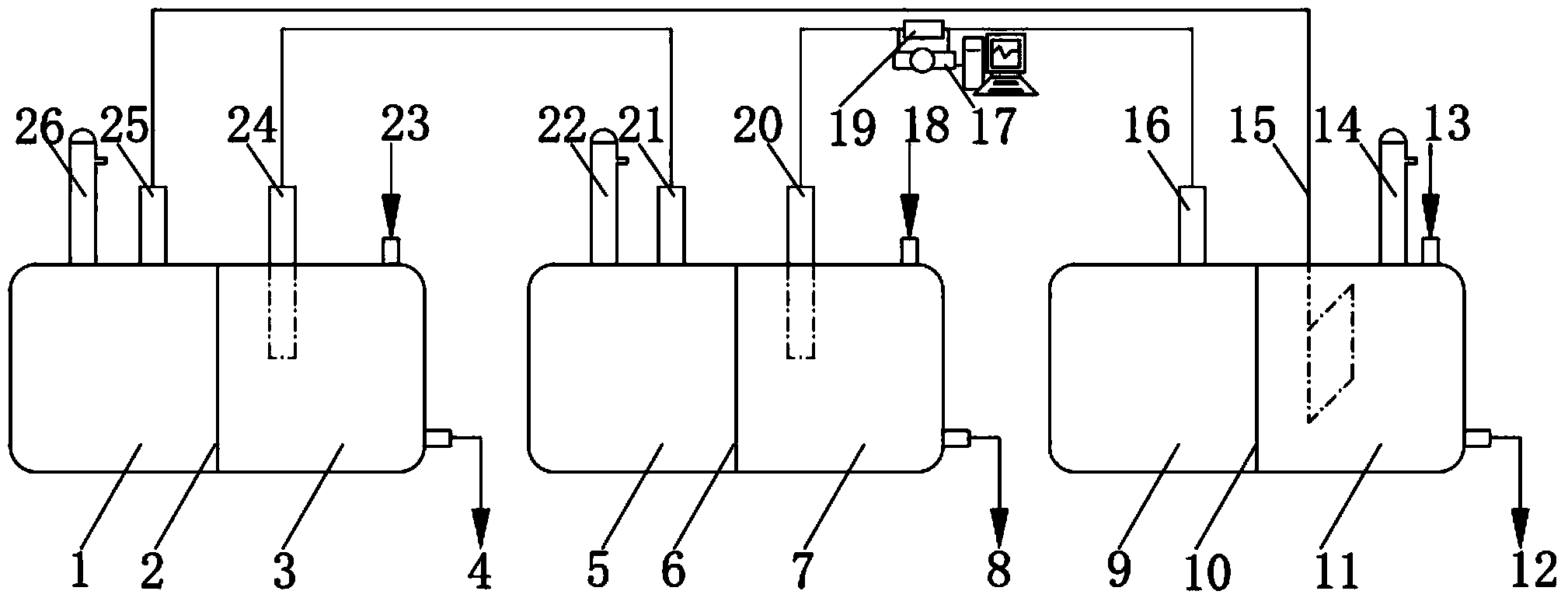
[0022] Step 1: Building MFCs Cr 、MFCs Cu and MECs Cd ,Such as figure 1 Shown: MFCs Cr Anode chamber, MFCs Cu Anode chamber, MECs Cd Anode chamber, MFCsCr cathode chamber, MFCs Cu Cathode chamber, MECs Cd The cathode chamber is made of plexiglass, MFCs Cr 、MFCs Cu and MECs Cd The volume of the solution in the anode compartment is 15mL, and the MFCs Cr 、MFCs Cu and MECs Cd The volume of the cathode chamber solution is 13mL, separated by ion exchange membrane (CMI-7000), MFCs Cr 、MFCs Cu and MECs Cd A small 10Ω resistor is connected in series to collect and calculate the current in the circuit.

[0023] Step 2: separate the MFCs Cr and MFCs Cu Anode electrodes (carbon rods or carbon felts) and cathode electrodes (carbon rods) are placed in MFCs Cr and MFCs Cu In the anode and cathode compartments, the MECs Cd Anode electrodes (carbon rods or carbon felts) and cathode electrodes (stainless steel mesh or titanium sheets or carbon rods) are placed in MECs Cd in ...