

Regeneration method of deactivated hydrogenation catalyst
A hydrogenation catalyst and deactivation technology, applied in catalyst regeneration/reactivation, chemical instruments and methods, physical/chemical process catalysts, etc., can solve the problems of inability to regenerate, catalyst deactivation, etc. And the effect of hydrodesulfurization activity and recovery activity
- Summary
- Abstract
- Description
- Claims
- Application Information
AI Technical Summary
Problems solved by technology
Method used
Image


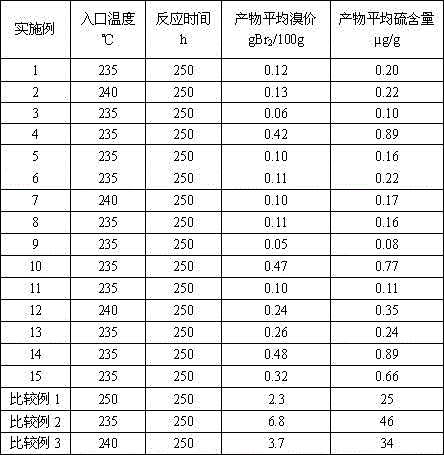
Examples
Embodiment 1
[0022] Using the traditional second stage catalyst for pyrolysis gasoline hydrogenation, the catalyst composition is: MoO 3 14~20%, CoO 1~6%, NiO 1~4%, and the rest γ-alumina carrier. The loading amount of the catalyst is 100ml. The reaction uses silicon-containing C 6 -C 8 The first-stage hydrogenation product of pyrolysis gasoline is used as the raw material, and the diene in the raw material is 0.0-2.0 gI 2 / 100g, bromine value is 15-40 gBr 2 / 100g, the sulfur content is 80-500 µg / g, the silicon content is 1-20 µg / g (by mass fraction), and the properties of the raw oil are shown in Table 1. At the reaction inlet temperature of 235°C, the volume space velocity is 2.8 h -1 , the hydrogen / oil volume ratio is 450, and the reaction pressure is 2.8 Mpa. After a period of operation, the main indicators in the reaction product have exceeded the standard for a long time, and the average bromine value of the 100-hour evaluation after exceeding the standard is greater than 2.0 ...
Embodiment 2
[0030] The components of the deactivated catalyst, the presulfidation conditions before the start-up reaction after the catalyst was regenerated, the raw materials and process conditions of the hydrogenation reaction were the same as in Example 1, only the regeneration conditions were changed. See Table 1 for the specific regeneration conditions, and see Table 2 for the average hydrogenation results after the catalyst was regenerated and driven for 250 hours.
[0031] The regeneration method includes the following steps:
[0032] a) Reduction: stop the feeding of liquid raw materials, feed hydrogen, and the GHSV of hydrogen is 1800h -1 , the temperature is raised to 300°C, the heating rate is 10-30°C / hour, and kept for 6 hours;
[0033] b) Oxidation burning: stop entering hydrogen, and pass nitrogen for replacement treatment, nitrogen GHSV is 2000h -1 , the temperature is raised to 480°C, and the heating rate is 10-30°C / hour; when the volume concentration of hydrogen in the ...
Embodiment 3
[0036] The components of the deactivated catalyst, the presulfidation conditions before the start-up reaction after the catalyst was regenerated, the raw materials and process conditions of the hydrogenation reaction were the same as in Example 1, only the regeneration conditions were changed. See Table 1 for the specific regeneration conditions, and see Table 2 for the average hydrogenation results after the catalyst was regenerated and driven for 250 hours.
[0037] The regeneration method includes the following steps:
[0038] a) Reduction: stop the feeding of liquid raw materials, feed hydrogen, the hydrogen GHSV is 2500h -1 , heat up to 330°C, the heating rate is 10-30°C / hour, and keep for 4 hours;
[0039] b) Oxidation scorching: stop entering hydrogen, pass nitrogen for replacement treatment, nitrogen GHSV is 3000h -1 , the temperature is raised to 450°C, and the heating rate is 10-30°C / hour; when the volume concentration of hydrogen in the reactor drops below 0.1%, a...
PUM
 Login to View More
 Abstract
Description
Claims
Application Information
 Login to View More