
Bi2WO6/BiOI heterojunction compound photocatalyst as well as preparation method and application thereof
A composite photocatalyst technology, applied in the field of photocatalysis, can solve the problems of easy recombination of photogenerated carriers, limited photocatalytic performance of semiconductor materials, slow photoelectron-hole separation, etc., to achieve simple process, good visible light absorption performance, low cost effect
- Summary
- Abstract
- Description
- Claims
- Application Information
AI Technical Summary
Problems solved by technology
Method used
Image

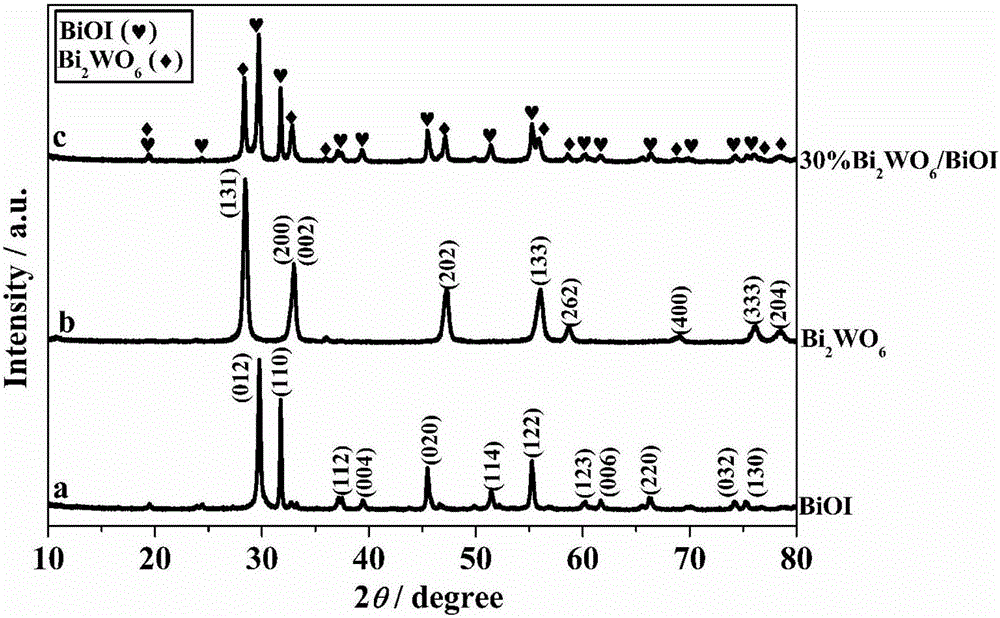
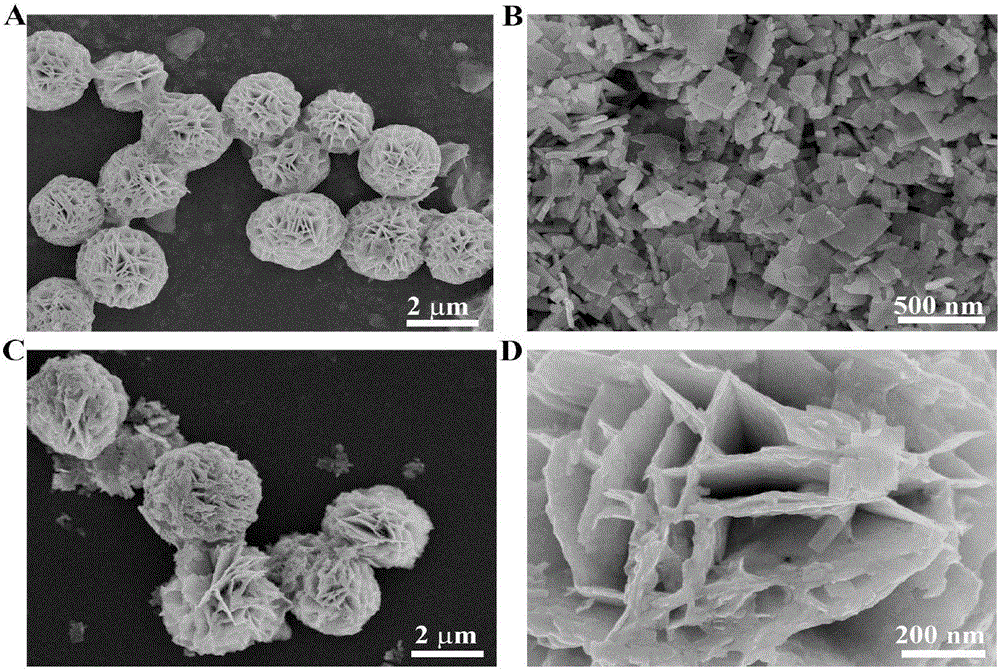
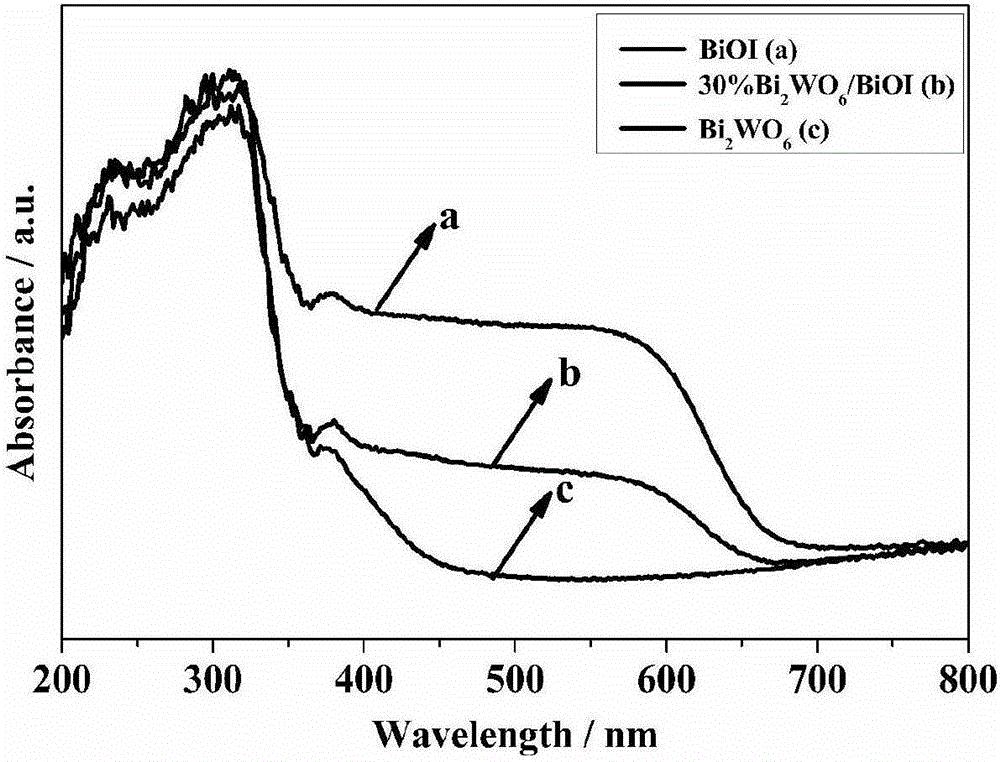
Examples
Embodiment 1
[0041] Bi 2 WO 6 / BiOI heterojunction composite photocatalyst preparation method:
[0042] (1) Preparation of BiOI: BiOI with a three-dimensional layered microsphere structure was prepared by hydrothermal synthesis. Weigh 1.0mmolBi(NO 3 ) 3 ·5H 2 O was added to 30.0 mL of absolute ethanol, and ultrasonically dispersed for 30 minutes to obtain dispersion A; at the same time, 1.0 mmol KI and 0.5 g of polyvinylpyrrolidone (PVP) were sequentially added to 30.0 mL of ultrapure water, and magnetically stirred to make it completely Dissolve to obtain the solution B; then add the above solution B dropwise to the above dispersion A under magnetic stirring to obtain a suspension, and use 2.0mol / LNH 3 ·H 2 O solution adjusts the pH of the suspension to 7, and then continues to stir for 60 minutes; after the stirring is completed, transfer the suspension to a high-pressure reactor equipped with a polytetrafluoroethylene liner, and put it in an electric constant temperature blast dry...
Embodiment 2
[0051] Bi 2 WO 6 / BiOI heterojunction composite photocatalyst preparation method:
[0052] Prepared under hydrothermal conditions by ion exchange method, the difference from Example 1 is that the control of Bi 2 WO 6 The molar ratio with BiOI is 1:9. Weigh the 1.0mmol BiOI obtained above and add it into 30mL ultrapure water, and ultrasonically disperse for 30min to obtain a dispersion; meanwhile, add 0.09mmolNa 2 WO 4 2H 2 O was added to 30mL ultrapure water, and magnetically stirred until it was completely dissolved to obtain a solution; then Na was added dropwise to the above BiOI dispersion. 2 WO 4 The solution was stirred magnetically for 60 minutes to obtain a mixed solution; after that, the mixed solution was transferred to a high-pressure reactor equipped with a polytetrafluoroethylene liner, and placed in an electric constant temperature blast drying oven for heat treatment at 160°C for 24 hours; after the reaction, The reactor was cooled to room temperature, t...
Embodiment 3
[0054] Bi 2 WO 6 / BiOI heterojunction composite photocatalyst preparation method:
[0055] Prepared under hydrothermal conditions by ion exchange method, the difference from Example 1 is that the control of Bi 2 WO 6 The molar ratio with BiOI is 1:4. Weigh 1.0mmol BiOI obtained above and add it into 30mL ultrapure water, and ultrasonically disperse for 30min to obtain a dispersion; at the same time, add 0.17mmolNa 2 WO 4 2H 2 O was added to 30mL ultrapure water, and magnetically stirred until it was completely dissolved to obtain a solution; then Na was added dropwise to the above BiOI dispersion. 2 WO 4 The solution was stirred magnetically for 60 minutes to obtain a mixed solution; after that, the mixed solution was transferred to a high-pressure reactor equipped with a polytetrafluoroethylene liner, and placed in an electric constant temperature blast drying oven for heat treatment at 160°C for 24 hours; after the reaction, The reactor was cooled to room temperature...
PUM
| Property | Measurement | Unit |
|---|---|---|
| Diameter | aaaaa | aaaaa |
| Thickness | aaaaa | aaaaa |
| Size | aaaaa | aaaaa |
Abstract
Description
Claims
Application Information
 Login to View More