
Optical film exhibiting excellent blocking properties for ultraviolet light and polarizing plate including the same
An optical film, ultraviolet technology, applied in the direction of optics, optical elements, polarizing elements, etc., can solve the problems of no heat resistance and moisture resistance, decreased light transmittance, generation of free radicals, etc.
- Summary
- Abstract
- Description
- Claims
- Application Information
AI Technical Summary
Problems solved by technology
Method used
Image

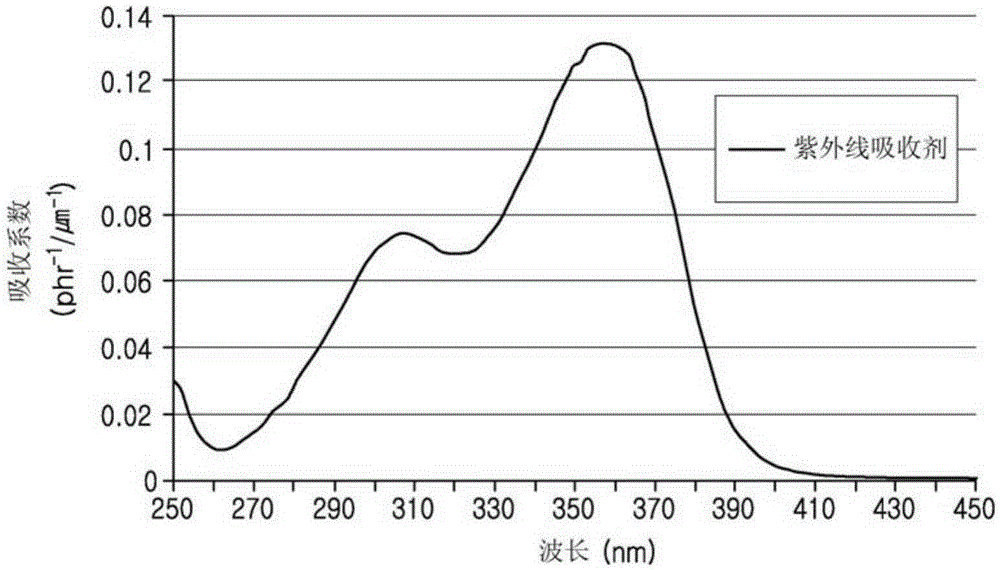
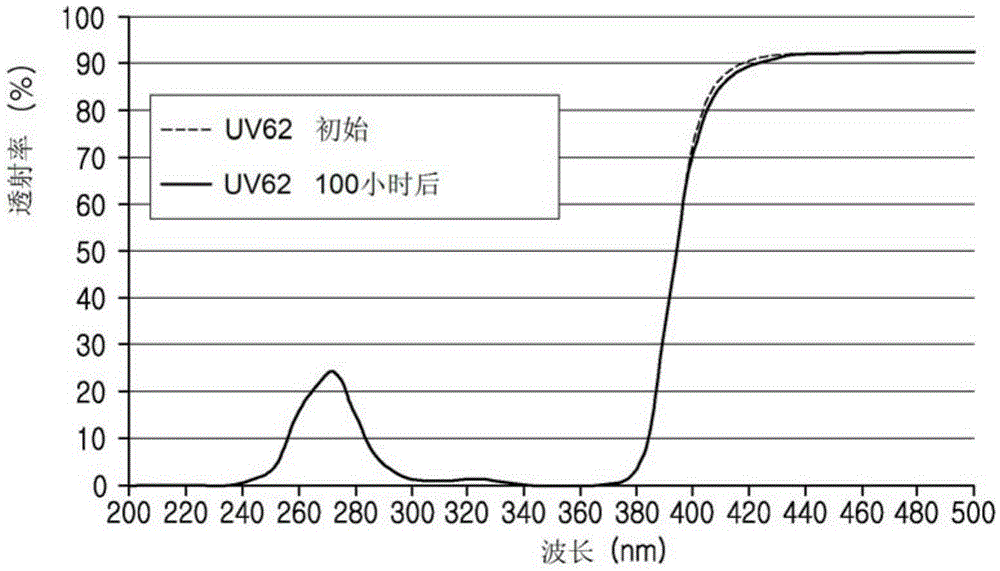
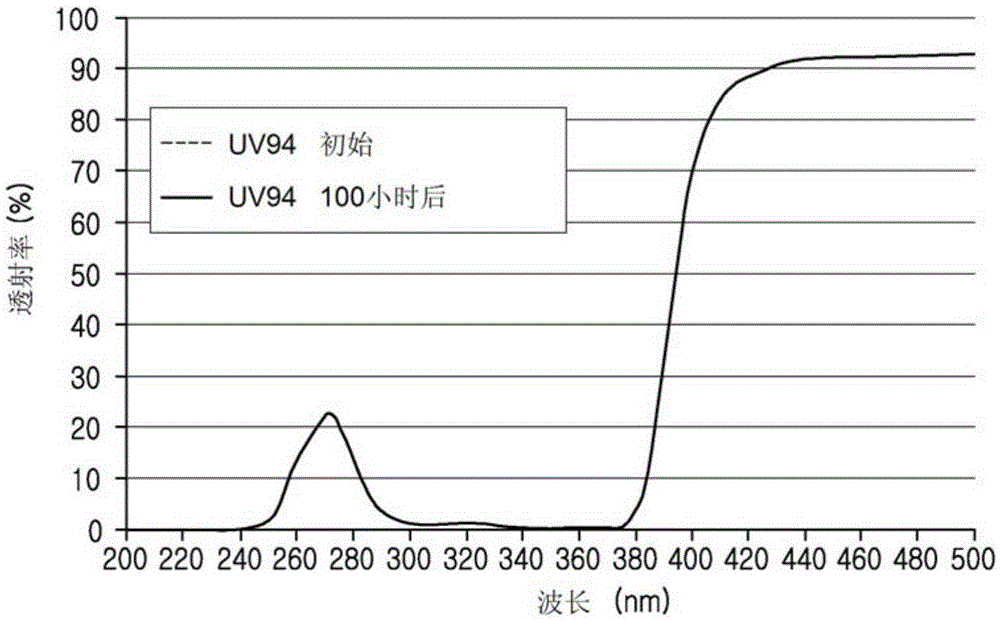
Examples
Embodiment 1
[0216] 0.7 parts by weight of UV absorber and 0.2 parts by weight of hindered amine light stabilizer (HALS) SABOSTABUV62 manufactured by Matsubara Co., Ltd. and 100 parts by weight of poly(N-phenylmaleimide-co-methacrylic acid Methyl ester-co-alpha-methyl-styrene-co-methacrylate) is uniformly mixed to obtain a resin composition with a glass transition temperature of 120°C, and the resin composition is provided to The resin composition was melted in an extruder in which nitrogen gas was replaced from a raw material hopper to the extruder at 250° C. to prepare raw material pellets. NMR analysis results show that poly(N-phenylmaleimide-co-methyl methacrylate-co-α-methyl-styrene-co-methacrylate) resin has 5.0% by weight of N-benzene maleimide and 2.0% by weight of α-methyl-styrene.
[0217] The above-prepared raw material pellets were dried under vacuum, melted at 250° C. using an extruder, and then passed through a coat hanger type T-die, chrome-plated casting rolls, drying rol...
Embodiment 2
[0220] 0.7 parts by weight of UV absorber and 0.2 parts by weight of hindered amine light stabilizer (HALS) SABOSTABUV94 manufactured by Matsubara Co., Ltd. and 100 parts by weight of poly(N-phenylmaleimide-co-methacrylic acid Methyl ester-co-alpha-methyl-styrene-co-methacrylate) is uniformly mixed to obtain a resin composition with a glass transition temperature of 120°C, and the resin composition is provided to The resin composition was melted in an extruder in which nitrogen gas was replaced from a raw material hopper to the extruder at 250° C. to prepare raw material pellets. NMR analysis results show that poly(N-phenylmaleimide-co-methyl methacrylate-co-α-methyl-styrene-co-methacrylate) resin has 5.0% by weight of N-benzene maleimide and 2.0% by weight of α-methyl-styrene.
[0221] The above-prepared raw material pellets were dried under vacuum, melted at 250° C. using an extruder, and then passed through a coat hanger type T-die, chrome-plated casting rolls, drying rol...
Embodiment 3
[0224] 0.7 parts by weight of UV absorber and 0.2 parts by weight of hindered amine light stabilizer (HALS) LA63 manufactured by ADEKA Corporation and 100 parts by weight of poly(N-phenylmaleimide-co-methyl methacrylate Esters-co-α-methyl-styrene-co-methacrylate) are uniformly mixed to obtain a resin composition with a glass transition temperature of 120°C, and the resin composition is provided to The resin composition was melted in an extruder in which nitrogen gas was replaced from a raw material hopper to the extruder at 250° C. to prepare raw material pellets. NMR analysis results show that poly(N-phenylmaleimide-co-methyl methacrylate-co-α-methyl-styrene-co-methacrylate) resin has 5.0% by weight of N-benzene maleimide and 2.0% by weight of α-methyl-styrene.
[0225] The above-prepared raw material pellets were dried under vacuum, melted at 250° C. using an extruder, and then passed through a coat hanger type T-die, chrome-plated casting rolls, drying rolls, etc. to fina...
PUM
 Login to View More
 Abstract
Description
Claims
Application Information
 Login to View More