

Method for extracting DNA of fertilized egg genome of ascaris suum
A technology of Ascaris suum and fertilized eggs, which is applied in the biological field, can solve the problems of the influence of genomic DNA extraction, the low content of genomic DNA in fertilized eggs of Ascaris suum, and the difficulty of extracting DNA, and achieve stable methods, reliable quality, and easy extraction. Effect
- Summary
- Abstract
- Description
- Claims
- Application Information
AI Technical Summary
Problems solved by technology
Method used
Image

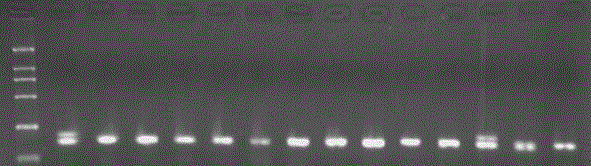
Examples
Embodiment 1
[0017] A method for extracting genomic DNA from fertilized eggs of Ascaris suum is as follows.
[0018] (1) Wash the eggs with distilled water.
[0019] Use a 1.5ml centrifuge tube, add distilled water and eggs, vortex at 3200rpm for 1min, then centrifuge at 10000r / min for 2min, discard the supernatant, repeat this process 3 times.
[0020] (2) Pretreatment of eggs.
[0021] Place the centrifuge tube alternately in boiling water at 100°C and -80°C for 1 min. After 6 times of repeated freezing and thawing, add PowerBead to the centrifuge tube, place it horizontally on a vortex shaker at 3200rpm for 10min, and centrifuge at 10000r / min for 30sec. , transfer the supernatant to a 1.5ml centrifuge tube.
[0022] (3) Proteinase K digestion.
[0023] Use Wizard ® Nucleic acid lysate and 0.5M EDTA (pH8.0) in the SV Genomic DNA Purification System kit: Add 220μl of nucleic acid lysate, 50μl of 0.5M EDTA (pH8.0), and 20μl of proteinase K (50mg / ml) to the above centrifuge tube , 56 ...
PUM
 Login to View More
 Abstract
Description
Claims
Application Information
 Login to View More