

Heterophase polyurethane composition with reduced foam formation
A composite, two-component polyurethane technology, applied in household appliances, other household appliances, coatings, etc., can solve the problems of damage to material properties, increased heat release, etc.
- Summary
- Abstract
- Description
- Claims
- Application Information
AI Technical Summary
Problems solved by technology
Method used
Image

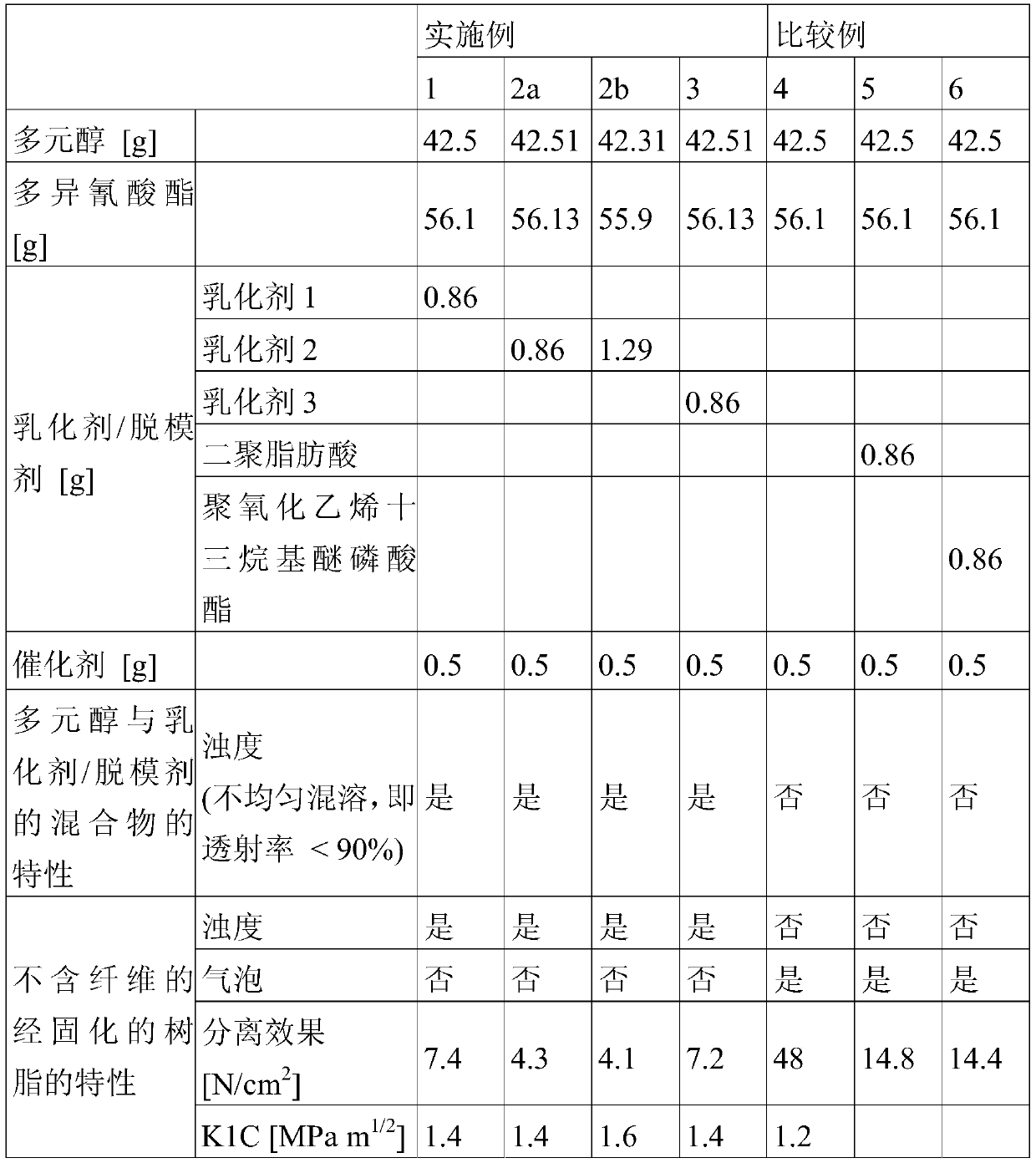
Examples
Embodiment
[0087] raw material
[0088] 1. Polyol: polyether triol, hydroxyl value=550mg KOH / g, viscosity at 25°C=1800mPas (Brookfield25°C, rotor 4, 20rpm), OH equivalent weight=102g, number average molecular weight=300g / mol
[0089] 2. Polyisocyanate: isomeric mixture of MDI and higher functional homologues, NCO content 32% by weight, viscosity at 25° C. = 43 (Brookfield 25° C., spindle 3, 50 rpm)
[0090] 3. Catalyst: solution of dicyclic tertiary amine (DABCO) in polyol (based on solution, 30% by weight of DABCO)
[0091] 4. Emulsifier / release agent:
[0092] - emulsifier 1: difunctional carboxylic acid (C 6 ) and unsaturated fatty acid (average C chain length 18) esterified tetrafunctional polyol
[0093] - Emulsifier 2: Dipentaerythritol fully esterified with oleic acid
[0094] - Emulsifier 3: dimer fatty acid and branched alcohol (average alcohol chain length C 8 ) diester
[0095] - dimer fatty acid
[0096] —polyoxyethylene tridecyl ether phosphate
[0097] Component A: ...
PUM
| Property | Measurement | Unit |
|---|---|---|
| hydroxyl value | aaaaa | aaaaa |
| hydroxyl value | aaaaa | aaaaa |
| glass transition temperature | aaaaa | aaaaa |
Abstract
Description
Claims
Application Information
 Login to View More