Unlock instant, AI-driven research and patent intelligence for your innovation.
Method for obtaining corneal endothelial cells
What is Al technical title?
Al technical title is built by PatSnap Al team. It summarizes the technical point description of the patent document.
A corneal endothelium and acquisition method technology, which is applied in the field of obtaining corneal endothelial cells, and achieves the effects of simple technical solution, broad application prospect and important clinical significance.
Active Publication Date: 2020-05-19
EYECURE THERAPEUTICS INC JIANGSU
View PDF0 Cites 0 Cited by
Summary
Abstract
Description
Claims
Application Information
AI Technical Summary
This helps you quickly interpret patents by identifying the three key elements:
Problems solved by technology
Method used
Benefits of technology
Problems solved by technology
However, this therapy is significantly limited by the shortage of donor corneal endothelial cells
Method used
the structure of the environmentally friendly knitted fabric provided by the present invention; figure 2 Flow chart of the yarn wrapping machine for environmentally friendly knitted fabrics and storage devices; image 3 Is the parameter map of the yarn covering machine
View more
Image
Smart Image Click on the blue labels to locate them in the text.
Viewing Examples
Smart Image
Click on the blue label to locate the original text in one second.
Reading with bidirectional positioning of images and text.
Smart Image
Examples
Experimental program
Comparison scheme
Effect test
Embodiment 1
[0033] The configuration of embodiment 1 culture medium
[0039] The basal medium is DMEM / F12 medium supplemented with 10% serum replacement, 1× non-...
Embodiment 2
[0047] The acquisition method of embodiment 2 class corneal endothelial cells
[0048] 1. Cultivation of Commercialized Human Embryonic Stem Cells
[0049] Mouse embryonic fibroblasts were routinely cultured, and the 3-4 passages were taken as feeder layers, and the proliferation was induced in the medium supplemented with leukemia inhibitory factor (LIF), and the undifferentiated state was maintained.
[0050] 2. Acquisition of Embryoid Bodies
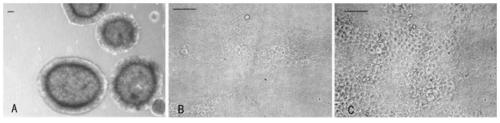
[0051] After the above-mentioned cultured commercial human embryonic stem cells were prepared and digested with collagenase IV and Dispase II at a ratio of 1:2, the prepared serum-free medium was used to culture human embryonic stem cells until they differentiated to form rosettes, that is, pseudo embryoid body, such as figure 1 as shown in a.
Embodiment 3
[0052] Embodiment 3 pre-differentiation culture
[0053] 1. Operation 1 of pre-differentiation culture
[0054] The embryoid bodies obtained in Example 2 were cultured in the differentiation medium A prepared in Example 1 supplemented with 500 ng / mL Noggin and 10 μM TGF-β1 receptor inhibitor for 4 days;
[0055] 2. Operation 2 of pre-differentiation culture
[0056] The embryoid bodies obtained in Example 2 were cultured in the differentiation medium B prepared in Example 1 supplemented with 500 ng / mL Noggin and 10 μM TGF-β1 receptor inhibitor for 2 weeks;
the structure of the environmentally friendly knitted fabric provided by the present invention; figure 2 Flow chart of the yarn wrapping machine for environmentally friendly knitted fabrics and storage devices; image 3 Is the parameter map of the yarn covering machine
Login to View More
PUM
Login to View More
Abstract
The invention relates to an obtaining method of an analogous corneal endothelial cell, and belongs to the technical field of a cellbiology. The analogous corneal endothelial cell is obtained through embryoid body obtaining, predifferentiation culture and differentiation culture. The analogous corneal endothelial cell obtained by a method of human multipotential stem cellin vitro differentiation can be used as the ideal cell resource for replacing the corneal endothelial cell for donation replacement. The method provided by the invention uses the commercial human embryonic stem cells; the commercial human embryonic stem cell has the self copying and unlimited proliferation capability and differentiation potential, so that the sufficient sources can be realized for the acquisition of the analogous corneal endothelial cell. The method provided by the invention solves the problem of low in vitro differentiation ratio of the analogous corneal endothelial cell; the in vitro differentiation ratio of the analogous corneal endothelial cell is improved; the time from the embryoid body stage to the analogous corneal endothelial cell obtaining is 11 days to the fastest degree. The method provided by the invention has the advantages that the technical scheme is simple and convenient; the operation is easy.
Description
technical field [0001] The invention relates to a method for obtaining corneal endothelial cells, belonging to the field of cell biology technology. Background technique [0002] Corneal endothelial cells are a monolayer of cells arranged in regular hexagons, which are the physiological barrier separating the corneal stroma from the aqueous humor and anterior chamber, and play a key role in maintaining corneal transparency. The reasons for the reduction or damage of corneal endothelial cells are: ① Gradually decrease with age; ② Infection, inflammation, trauma (such as mechanical injury, chemical injury, birth injury, laser rays, etc.), eye surgery (such as cataract surgery, anti-aging, etc.) Glaucomasurgery, and other intraocular operations (such as anterior chamber foreign body removal, etc.), genetic diseases, metabolic diseases, etc. can cause the reduction and damage of endothelial cells. Because adult corneal endothelial cells do not have the ability to proliferate, ...
Claims
the structure of the environmentally friendly knitted fabric provided by the present invention; figure 2 Flow chart of the yarn wrapping machine for environmentally friendly knitted fabrics and storage devices; image 3 Is the parameter map of the yarn covering machine
Login to View More
Application Information
Patent Timeline
Application Date:The date an application was filed.
Publication Date:The date a patent or application was officially published.
First Publication Date:The earliest publication date of a patent with the same application number.
Issue Date:Publication date of the patent grant document.
PCT Entry Date:The Entry date of PCT National Phase.
Estimated Expiry Date:The statutory expiry date of a patent right according to the Patent Law, and it is the longest term of protection that the patent right can achieve without the termination of the patent right due to other reasons(Term extension factor has been taken into account ).
Invalid Date:Actual expiry date is based on effective date or publication date of legal transaction data of invalid patent.



 Login to View More
  Login to View More